
Epic Hyperdrive Responsiveness Through the Clinician’s Eyes
One of the largest Nonprofit Health Systems in the US was experiencing clinician and nursing complaints from users of Epic Hyperdrive. They engaged Goliath to help them frame up the size of the problems, isolate root cause, and determine a remediation plan based on the findings.
This post will be in two parts due to the nature of the engagement. Each will represent how we worked with our client to deliver an improved clinician experience. First, we needed to separate the “perception” of clinician experience based on subjective feedback and reality based on empirical data to determine the “true” experience through the eyes of the clinician.
Want to learn more? Request to speak with a healthcare IT consultant.
Challenge
“We had spotty complaints from very vocal and prominent surgeons in one of our geographic regions which amplified the feedback. Both Clinical and IT Executives wanted to understand the extent of the issues and if possible, the contributing factors so they could be remediated. I exhausted all tools at my disposal as well as our primary Citrix consulting vendor. Nothing provided insight into the issues. Then, we reached out to another region that was using Goliath Technologies and asked for assistance.”
– Health System Project Leader
The frustration was acute, like a 911 call without an address. The executives wanted to respond to and resolve the reported issues but there was no actionable data, so our first challenge was to understand the true extent of the issues our client was facing.
As a general statement, IT and Clinical executives have difficulty knowing at a meaningful level whether clinicians are having issues with speed and reliability when it comes to Epic Hyperdrive or any other EHR, business, or clinical application. This is not from a lack of interest or investment. Health systems in the US are estimated to spend between $250,000 and $2 million per year on clinician and staff surveying, depending on the size and number of physicians.
The problem is traditional methods rely on clinician feedback or self-reporting. Surveys or feedback sessions, regardless of the methodology used to conduct them, receive between >10%-25% participation. Add to that, according to the AMIA less than 10%-15% of clinicians even report EHR slowness or logon problems to help desk.
Finally, when it comes to understanding EHR speed and reliability issues specifically, it is impossible to arrive at actionable data through human interaction. In direct interaction, a clinician or user can describe their experience using the application at a nuanced level. Conversely, even the best description of speed and reliably issues are usually conflated and ambiguous, “Epic is slow”, or “My logon is slow”.
To quantify or frame the extent of the clinician issues, we correlated user experience data into our Epic Hyperdrive and Citrix Clinician Experience Reports. Though this is complimentary to other feedback mechanisms, it is vastly different in two ways:
- We use digital data to provide the nuanced details that are missing from most descriptions of speed and reliability issues. Technology is needed to translate technical challenges impacting a clinician’s experience.
- Data is correlated from 100% of clinicians without the need for their participation. This is not a sample, it is the entire user base.
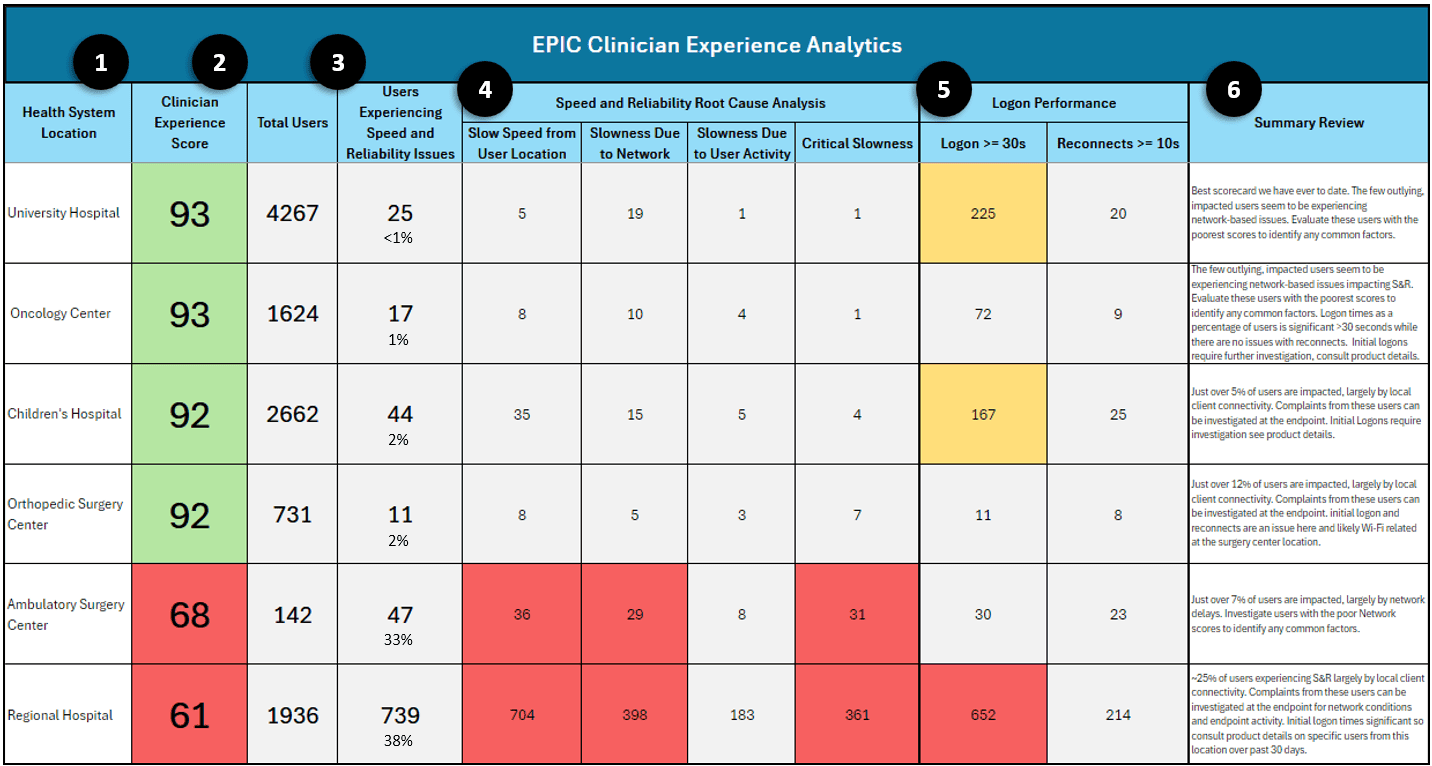
We began to gather and correlate the data represented below (Image A).
Note: We were able to correlate and present this data within five business days to provide a full view of clinician experience from every user, location, application, and specialty.
This uppermost presentation layer allows us to see the numbered data quickly:
- Data by health system or clinic location.
- Clinician experience score based on the user experience metrics that are automatically compared to industry best practices.
- Total number of users correlated with those that are experiencing speed and reliability issues.
- Speed and reliability root cause analysis to see quickly why issues are occurring so we can focus on those areas for remediation.
- Logon times for those locations and users.
- High level summary data to convey initial impressions and areas for remediation focus.
These data-driven insights unite clinical and IT teams around facts, not opinions. Shared, unbiased data enables productive collaboration between Clinical and IT leadership, so permanent remediation actions can be approved and implemented. Now, from an IT perspective, many hours are saved attempting to quantify and identify the clinicians who are experiencing issues and the corresponding root cause, often multiplied over the course of months.
We met with both Clinical and IT executives so we could review the data and immediately draw a few conclusions:
- In aggregate, overall EHR speed and reliability were within acceptable ranges. So, the initial perception of broad poor experience was exaggerated.
- There were several locations experiencing clear issues with clinician experience, but they were not caused by Epic Hyperdrive or the datacenter infrastructure.
- Further investigation was required in areas experiencing poor performance, but the aperture for investigation was significantly narrowed by the data, allowing for much more productive and efficient investigation.
In a follow-on post, we will discuss the findings in more depth and how we worked with health IT and clinicians to fully understand, quantify, and resolve chronic speed and reliability issues.
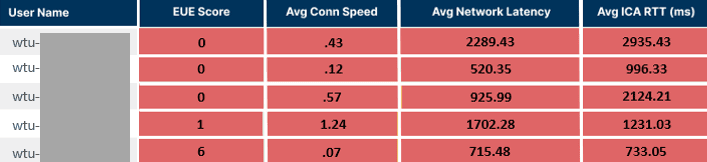
Next, we searched for some of those user accounts that had the worst scores over an extended period to put together trends and we noticed that they were running a Citrix Receiver version that was 10 versions behind and that the Wyse thin clients themselves were also old. (Image C)
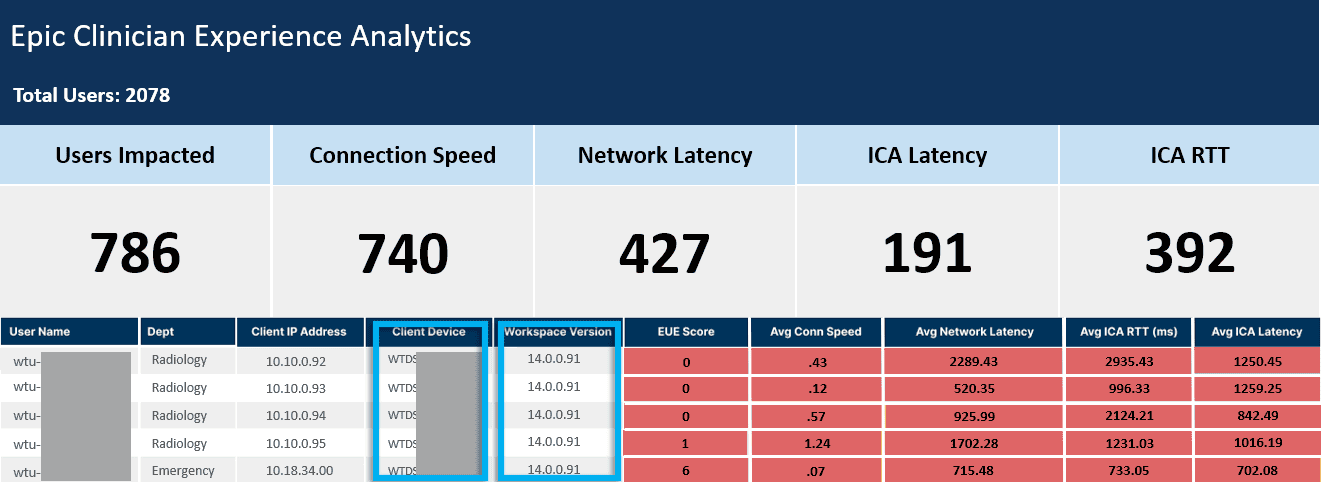
When analyzing user sessions, we confirmed consistently high latency, which was a downstream effect of having outdated versioning on Citrix and the thin client technology. These older versions cannot take advantage of the optimization technology enhancements that Citrix has delivered over the last 10 updates.
Remediation Actions
The IT department submitted change requests to update both Citrix and the old Wyse Thin Clients. There was a concerted outreach effort to upgrade the sites and users so within 60 days after the updates were made the issues were resolved. It was significant that test upgrades were made by IT to validate versioning as the root cause and the performance improvement was significant.
There are a few takeaways from this engagement that are significant to note:
- Overall, this Epic speed & reliability improvement engagement was initiated because of what were thought to be widespread issues. In fact, the complaints were amplified and only came from two facilities.
- Tremendous cost was saved as they were initially suggesting network upgrades to all sites as a potential solution. Once the size of the problems was understood, there was no need for a widespread upgrade.
- Within 48 hours suggested remediation actions were proposed and in 60 days chronic performance issues that had been challenging for IT and problematic for clinicians were solved at low cost.
- Ongoing, the IT and Clinical teams have access to data weekly that they can use to understand, isolate, and resolve clinician issues.
The Health IT Team and Goliath Performance Consultants did a great job working together to positively impact clinician experience with Epic and corresponding patient care.