
How They Did IT
How 3 Children’s Hospitals Made Oracle Health EHR Faster
In one case, substantial financial resources were deployed to upgrade networks, add server resources, and implement other remediation actions. No positive improvement in speed and reliability had been realized by the clinicians.
The teams at these health systems, both clinical and IT, were positively engaged in arriving at a solution, as were the account teams from Oracle. The collaboration and teamwork were fantastic, but the solution remained elusive. We were then engaged to assist in finding the cause of the EHR speed and reliability issues.
The result, in our clients’ words
In 48 hours, we were able to isolate the root cause of problems that have plagued us for months. And, we now also understand the scope of the issues, which were not as widespread as we thought. We should have had this data years ago.
CTO
Now, without being physically present, I can understand what clinicians are experiencing as if I were at the elbow. And, on 100% of my clinicians, whenever I need the data.
CMIO
I blamed these speed issues on Oracle, but the data clearly shows they are a result of our on-premises infrastructure and not Oracle.
Director of IT
Challenge
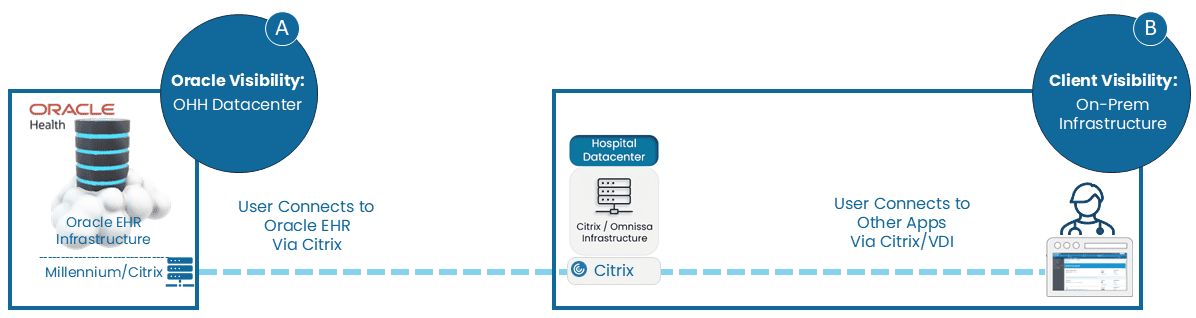
The challenge with Oracle clients is always the same: limited and siloed visibility compounded with missing data. The image below describes the limited visibility well. Oracle only has visibility to the edge of the data center (A). The client’s view is restricted to their infrastructure on premises (B). This challenge is a byproduct of cloud architecture and is common with most hosted applications. There are great benefits to this type of architecture, especially for health systems with the inherent resource constraints faced by health IT. However, additional technology is required to accentuate the benefits and close the visibility gap.
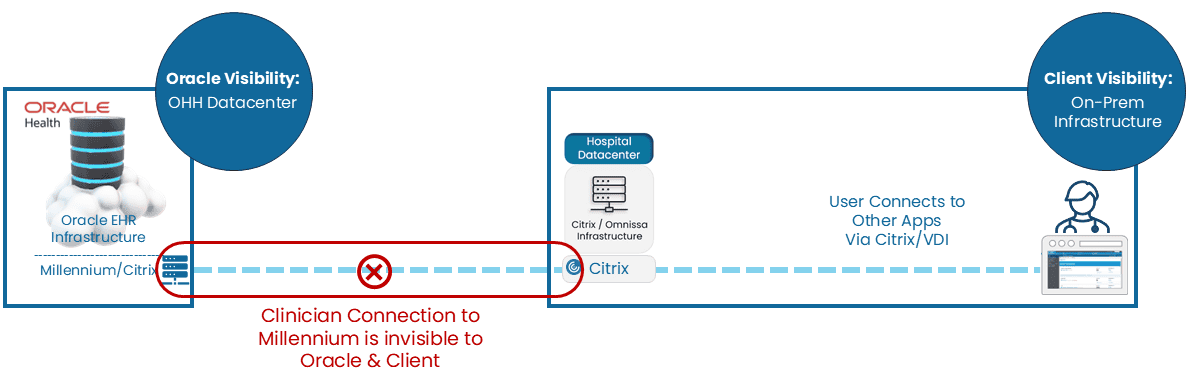
You have two teams trying to resolve clinician experience issues, but each is working from different performance data. Crucially, neither has access to the missing dataset: the clinician’s actual experience as they connect to Oracle EHR/Cerner Millennium, as shown in the image below.
Beyond the technical challenges is the need to understand the true scope of the issues and act on meaningful data. Standard methods for gauging clinician satisfaction make this nearly impossible. Surveys, feedback, and ticket volumes produce only 10%–25% response rates, and human descriptions of EHR speed and reliability like “slow”, “unavailable”, etc., are too vague to drive action. Ticket volumes are equally misleading; clinicians rarely submit tickets, certainly not more than once, even as frustration grows.
Solution: digital problems require digital answers
The foundation of the challenges formed the basis of our solution. Clinician speed and reliability issues with Oracle are digital issues. There is a footprint, literal documentation of who, where, when, and why every time a clinician attempts to initiate a connection to Oracle Health EHR. We used proprietary and purpose-built technology to:
- Resolve the siloed visibility gap, so both Oracle and the client had the same end-to-end visibility data (within 48 hours).
- Quantify the number of clinicians experiencing speed and reliability issues, frequency, duration, and possible root cause.
- Work with Oracle, IT, and clinical teams to isolate and remediate the root cause of clinician experience issues.
Reading the report
An example of one report we commonly use is below. The letters match the columns in the table.
- Hospital or clinic location
- Clinician experience score
- Total number of clinicians
- Number experiencing issues
- Root cause analysis, which shows why issues are occurring
- User location
- Network
- User behavior
- Critical slowness
- Logon timing
- Summary analysis and remediation actions
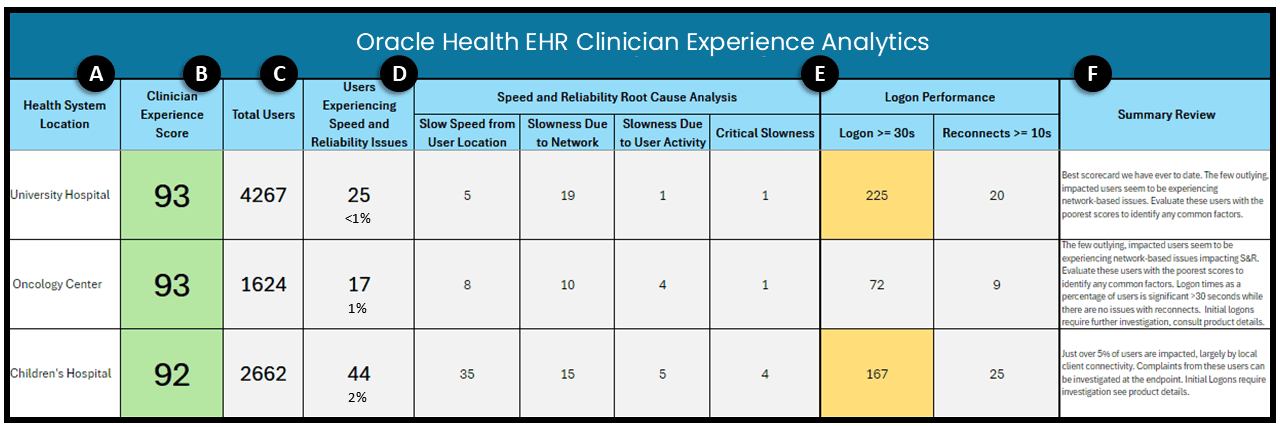
Working closely with the local IT teams across the three children’s hospitals, we determined that most issues originated on the client side, not in the Oracle-hosted environment.
Many of these issues were simple to fix but completely invisible without the right technology. Remediation included:
- Rebooting Wi-Fi devices at clinics
- Replacing laptops
- Replacing routers and local network equipment
- Increasing bandwidth at remote clinics
- Upgrading home broadband packages for clinicians
- Increasing on-prem server resources
Ongoing clinician experience management
Reactions from Oracle and client teams were extremely positive. Most said that having this level of data years earlier would have enabled proactive identification and resolution of clinician experience issues.
Going forward, the report above is automatically generated and distributed to clinical and IT leadership, as well as select vendors. Two health systems have already formed cross-functional tiger teams that meet bi-monthly to address proactive measures and prevent future issues. In all three cases, clinical executives are using this data to communicate more effectively with clinicians.
If you’re experiencing end-user issues with your clinical or business applications, let’s talk. We identify and fix highly specific problems, and in a brief discovery call we’ll tell you whether we can help. If the issues fall outside our scope, we’ll let you know that too.
To talk with a healthcare IT consultant, email techinfo@goliathtechnologies.com.
About Goliath Technologies
Goliath helps ensure EHR speed and reliability for 25 million care interactions annually by providing at-the-elbow digital experience insights for 100% of clinicians without the need for self-reporting. Purpose-built for Epic, Oracle Health, and Meditech, Goliath provides the data that clinical and IT leaders use to understand EHR speed and reliability issues and implement fact-based initiatives to improve clinician experience.