
How They Did IT: Epic Health System Measured, Benchmarked & Reduced Epic Hyperdrive Clinician Logon Times by 50%
By Thomas Charlton, CEO Goliath Technologies
How objective clinician EHR experience measurement established the baseline, identified a widespread performance gap, guided targeted remediation, validated best-practice performance, and created a foundation for proactive management.
Acute care health system | 9,500 employees | 24 clinics | 7,000+ Epic Hyperdrive users
Executive Summary
An acute care health system with 9,500 employees was receiving clinician reports of slow Epic Hyperdrive logons and other application performance issues, particularly in patient-care settings. Support tickets and user reports confirmed that a problem existed, but they could not show leadership the full scope of the experience, how frequently it occurred, or where remediation should begin.
Goliath Technologies established an objective baseline of the clinician digital experience and quantified the issue across the environment. Within hours, the measurement showed that the problem was intermittent but chronic, spanning 24 clinics and more than 7,000 Epic Hyperdrive users. The data also showed that the latency was occurring between the endpoint and the application rather than within the Epic Hyperdrive application itself. Epic was being identified as the root cause, but data proved otherwise.
The baseline provided a benchmark for action. Using contextual performance data, the IT team isolated a legacy home-folder path in Active Directory that was forcing timeouts during the Citrix profile-load stage. An emergency change removed the obsolete path. Within two weeks, clinician logon times improved by 50%. Over the following 45 days, initial logons fell to under 30 seconds and reconnects to under 10 seconds, achieving the case study’s stated industry best-practice standards for logon performance.
The engagement illustrates a repeatable clinician experience improvement model: measure the lived digital experience, benchmark performance against best-practice thresholds, act on the evidence, re-measure the outcome, and use the same data proactively to prevent future clinician disruption.
Background
The health system relies on Epic Hyperdrive to support clinicians across a broad acute and ambulatory care environment. Clinicians began reporting slow logon performance with Epic Hyperdrive and other applications, creating frustration and potentially taking time away from patient care.
The IT Incident Response Team was actively investigating the complaints. The challenge was not simply determining whether individual clinicians had experienced a slow logon. The organization needed an objective view of the experience across the clinician population: who was affected, where the issues occurred, how often they occurred, how long they lasted, and which part of the technology delivery path was responsible.
Challenge: Moving Beyond Self-Reported Experience
Support tickets, surveys, and clinician complaints are valuable signals, but they are inherently limited as a measurement system. They reflect the clinicians who choose to report an issue and often describe the symptom rather than the technical condition causing it. That makes it difficult to determine the true scale of a problem or prioritize remediation based on impact.
The health system needed empirical clinician experience data that could quantify the digital experience at scale and create a common set of facts for IT and clinical stakeholders.
Step 1: Measure the Clinician EHR Experience
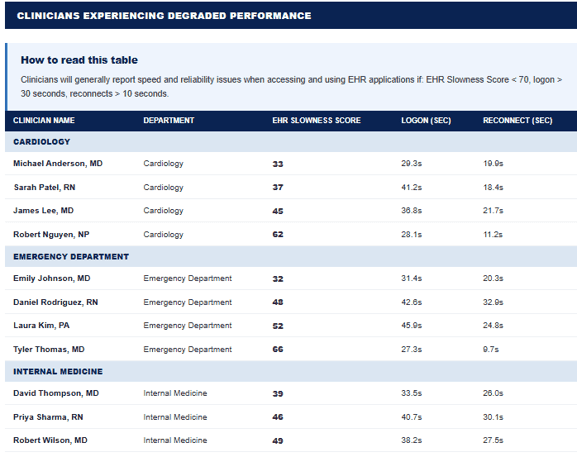
Goliath used technology-enabled empirical data to establish a baseline of the clinician experience within hours. Instead of beginning with an assumption about the cause, the measurement framed the problem objectively and showed how clinicians were actually experiencing the Epic delivery environment.
The baseline report sample below revealed that:
- The issue affected more than 7,000 Epic Hyperdrive users.
- The experience problem extended across 24 clinics.
- The slowdowns were intermittent and chronic rather than a single isolated event.
- The latency was occurring from the endpoint to the application, not within the Epic session itself.
- The organization could quantify affected users, frequency, duration, location, and the likely technology domain contributing to the poor experience.
Illustrative example data:
Step 2: Benchmark Performance Against Best-Practice Thresholds
Once the experience was measurable, the organization could evaluate logon performance against expected and best-practice thresholds. This converted clinician complaints into a measurable performance gap and gave the team a clear definition of success: reduce the observed delays until initial logons and reconnects were operating within acceptable standards.
Benchmarking also helped focus the investigation. Rather than treating every technology component as equally suspect, the team could concentrate on the part of the delivery path where the measured experience deviated from expectations.
Illustrative example data:

Step 3: Turn the Benchmark into Actionable Data
Goliath’s AI-enhanced contextual data allowed the IT team to move from identifying the scope of the problem to isolating its root cause. The data showed repeated Citrix and Epic Hyperdrive login failures followed by slow logons across multiple devices.
The investigation traced the delay to the Citrix “profile-load” stage. A legacy home-folder path remained on the Active Directory object even though the network location no longer existed. Each logon attempt waited for the unavailable path, creating forced timeouts and extending the clinician’s logon experience.
Because the problem was supported by empirical evidence, the team could make a targeted change rather than broadly modifying the Epic, Citrix, network, or endpoint environments. An emergency change removed the obsolete home-folder path from Active Directory and eliminated the forced timeout.
Step 4: Re-Measure and Validate the Outcome
After remediation, the health system used the same clinician experience data to determine whether the change had produced the intended result. The before-and-after measurement demonstrated a substantial improvement rather than relying on a reduction in complaints as a proxy for success.
Within the first two weeks, Epic Hyperdrive clinician logon times were reduced by 50%. During the following 45 days, initial logon times dropped to under 30 seconds and reconnects to under 10 seconds. According to the source case study, the organization had reached industry best-practice standards for logon performance.
Step 5: From Measurement to Proactive Experience Management
With the reported issue permanently resolved, the organization extended the same approach into ongoing operations. The IT team implemented proactive alerting so future availability and logon problems could be detected by technology rather than waiting for clinicians to report them.
Goliath’s application availability capability automatically logs on to Epic 24/7/365 and alerts on logon difficulties, providing evidence that can be used for rapid troubleshooting. This changes the operating model from reactive support to proactive clinician experience management.
For IT, the data provides early visibility into emerging performance issues and evidence for root-cause analysis. For clinical and informatics teams, the same measurements can provide objective context around clinician feedback and help prioritize where intervention will have the greatest impact.
A Repeatable Clinician Experience Improvement Model
The Epic health system case demonstrates that measurement and benchmarking are not separate from remediation; they are what make precise remediation possible. The baseline defines the actual clinician experience. Benchmarking establishes the performance gap. Contextual analytics identify the likely cause. Remediation addresses the specific condition. Re-measurement proves whether the intervention worked. Ongoing monitoring helps preserve the improvement.
MEASURE → BENCHMARK → IDENTIFY → REMEDIATE → RE-MEASURE → PROACTIVELY MANAGE
Key Outcomes
-
50% reduction in Epic Hyperdrive clinician logon times within two weeks
-
Initial logon times reduced to under 30 seconds within the subsequent 45-day period
-
Reconnect times reduced to under 10 seconds
-
Performance brought to the case study’s stated industry best-practice standards for logon times
-
Objective measurement across more than 7,000 Epic Hyperdrive users and 24 clinics
-
Identification of an intermittent, chronic issue that self-reported data alone could not quantify
-
Root cause isolated to a legacy Active Directory home-folder path affecting Citrix profile load
-
Targeted remediation based on empirical evidence rather than broad speculative changes
-
Before-and-after measurement validating the impact of the corrective action
-
Proactive 24/7/365 availability and logon monitoring to identify future issues before clinicians report them
Key Insights for Health System Leaders
- Clinician complaints identify symptoms; measurement defines the problem.
Self-reported feedback is important, but objective experience data can quantify how many clinicians are affected, where the issue occurs, its frequency and duration, and the likely technology domain involved.
- Benchmarking gives the measurement context.
Performance data becomes more actionable when it is compared with expected thresholds and best practices. The benchmark establishes both the size of the gap and a measurable target for improvement.
- Evidence enables precision remediation.
The measured data narrowed the investigation from a broad “Epic is slow” complaint to a specific profile-load delay caused by an obsolete network path. That distinction allowed a focused corrective action. - Re-measurement proves the result.
A 50% reduction in logon times and subsequent achievement of stated best-practice logon thresholds provided objective evidence that the remediation improved the clinician experience. - The same data supports proactive management.
Once the baseline and measurement framework are established, the organization can use continuous availability and experience data to identify emerging issues before they become widespread clinician complaints.
Conclusion: From “Epic Is Slow” to a Measurable Improvement Discipline
This health system’s experience demonstrates the value of beginning clinician EHR improvement with measurement rather than assumptions. Objective data revealed the scope of the issue across thousands of users, benchmarked the experience against expected performance, directed the team to the actual root cause, and provided a way to validate the result after remediation.
For health systems seeking to improve Epic clinician experience, the lesson is straightforward: measure first, benchmark the experience, act on evidence, and measure again. The same data can then become the foundation for proactive IT performance management and a shared, objective understanding of the clinician’s lived digital experience.
Learn More Here: EHR Speed & Reliability Improvement Program.
Source Notes
This case study was developed from Goliath Technologies’ interview with Dr. Dieter Sumerauer, Associate CHIO at Rady Children’s Health, and the July 2026 KLAS Summit presentation “How Informatics Improved EHR Speed and Reliability 13%.” The 13% result and August 2025 to October 2025 measurement period are drawn from the KLAS presentation. Quotations attributed to Dr. Sumerauer are drawn from the published Goliath interview.
About Goliath Technologies
Goliath helps ensure EHR speed & reliability for 25 million care interactions annually by providing at-the-elbow digital experience insights for 100% of clinicians without the need for self-reporting. Purpose-built for Epic, Oracle Health, and Meditech, Goliath provides the data that clinical and IT leaders use to understand EHR speed & reliability issues and implement fact-based initiatives to improve clinician experience.