
How They Did IT
Measured, Benchmarked & Improved Oracle Health EHR Speed & Reliability by 17%
How objective clinician experience measurement turned a KLAS survey result into a baseline, found a root cause that infrastructure monitoring missed, and proved a 17% improvement across every location.
Non-profit health system | 28+ hospitals | 300 outpatient clinics | Oracle Health Millennium (hosted) | Citrix
By Thomas Charlton, CEO, Goliath Technologies
At a Glance
- Measure: baseline of clinician experience on Oracle Health Millennium within one week; deployment took about four hours
- Benchmark: every location scored on the Oracle Health EHR Speed & Reliability Score
- Root cause: slowness at a remote clinic traced to bandwidth allocated to Citrix sessions after an application upgrade, not the EHR
- Re-measure: 17% increase in the Speed & Reliability Score across all locations within the 45-day program
A large non-profit health system in the Western United States, serving a broad region through more than 28 hospitals and 300 outpatient clinics, was facing growing concerns about Oracle Health Millennium speed and reliability. Clinician feedback and a KLAS Research survey confirmed what leadership already suspected: performance issues were affecting daily work and patient-facing care.
The organization engaged Goliath’s accelerated 45-day EHR Speed & Reliability Improvement Program with a clear objective: move beyond perception-based feedback and establish an objective, data-driven foundation for improvement.
Here’s how the project leader summarized the impact:
“In a matter of one week we were able to review data about the daily experience of our clinicians when using Millennium. It was truly amazing to have hard facts about which clinicians were experiencing issues, what time of day, at which locations, and how performance changed based on what they were doing within the application. In some cases, we found problems we didn’t know existed, and in others we confirmed long-standing suspicions. Once we had objective facts, clinical and IT teams could finally partner around a common set of data – and we did.” – Project Leader
Want to learn more? Request to speak with a healthcare IT consultant.
The Challenge: The Survey Confirmed the Problem, Not the Cause
The health system had recently taken part in a KLAS Research clinician survey that showed poor satisfaction scores for EHR speed and reliability. The survey validated that a problem existed. It didn’t provide the operational detail needed to fix it.
Two priorities emerged. The first was visibility into the true scope of the issues across the organization. The second was turning that data into action. Clinicians can report that a system is “slow” or “unavailable,” but degradation caused by infrastructure, virtualization, network conditions, or endpoint constraints takes technical instrumentation to diagnose.
Step 1: Measure the Clinician EHR Experience
Goliath worked with the Oracle Health hosting team and the health system’s internal IT organization to deploy Goliath’s monitoring and troubleshooting analytics. The technical deployment took about four hours, mostly coordination between teams.
Surveys rely on voluntary participation and perception. Goliath captures experience data directly from clinician sessions, with no user interaction or self-reporting, so the dataset reflects every monitored clinician session, not just the people motivated to answer a survey.
Once deployed, Goliath began collecting and correlating data across the EHR delivery stack: session performance, application responsiveness, authentication, infrastructure dependencies, and end-user experience metrics.
Step 2: Benchmark the Experience
With the experience measured, each location could be scored and compared. Goliath’s analytics flagged abnormal patterns and surfaced bottlenecks in a format the team could act on right away. Combined with the KLAS survey feedback, the organization had both validation of the problem and the operational detail to fix it.
Step 3: Find the Real Root Cause
One example shows why experience-level data matters.
Several clinicians at a remote outpatient clinic consistently reported slow Millennium performance. The network team confirmed bandwidth to the site was well within acceptable thresholds. Oracle Health support verified there were no performance issues in the hosted Millennium environment. On the surface, nothing explained the slowness.
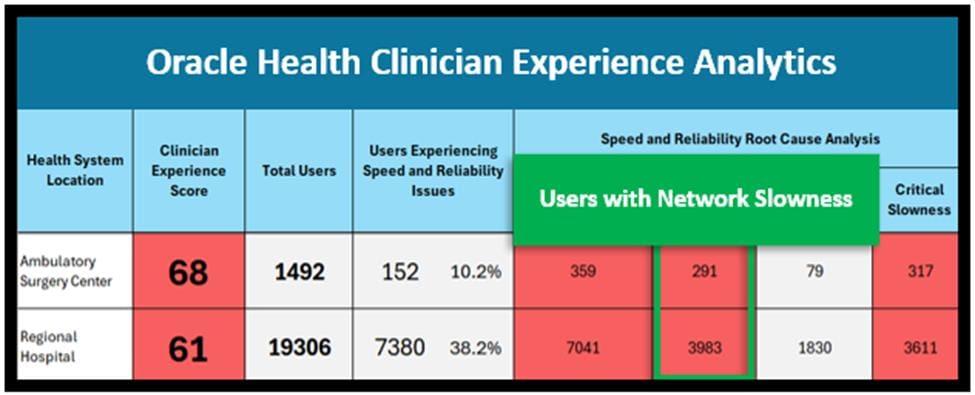
Session-level analysis in Goliath showed that the clinicians with the most slowness were consistently using video-based applications alongside Millennium. At the same time, Goliath identified increased end-user network latency on those specific sessions.
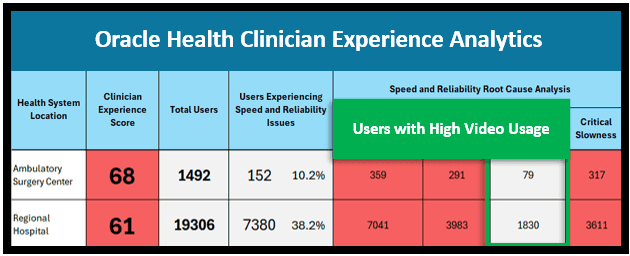
This wasn’t the kind of latency traditional network monitoring captures. Total site bandwidth was fine, but individual clinician sessions were competing for it, which directly affected application responsiveness. Without end-user experience data, the condition would have stayed invisible while the infrastructure looked healthy.
The application team confirmed it had recently been upgraded and clinicians were making heavy use of video, so the network settings that prioritize user traffic were no longer adequate. The conclusion: not enough bandwidth was allocated to Citrix users at this site to support the application. It’s a common issue, hard to see without specialized software, and relatively quick to fix.
Step 4: Remediate with Precision
With the real bottleneck identified, the IT team adjusted network settings and upgraded some of the network equipment on site, instead of continuing to troubleshoot the EHR itself. This was one of several targeted improvements made during the program.
Step 5: Re-Measure and Prove the Result
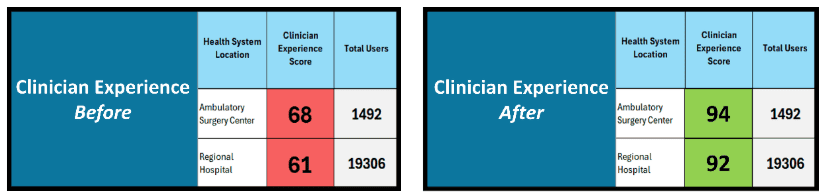
Coordinated remediation across IT, network operations, and the Oracle Health hosting team produced measurable gains. Within the program window, the organization realized a 17% increase in its Oracle Health EHR Speed & Reliability Score across all locations. Clinicians got faster access to the EHR, fewer interruptions, and less performance-related frustration at the point of care.
Key Takeaways
- Surveys confirm a problem; measurement defines it. The KLAS survey showed dissatisfaction. Experience data showed who, where, when, and why.
- Healthy infrastructure can still deliver a poor experience. Site bandwidth and the hosted EHR both checked out. Session-level data found the contention.
- Re-measurement proves the result. The same score used to set the baseline showed a 17% improvement across all locations.
Talk to Us
If you’re having end-user experience issues with your clinical or business applications, let’s talk. We find and fix very specific issues, and in a discovery conversation we’ll tell you whether we can help. If the issue is outside our scope, we’ll tell you that too.
Reach out to techinfo@goliathtechnologies.com or request to speak with a healthcare IT consultant.
Oracle Health and Millennium are trademarks of Oracle and/or its affiliates. Citrix is a trademark of Cloud Software Group. All other brands are the trademarks of their respective owners.