
Case Study: Rady Children’s Health Measured, Benchmarked & Improved Oracle Health EHR Clinician Experience by 13%
Objective measurement of the clinician’s lived digital experience when using Oracle EHR enabled evidence-based remediation, validated results, and a foundation for proactive experience management.
Executive Summary
Rady Children’s Health in Orange County faced a familiar healthcare technology problem: clinicians were reporting long login times, application slowness, and system instability, but the traditional technical metrics often suggested that the Oracle Health EHR environment was performing as expected. The missing element was an objective measure of what clinicians were experiencing at the point of care.
Goliath Technologies provided an Oracle EHR clinician experience measurement capability that established an empirical baseline across the clinician population and made previously invisible performance issues measurable. The baseline was evaluated against speed and reliability best-practice thresholds, allowing Rady Children’s to identify where experience was falling short, which clinicians and locations were affected, how frequently problems occurred, and where in the delivery chain the likely cause existed.
See the image below:
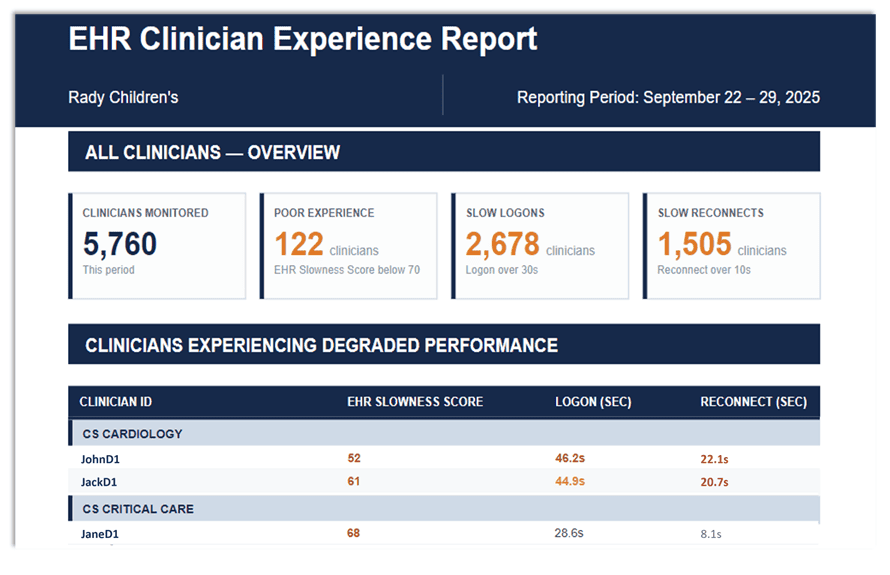
The measurement became actionable. Clinical Informatics and IT used the evidence to prioritize targeted remediation—including replacement of laptops at specific locations, bandwidth increases, network switch upgrades, and identification of other focused IT resource improvements rather than making broad infrastructure investments based on assumptions. A subsequent measurement showed a 13% improvement in EHR speed and reliability from August to October 2025, validating the impact of the changes.
The engagement illustrates a repeatable model for clinician EHR experience improvement: measure the lived experience, benchmark it, act on the evidence, re-measure the outcome, and then use the same data proactively to manage performance over time.
“We practice evidence-based medicine on the clinical side. There is no reason we should not be practicing evidence-based decision-making in IT as well.”
– Dieter Sumerauer, MD, Associate CHIO, Rady Children’s Health
Background
Rady Children’s Health in Orange County, previously known as Children’s Hospital of Orange County (CHOC), uses Oracle Health Millennium to support clinicians and care delivery. Dr. Dieter Sumerauer, Associate Chief Health Information Officer, operates at the intersection of clinical care, informatics, and technology delivery — an increasingly important role as the digital experience of the EHR becomes inseparable from the clinical experience itself.
Clinicians had been raising concerns through email, Microsoft Teams, the help desk, rounding, and KLAS survey feedback. Those channels were important signals, but they could not answer the operational questions required to drive precise improvement: Who was affected? Where? How often? For how long? Was the issue in the Oracle-hosted environment, the local infrastructure, the endpoint, the network, or another part of the delivery chain?
Challenge: The Clinician “Lived Experience” Gap
The core problem was a disconnect between human feedback and technical reporting. Frontline clinicians experienced delays and instability, while infrastructure and application teams could look at conventional system metrics and conclude that the environment appeared healthy. Without empirical data describing the clinician’s actual digital experience, both perspectives could be true and neither side had enough evidence to resolve the disagreement.

Traditional survey and rounding approaches are valuable for understanding sentiment, but they depend on voluntary participation, recall, and the time available for clinicians and informatics teams to provide or collect feedback. Rady Children’s needed a complementary approach: objective measurement of the experience being delivered to clinicians, at scale, and quickly enough to guide operational action.
Step 1: Measure the Clinician EHR Experience
Goliath was deployed to establish a baseline of the clinician digital experience while clinicians connected to and used Oracle Health Millennium. The Goliath difference is that they can deploy directly into the Oracle Hosted Environment (OHH or OCI) so that there is a true end-to-end picture of clinician experience from initial log on using Millennium. This approach connected human experience to empirical performance data, providing visibility into the technical delivery path from the clinician endpoint and Citrix/VDI environment through the Oracle-hosted infrastructure.
The measurement provided visibility into experience dimensions such as:
- Login performance and long login events
- Session and keystroke latency
- Video and site slowness
- Printing and dictation-related performance issues
- Frequency and duration of poor experience
- Affected clinicians, locations, devices, and infrastructure
- Hosted versus client-side conditions contributing to the experience
Instead of waiting for a survey cycle or relying only on the clinicians who reported a problem, the organization could evaluate the experience across the clinician population and establish an objective baseline in a matter of days.
Step 2: Benchmark Performance Against Best-Practice Thresholds
Measurement alone is not enough. The data must be put into context. Goliath compared the observed speed and reliability experience against established performance thresholds and best-practice criteria to identify where clinician experience was performing well and where it required attention.
This benchmarking approach converted thousands of individual performance observations into a practical improvement framework. Clinical and IT leaders could focus on the clinicians, sites, workflows, and components that materially deviated from expected performance rather than treating every complaint—or every infrastructure component—as equally likely to be the problem.
Step 3: Turn the Benchmark into Actionable Data
Once the baseline and performance gaps were visible, the data was used to isolate likely causes and determine where remediation would have the greatest impact. The evidence also helped bring Oracle, internal IT, application teams, and Clinical Informatics into the same conversation with a common set of facts. The analysis led to targeted actions supported by the observed data:
- Replacing laptops at specific locations where data showed slowdowns and devices had exceeded their replacement lifecycle
- Increasing bandwidth to affected sites
- Replacing network switches that were limiting throughput
- Identifying under-resourced VDI infrastructure servers contributing to performance problems
- Using end-to-end visibility to distinguish Oracle-hosted conditions from client-side infrastructure issues
Step 4: Re-Measure and Validate the Outcome
After remediation, Rady Children’s measured the clinician experience again. The follow-up assessment provided an objective before-and-after view of whether the changes improved the experience delivered to clinicians.
13% IMPROVEMENT
Oracle Health EHR Speed & Reliability
August 2025 → October 2025
The 13% improvement demonstrated the value of treating clinician EHR experience as a measurable operational outcome. Rather than if an infrastructure investment, configuration change, or remediation project had worked, the organization could verify the result using the same experience data that established the original baseline.
Step 5: From Benchmarking to Proactive Experience Management
The value of the measurement did not end with the assessment. Rady Children’s began thinking about how the same data could be used continuously by both IT and Clinical Informatics. For IT, clinician experience data creates an opportunity to identify performance trends and emerging issues before they become widespread complaints or clinical disruptions. For Clinical Informatics, it provides objective evidence to advocate for clinicians, target rounding and improvement efforts, and communicate transparently about whether the EHR experience is improving. Dr. Sumerauer also described plans to share performance metrics with clinicians through a monthly newsletter, helping clinicians see login-time trends and other indicators of system performance. This transparency can strengthen trust by showing that the organization is measuring and responding to the same issues clinicians experience every day.
A Repeatable Clinician Experience Improvement Model
The core problem was a disconnect between human feedback and technical reporting. Frontline clinicians experienced delays and instability, while infrastructure and application teams could look at conventional system metrics and conclude that the environment appeared healthy. Without empirical data describing the clinician’s actual digital experience, both perspectives could be true and neither side had enough evidence to resolve the disagreement.
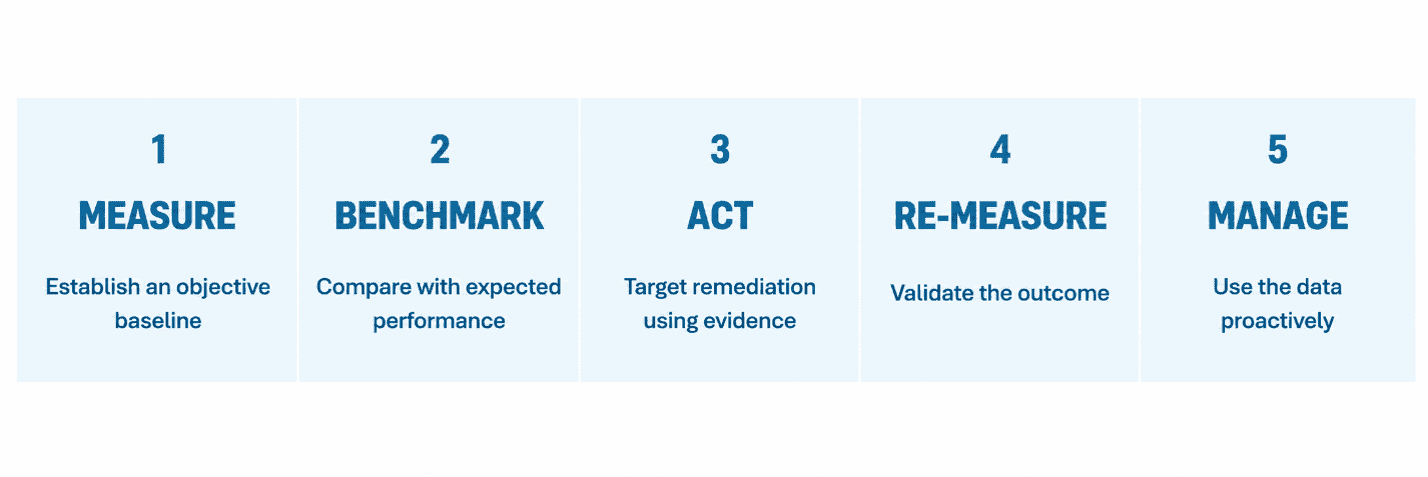
This cycle changes clinician experience improvement from a periodic perception exercise into a measurable discipline. The baseline establishes where the organization stands. Benchmarking identifies meaningful gaps. Actionable data directs resources toward the right problems. Re-measurement proves whether the intervention worked. Ongoing measurement then supports proactive management by IT and Clinical Informatics.
Key Outcomes
- 13% improvement in Oracle Health EHR speed and reliability between August and October 2025
- Objective visibility into the clinician’s lived digital experience
- A baseline for evaluating experience across the clinician population
- Benchmarking against speed and reliability best-practice thresholds
- Identification of specific clinicians, locations, devices, and conditions associated with poor experience
- Targeted, evidence-based remediation rather than broad speculative investment
- A common set of facts for Clinical Informatics, IT, application teams, and Oracle
- Before-and-after measurement to validate the impact of remediation
- A foundation for proactive IT performance management and clinician advocacy
Key Insights
- Surveys tell you what clinicians perceive, measurement shows what they experience: Human feedback remains essential, but objective digital experience data can validate, quantify, and operationalize that feedback across the clinician population.
- Benchmarking creates context for action: A score is most useful when leaders can understand what is driving it and where performance differs from expected levels. Benchmarking helps separate normal variation from experience problems that deserve attention.
- Evidence improves investment decisions: When resources are finite, data can identify the specific endpoints, network components, sites, or systems that should be addressed rather than relying on broad upgrades and hoping the experience improves.
- Re-measurement closes the loop: Improvement initiatives should have a measurable outcome. Repeating the same clinician experience assessment provides evidence that the action taken produced the intended result.
- The same data can become an operating system for continuous improvement: Once measurement is established, IT can use it proactively to manage performance while Clinical Informatics can use it to advocate for clinicians, prioritize outreach, and create transparency around the experience being delivered.
Conclusion: Evidence-Based EHR Improvement
Rady Children’s experience demonstrates a different way to improve clinician EHR experience. Rather than beginning with a presumed technology problem or waiting for enough complaints to accumulate, the organization began by measuring what clinicians were experiencing. The measurement created a baseline. Benchmarking identified opportunities for improvement. The data guided targeted remediation. Re-measurement validated a 13% improvement. And the same visibility now provides a foundation for proactive management. For health systems seeking to improve clinician EHR experience, the lesson is straightforward: measure first, benchmark the experience, act on evidence, and measure again.
Learn More Here: EHR Speed & Reliability Improvement Program.
Source Notes
This case study was developed from Goliath Technologies’ interview with Dr. Dieter Sumerauer, Associate CHIO at Rady Children’s Health, and the July 2026 KLAS Summit presentation “How Informatics Improved EHR Speed and Reliability 13%.” The 13% result and August 2025 to October 2025 measurement period are drawn from the KLAS presentation. Quotations attributed to Dr. Sumerauer are drawn from the published Goliath interview.
About Goliath Technologies
Goliath helps ensure EHR speed & reliability for 25 million care interactions annually by providing at-the-elbow digital experience insights for 100% of clinicians without the need for self-reporting. Purpose-built for Epic, Oracle Health, and Meditech, Goliath provides the data that clinical and IT leaders use to understand EHR speed & reliability issues and implement fact-based initiatives to improve clinician experience.