
How They Did IT
Oracle Health Was Slow – They Improved Performance 17% by Fixing the Real Problem
A large non-profit health system in the Western United States, serving a broad geographic region through more than 28 hospitals and 300 outpatient clinics, was facing growing concerns around Oracle Health Millennium speed and reliability. Clinician feedback and third-party benchmarking confirmed what leadership already suspected: performance issues were impacting daily workflows and patient-facing care delivery.
To address this, the organization engaged Goliath’s accelerated 45-day EHR Speed & Reliability Improvement Program with a clear objective – move beyond perception-based feedback and establish an objective, data-driven foundation for performance improvement.
Want to learn more? Request to speak with a healthcare IT consultant.
For those who want the results up front, here’s how the project leader summarized the impact:
“In a matter of one week we were able to review data about the daily experience of our clinicians when using Millennium. It was truly amazing to have hard facts about which clinicians were experiencing issues, what time of day, at which locations, and how performance changed based on what they were doing within the application. In some cases, we found problems we didn’t know existed, and in others we confirmed long-standing suspicions. Once we had objective facts, clinical and IT teams could finally partner around a common set of data – and we did.”
Challenge
The health system had recently participated in a KLAS Research clinician survey, which revealed poor satisfaction scores related to EHR speed and reliability. While the survey validated that a problem existed, it did not provide the operational detail required to resolve it.
Two priorities immediately emerged.
The first was establishing visibility into the true scope of performance issues across the organization. Surveys rely on voluntary participation and subjective perception. In contrast, Goliath captures empirical experience data directly from clinician sessions, requiring no user interaction or self-reporting. This resulted in a complete dataset representing the experience of 100% of users, not just the small subset motivated to respond to a survey.
The second priority was turning that data into action. When it comes to EHR performance, human feedback can identify frustration, but it cannot pinpoint technical root causes. Clinicians can report that a system is “slow” or “unavailable,” but performance degradation caused by infrastructure, virtualization, network conditions, or endpoint constraints requires technical instrumentation to diagnose. By combining KLAS survey feedback with Goliath’s experience analytics, the organization gained both validation of the problem and the operational intelligence required to fix it.
Solution
Goliath worked closely with both the Oracle Health hosting team and the health system’s internal IT organization to deploy Goliath Monitoring and Troubleshooting Analytics. The technical deployment required approximately four hours and consisted primarily of coordination between teams.
Once deployed, Goliath’s embedded intelligence, automation, and AI-driven analytics immediately began collecting and correlating performance data across the EHR delivery stack. This included session performance, application responsiveness, authentication workflows, infrastructure dependencies, and end-user experience metrics. The platform automatically identified abnormal patterns and surfaced performance bottlenecks in a format that enabled immediate remediation.
The result was improved visibility and operational clarity.
Finding the Root Cause
One example from the engagement highlights why experience-level analytics matter.
Several clinicians at a remote outpatient clinic were consistently reporting slow Millennium performance. The network team confirmed that available bandwidth to the site was well within acceptable thresholds. Oracle Health support also verified that no performance issues were present within the hosted Millennium environment. On the surface, there appeared to be no clear explanation for the degradation.
Using Goliath’s clinician experience analytics, the team performed deeper session-level analysis. The data revealed that clinicians experiencing performance issues were consistently using video-based applications alongside Millennium workflows. At the same time, Goliath identified increased end-user network latency impacting those specific sessions.
This was not the type of latency typically captured by traditional network monitoring tools. While total site bandwidth was sufficient, individual clinician sessions were experiencing contention that directly impacted application responsiveness. Without end-user experience telemetry, this condition would have remained invisible, continuing to create performance degradation while appearing “healthy” at the infrastructure level.
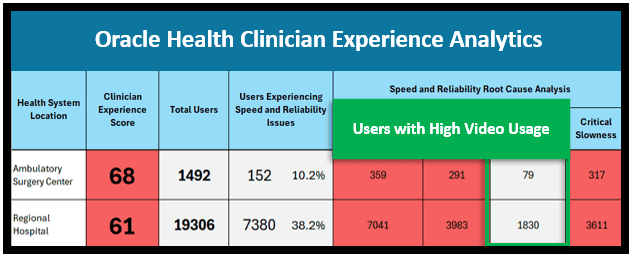
Discussions with the application team revealed that the application had recently been upgraded and the clinicians were making heavy use of video, so the network settings that prioritize user traffic were no longer adequate after the upgrade. This is a common issue we see often that is impossible to see without specialized software but relatively quick and easy to fix.
The root cause investigation conclusion, again, not available through other means, is clear. There isn’t enough bandwidth allocated to Citrix users at this site to accommodate the application.
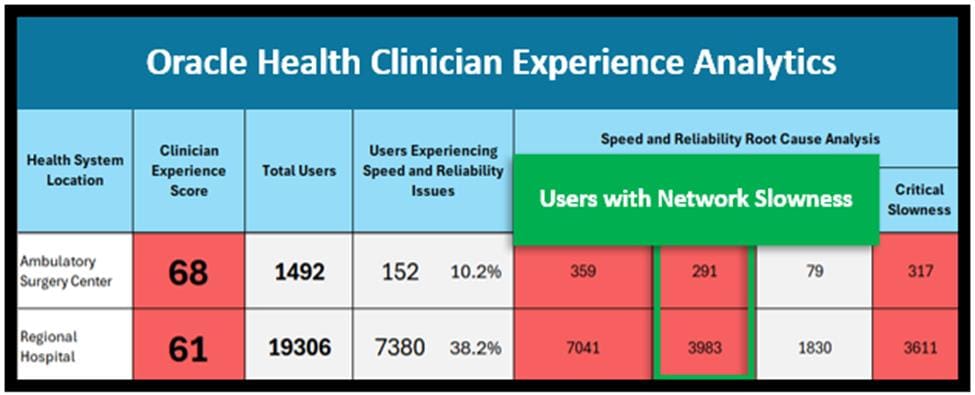
Armed with this insight, the IT team was able to implement targeted remediation strategies that addressed the real bottleneck instead of continuing to troubleshoot the EHR application itself.
The IT team was able to adjust the network settings and upgrade some of the network gear on site to improve performance. This is one example of the improvements we made as part of our EHR performance improvement program.
Proof in the Data: Clinician Experience Scores Before and After
By combining clinician experience analytics with coordinated remediation efforts across IT, network operations, and Oracle hosting teams, the health system achieved measurable improvements in Millennium performance.
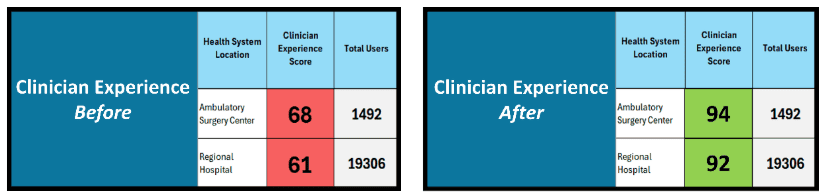
Within the program window, the organization realized a 17% increase in its Oracle Health EHR Speed & Reliability Score across all locations. More importantly, clinicians experienced faster access to the EHR, fewer workflow interruptions, and reduced performance-related frustration at the point of care.
The impact of the remediation effort is clearly reflected in the clinician experience data shown above. The “before” image highlights widespread performance degradation, with elevated latency and reliability issues impacting a significant portion of Millennium users. After targeted remediation actions were implemented, the “after” image shows a measurable improvement in overall experience scores, with fewer degraded sessions, faster response times, and improved consistency across clinical locations. This side-by-side comparison provides objective proof that focusing on the true root cause rather than surface-level symptoms delivered meaningful performance gains for clinicians at the point of care.
If you are having end user experience issues with your clinical or business applications, reach out and let’s discuss. We find and fix very specific issues and in a discovery conversation we will let you know if we can assist. If the issues you are experiencing are outside our purview, we will share that as well.
If you would like to discuss, reach out to techinfo@goliathtechnologies.com or request to speak with a healthcare IT consultant.