
Our ControlUp Alternative Was the Goliath Epic Healthcare Solution
Our ControlUp Alternative Was the Goliath Epic Healthcare Solution
How one health system traded out ControlUp for Goliath to enable proactive management of clinician experience when accessing and using Epic Hyperdrive.
This is how a large health system using Epic Hyperdrive found a ControlUp alternative built for healthcare, and why the switch cost them less.
The Challenge: Clinicians Were Struggling in Epic, and IT Couldn’t See How Far It Went
The complaints were familiar. Epic was slow to launch. Logons dragged at shift change. Sessions froze mid-charting. Clinicians rarely called the help desk anymore; more often, they just worked
around it.
A recent survey indicated broad displeasure with the speed and reliability when accessing and using Epic. Of course the survey only captured a subset of the users and little actionable data for IT to understand or troubleshoot the issues.
The IT team had ControlUp in place to monitor Citrix, but what they didn’t have was the full picture. They could not correlate IT element performance with Epic System Pulse data to see how many clinicians were affected and root cause. Without integration to Epic System Pulse, user experience data on 100% of clinicians is impossible.
That gap had real costs. Clinicians lost minutes meant for patients. The help desk escalated on a hunch. Network, server, Citrix, and Epic teams each checked their own dashboards, found nothing wrong, and handed the problem off. Clinical and IT leadership heard “Epic is slow” but had no data to act on.
What They Tried: Citrix Tools and ControlUp
The team started where most health systems do, with their Citrix tools. Those tools did what they were designed to do. They showed the health of the Citrix layer. But a clinician’s Epic session crosses the endpoint, the network, the hypervisor, the Citrix or VMware Horizon session, and Epic itself. Seeing one layer clearly doesn’t tell you which layer is failing and without integration to Epic it is difficult to tie the performance of a degraded IT element to specific clinicians using Epic Hyperdrive.
So, they added ControlUp, running it side by side with their Citrix tools. It gave the team more
visibility into their virtual desktops, and for general VDI monitoring it had a lot to offer. For Epic,
the blind spots remained.
The team wasn’t short on tools. They were short on answers. That’s when they started looking for a
ControlUp alternative.
The Solution: Goliath, Purpose-Built for Epic
The team found Goliath through KLAS Research, where Goliath is “A” rated and is the only KLAS-measured third-party solution validated for improving EHR reliability and response time. They reached out, and began a full proof of concept to find an alternative to ControlUp.
It started with Epic. Goliath’s module for Epic Hyperdrive integrates with Epic System Pulse and combines three data sources in one console: Epic System Pulse, the clinician’s end-user experience, and the underlying Citrix or VMware Horizon infrastructure. In addition, the Goliath Epic Module provides automated optimization checks to make sure that the Epic environment is fully configured to Epic best practices guidance or on target. For the first time, the team could see an Epic slowdown and trace its root cause in one place.
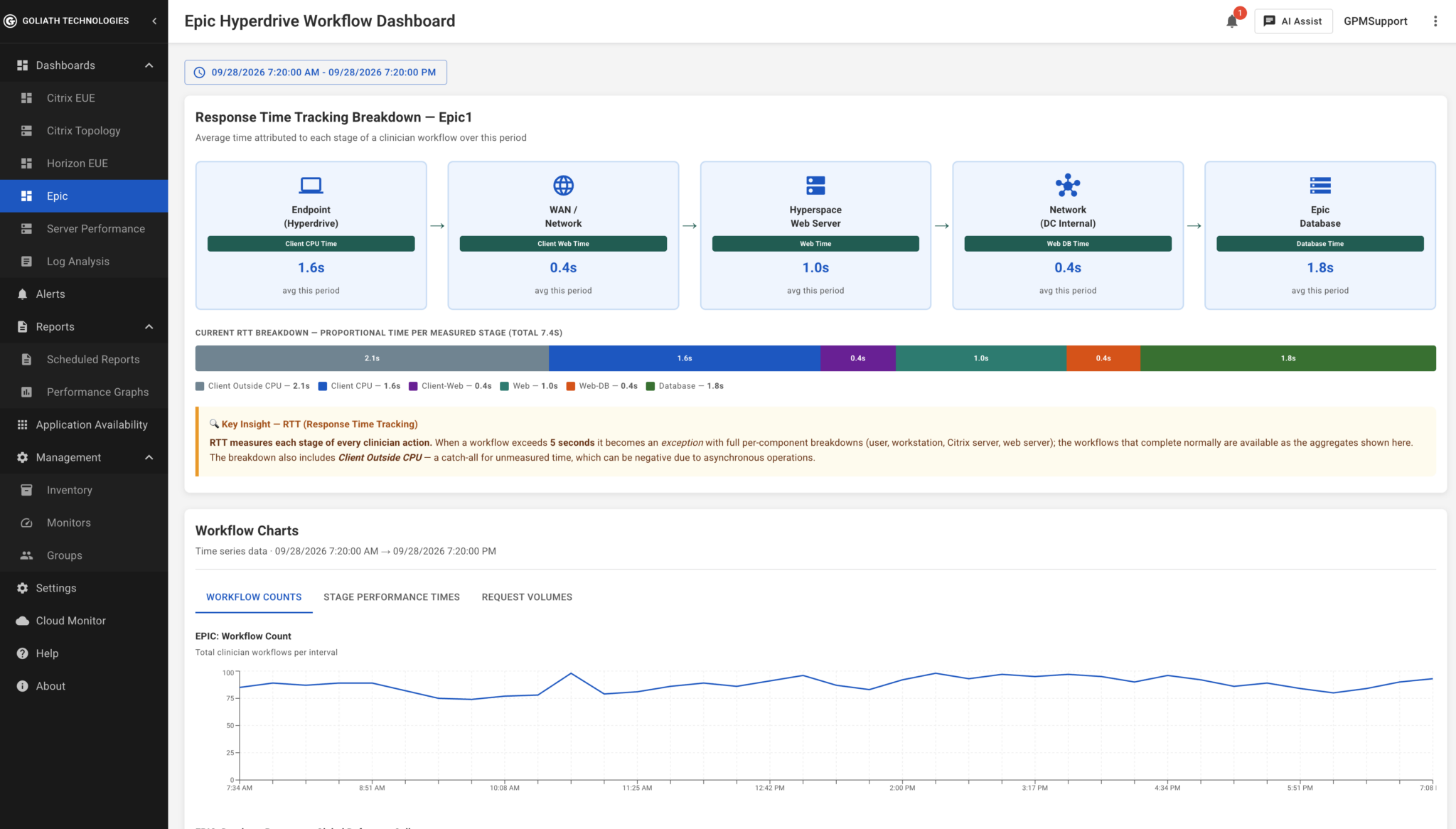
The second difference was how little work it took. Goliath auto-discovers the environment, monitors 250+ failure points out of the box, and tracks all 33+ stages of the logon process. No scripting projects. No custom dashboards to maintain. The team could open Goliath and immediately see the top 25 users having issues, how long each issue lasted, and why.
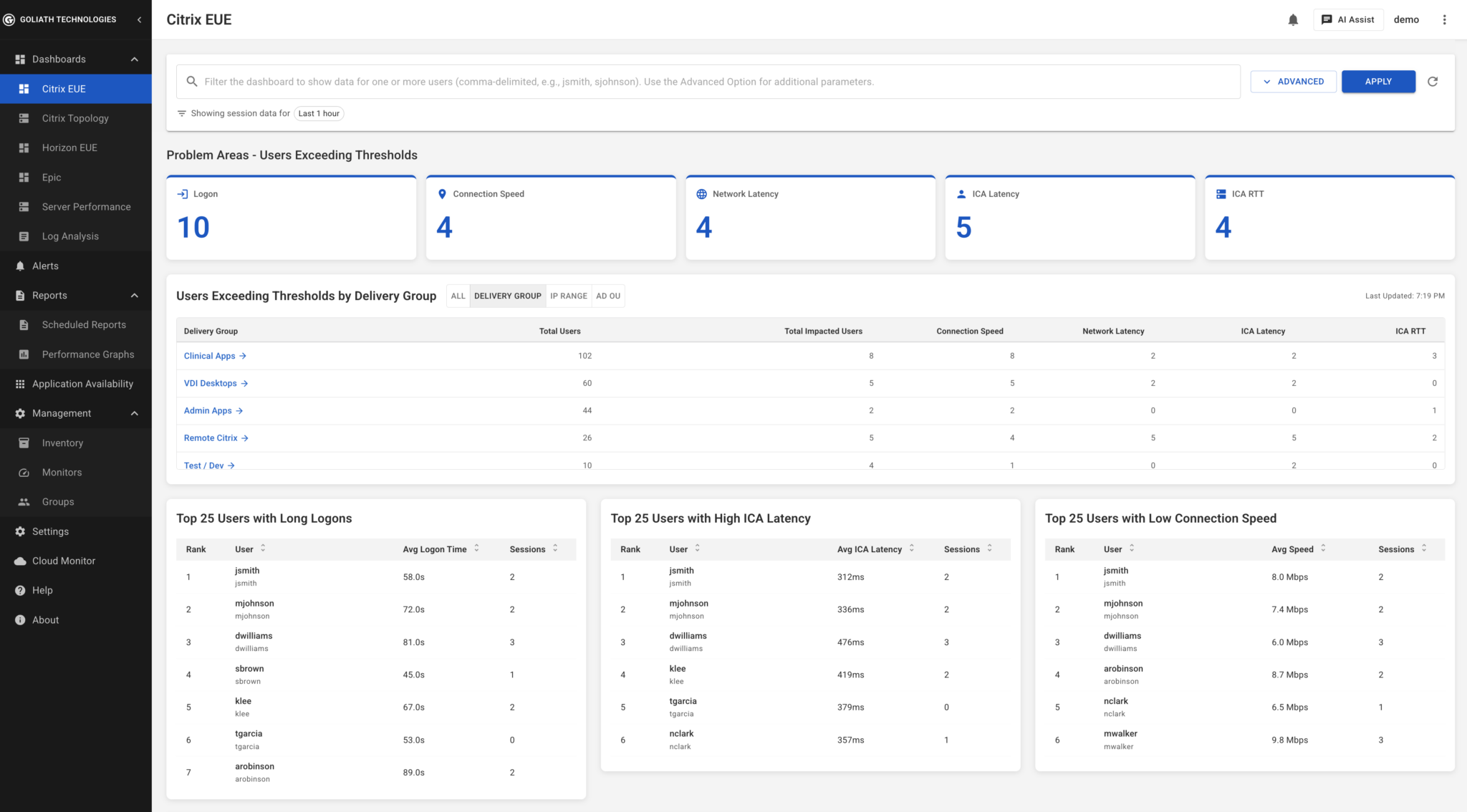
Most important, Goliath tracks the experience of every clinician, not a sample and not only the ones who call the help desk. The End User Experience and Logon Duration Scorecards grade that experience against industry standards, so “Epic is slow” becomes a measurable number that leaders can track over time.
One Set of Facts, Used Across the Organization
After the ControlUp alternative was implemented, Goliath became the shared source of truth for four groups:
- Clinical executives use it when they meet with clinicians. They know who is having issues, how long the issues lasted, and what caused them before the conversation starts.
- IT executives see the same data. Clinical and IT leadership now work from one set of facts to fund initiatives that improve clinician experience.
- The help desk resolves many issues on the first call. When a ticket does need escalation, it goes to the right team, whether that’s network, server, Epic, or Citrix, with root-cause data and screenshot evidence attached.
- Architects use Goliath’s analytics to spot global patterns by location, department, device, and time of day, and to plan capacity and upgrades based on evidence.
A ControlUp Alternative That Cost Less
The health system expected better Epic visibility to cost more. It didn’t. Goliath came in below their
ControlUp renewal. The pricing was simple to understand, and the full platform, including unlimited
reporting, retention, and synthetic monitoring, was included.
In addition to the product the health system executives opted for the Goliath Clinician Experience
Measurement and Benchmarking support package which provides continuous measurement of clinician experience with Epic and compares that to benchmarks from similar health systems.
Going Forward
Today the health system uses Goliath to proactively manage clinician experience in Epic, along with the delivery infrastructure behind it: endpoints, network, Citrix, and the servers underneath. Issues get caught and fixed before clinicians feel them, not after they call the help desk.
Learn more about Goliath as a ControlUp alternative. Get results like these—start here.
See more about our Epic Speed & Reliability Improvement programs here.