
Physician Burnout:  Fix the Foundation First

Physician Burnout: Fix the Foundation First

Physician Burnout: Fix the Foundational Elements First

Physician Burnout: Fix the Foundational Elements First

By Ryan Oliver, former Research Director at KLAS


Efforts to reduce physician burnout and increase productivity remain a top priority for health systems. In this blog, we will explore the high cost of physician burnout, the fundamental contributing factors that are often overlooked, and how technology can be used to identify and address these issues.

Significant investments are being made in ambient speech technology and education to reduce documentation time, decrease cognitive burden, and improve overall productivity. While these efforts are valuable, it’s time to take a step back and consider all the fundamental factors contributing to burnout, beginning with the low-hanging fruit – long logon times and application slowness. According to KLAS Research, more than half of physicians still report EHR slowness and long logon times as major contributors to dissatisfaction and, ultimately, burnout. In fact, KLAS identified speed & reliability as the foundational element to clinician satisfaction with their EHR.

I recently met with a CMIO who spoke enthusiastically about reducing physician documentation time by 45 minutes per shift. At the same time, however, several physicians are complaining about spending 45 minutes per shift waiting for applications to load and logon issues.


Turnover, The High Cost of Doing Nothing

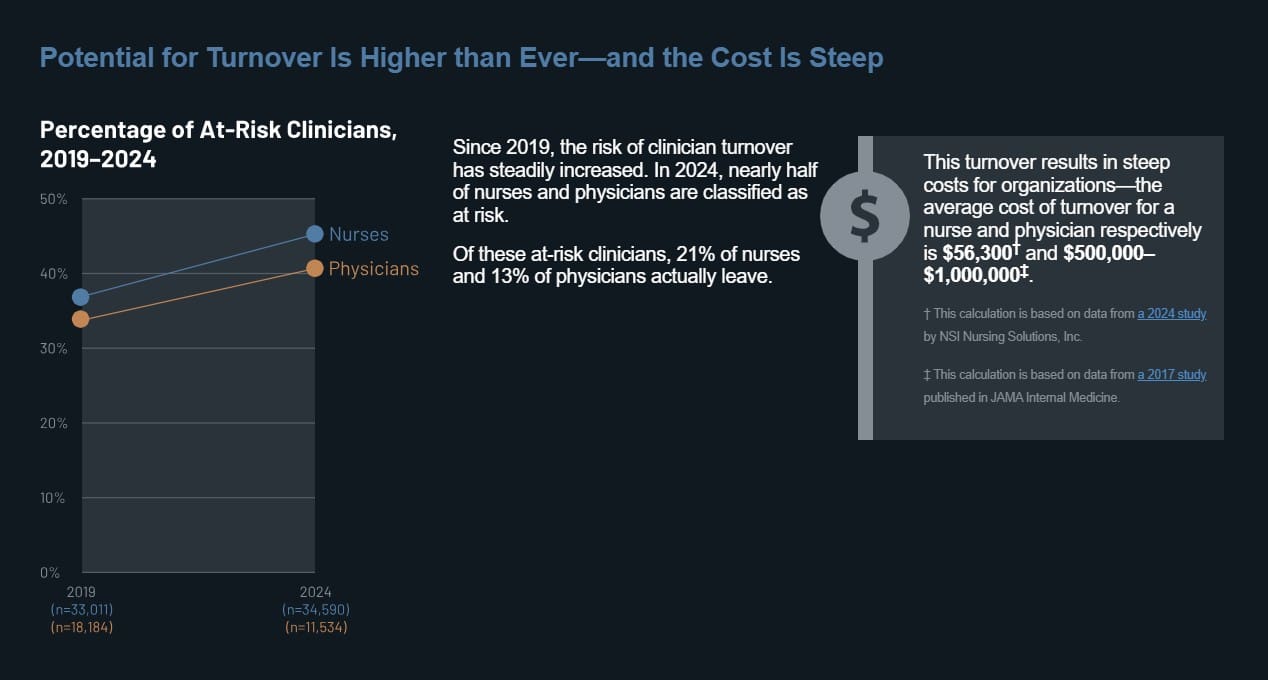
According to KLAS Research’s Clinician Turnover 2024 report, physicians report EHR inefficiency as a top contributor to burnout. Not surprisingly, burnout is highly correlated to risk of turnover. In another KLAS report, nearly 40% of physicians were found to be at risk of turnover and the cost is steep – upwards of $1M per/physician.
 

Turnover-Cost-Graphic

EHR Slowness and Logon Problems are Still a Major Problem 
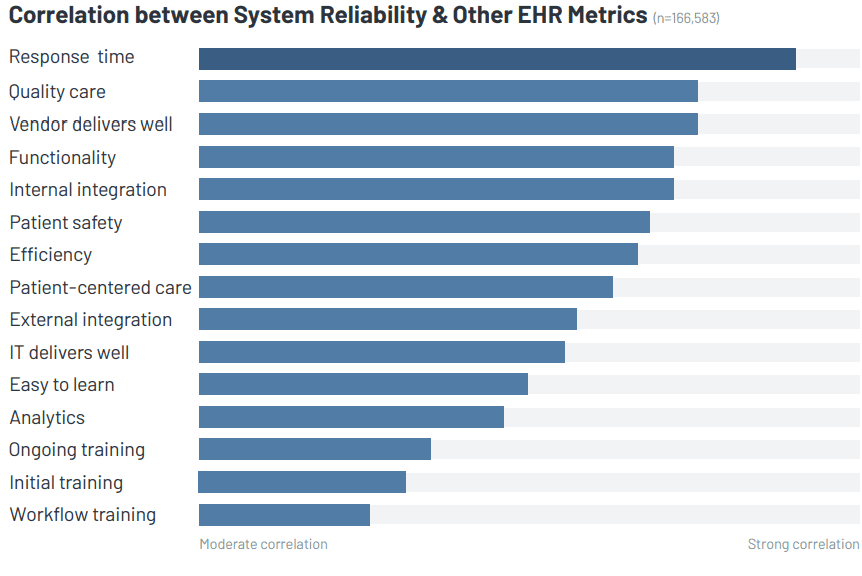
According to KLAS Research’s EHR Response Time & Reliability 2022 report, around half of clinicians are still experiencing EHR slowness. System response time is highly correlated to overall user satisfaction, as well as other metrics including burnout and turnover. So why does the problem persist?In most cases, the root causes are difficult to identify, but relatively easy to fix.


The Difference a Few Weeks Can Make 

Just a few weeks ago, Goliath received a call from the CTO and CMIO of a leading children’s hospital. They were urgently seeking answers to a persistent EHR slowness issue that was directly impacting physician workflows, and ultimately, patient care. 


Their story was familiar: 

  • “We’re getting constant complaints from clinicians. I’ve even walked the floors and seen the delays firsthand.” 
  • “Our on-prem infrastructure checks out—no red flags.” 
  • “The EMR vendor reports no issues within the application or hosted environment.” 
  • “We’ve exhausted every angle—and we heard Goliath might be able to help.” 


After unsuccessful efforts to find the root cause, they engaged Goliath for our 60-day EHR Speed and Reliability Improvement Program with the hope they could uncover the issues in a few days and get some results for clinicians the first week. 

We deployed our technology within days – and in just 24 hours, the hospital had access to user experience reporting and performance insights they’d never seen before. The data revealed that over 140 clinicians were affected by slowness and logon delays, far exceeding acceptable thresholds. Most importantly, we identified the true root cause: issues within the hospital’s own infrastructure – not the EHR vendor. One outdated Citrix server alone was impacting nearly a dozen clinicians daily. 

By the end of the project, we expect this hospital to join the growing list of Goliath Success Stories where we helped health systems reduce downtime, improve clinician satisfaction, and enhance patient care. 

If you are having end user experience issues with your clinical or business applications reach out and let’s discuss. We find and fix very specific issues and in a discovery conversation we will let you know if we can assist. If the issues you are experiencing are outside our purview, we will share that as well. 
 

Improve Oracle EHR Physician Experience and Reduce MTTR

Improve Oracle EHR Physician Experience and Reduce MTTR

Improve Oracle EHR Physician Experience and Reduce MTTR

By Cory Crawford, 14 years as a Lead Integration Architect with Oracle Health 

Throughout my 14-year career at both Cerner and Oracle Health, I’ve spent countless hours on the phone with the Oracle Health IRC (Immediate Response Center). Typically, an end user reports an issue with minimal details, expecting a swift resolution. While numerous tools exist to assist in troubleshooting, logging into multiple systems to gather scattered data points is both tedious and time-consuming. 

During a demo with Goliath, I immediately recognized the value of having an all-in-one solution. From accelerating initial triage to reducing overall resolution time, Goliath streamlines the troubleshooting process in a way that traditional methods simply can’t match. 


Faster Triage, Quicker Mean Time to Resolution

When you call the IRC, a Situation Manager is your first point of contact. Their role is to assess the issue and connect you with the right resource to resolve it. 

With Goliath’s comprehensive data insights, you can provide precise, real-time information, allowing the Situation Manager to immediately page the appropriate team. This eliminates the common frustration of waiting for a resource to join the call – only for them to say, “This isn’t me; you need to page another team.” 

The Goliath Solution is unique due to the partnership they maintain with Oracle Health Hosted which allows them to deploy their technology into the hosted environment. This gives them access to data regarding end user clinician experience that is not available through other means. The technical reasoning for this deployment architecture and why it is wholly complimentary to Lights On Network will be explained in a future post or on the next webinar.    

Given the complexity of healthcare IT and the vast number of teams and subject matter experts (SMEs) at Oracle Health, having instant access to key metrics significantly improves both initial triage and overall troubleshooting. 

My Personal Experience Managing a Client Crisis

When put to use, Goliath’s Technology immediately gives end-to-end visibility from multiple Oracle Health domains to on-premises issues, all the way to the clinician’s experience at their devices. For the first time, we could quickly determine whether the issue was client side or vendor side and approach the IRC with a common set of facts. We could stop pointing fingers and build a resolution plan.  

I can recall one situation where we were informed of massive slowness issues and we were engaged along with other members of the Oracle team, health system IT department, and multiple vendors. Fortunately, we were able to run reports from Goliath on demand to help us frame up the problems.  Again, the tension was high because of all the complaints that had been registered.  

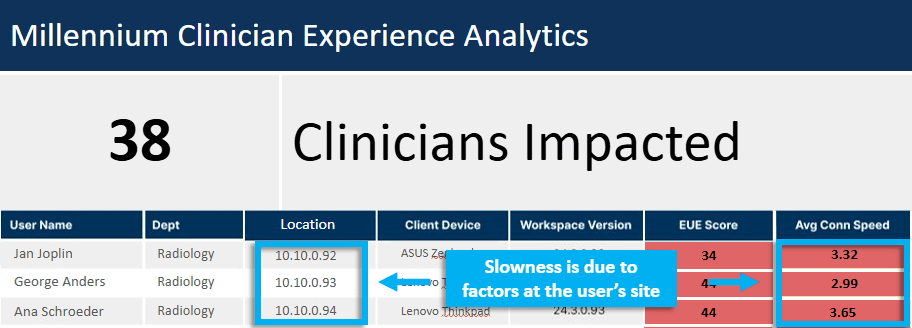
What we found was a more manageable situation. The clinician experience issues had been greatly amplified. That “over amplification” was not unusual but in this case, we were able to prove, as seen in the image below that the complaints were not from hundreds of clinicians but a few dozen and further, they were all from one location.  


With that knowledge, we were able to drill down into historical and real time data to confirm that the issues were connection speed related caused by problems with Citrix receiver versions, improperly patched routers, and downed Wi-Fi devices. Easy to fix, but impossible to find without Goliath. 

We want to fix issues no matter the root cause so clinicians can provide seamless patient care without having to overcome technical challenges. Goliath is able to deploy their technology on both the Oracle and Healthcare infrastructures so complete visibility is now achievable and consequently troubleshooting is made not only easier, but possible, which sometimes is not the case without full end-to-end visibility.

Real-Time Insights for Proactive Issue Resolution

Using Goliath while working with an Oracle Health SME provides real-time alerting, detailed troubleshooting feedback, and visibility into CPU/memory utilization to ensure domain stability. Most importantly, it enables instant confirmation of issue resolution – helping you close the loop faster and with confidence. 

By leveraging Goliath, you’re not just resolving issues more efficiently, you’re transforming how healthcare IT teams approach troubleshooting and system stability. 

If you are having end user experience issues with your clinical or business applications, reach out and let’s discuss. We find and fix very specific issues and in a discovery conversation we will let you know if we can assist. If the issues you are experiencing are outside our purview, we will share that as well. Learn more about our EHR Speed & Reliability Improvement Program. 


thomas charlton

Cory Crawford

With a background as a System Engineer, transitioning to a Lead Integration Architect, I’ve honed my skills in project management, solution support and domain strategy planning, most notably with Oracle and now at Vandalia Health. Over ten years of experience in this specialized field have equipped me to tackle complex integration challenges within the healthcare sector. At Vandalia Health, my mission is to streamline systems to improve patient outcomes, reflecting my commitment to technological excellence and patient-centric care. My approach is collaborative, ensuring that my work not only supports but also advances the organization’s goals through innovative solutions.