How They Did IT  Epic Health System  Measured, Benchmarked & Reduced Epic Hyperdrive Clinician Logon Times by 50%

How They Did IT Epic Health System Measured, Benchmarked & Reduced Epic Hyperdrive Clinician Logon Times by 50%

How They Did IT

Epic Health System

Measured, Benchmarked & Reduced Epic Hyperdrive Clinician Logon Times by 50%

How objective clinician EHR experience measurement established the baseline, identified a widespread performance gap, guided targeted remediation, validated best-practice performance, and created a foundation for proactive management.

Acute care health system | 9,500 employees | 24 clinics | 7,000+ Epic Hyperdrive users

Executive Summary

An acute care health system with 9,500 employees was receiving clinician reports of slow Epic Hyperdrive logons and other application performance issues, particularly in patient-care settings. Support tickets and user reports confirmed that a problem existed, but they could not show leadership the full scope of the experience, how frequently it occurred, or where remediation should begin.

Goliath Technologies established an objective baseline of the clinician digital experience and quantified the issue across the environment. Within hours, the measurement showed that the problem was intermittent but chronic, spanning 24 clinics and more than 7,000 Epic Hyperdrive users. The data also showed that the latency was occurring between the endpoint and the application rather than within the Epic Hyperdrive application itself. Epic was being identified as the root cause, but data proved otherwise.

The baseline provided a benchmark for action. Using contextual performance data, the IT team isolated a legacy home-folder path in Active Directory that was forcing timeouts during the Citrix profile-load stage. An emergency change removed the obsolete path. Within two weeks, clinician logon times improved by 50%. Over the following 45 days, initial logons fell to under 30 seconds and reconnects to under 10 seconds, achieving the case study’s stated industry best-practice standards for logon performance.

The engagement illustrates a repeatable clinician experience improvement model: measure the lived digital experience, benchmark performance against best-practice thresholds, act on the evidence, re-measure the outcome, and use the same data proactively to prevent future clinician disruption.

Background

The health system relies on Epic Hyperdrive to support clinicians across a broad acute and ambulatory care environment. Clinicians began reporting slow logon performance with Epic Hyperdrive and other applications, creating frustration and potentially taking time away from patient care.

The IT Incident Response Team was actively investigating the complaints. The challenge was not simply determining whether individual clinicians had experienced a slow logon. The organization needed an objective view of the experience across the clinician population: who was affected, where the issues occurred, how often they occurred, how long they lasted, and which part of the technology delivery path was responsible.

Challenge: Moving Beyond Self-Reported Experience

Support tickets, surveys, and clinician complaints are valuable signals, but they are inherently limited as a measurement system. They reflect the clinicians who choose to report an issue and often describe the symptom rather than the technical condition causing it. That makes it difficult to determine the true scale of a problem or prioritize remediation based on impact.

The health system needed empirical clinician experience data that could quantify the digital experience at scale and create a common set of facts for IT and clinical stakeholders.

Step 1: Measure the Clinician EHR Experience

Goliath used technology-enabled empirical data to establish a baseline of the clinician experience within hours. Instead of beginning with an assumption about the cause, the measurement framed the problem objectively and showed how clinicians were actually experiencing the Epic delivery environment.

The baseline report sample below revealed that:

  • The issue affected more than 7,000 Epic Hyperdrive users.
  • The experience problem extended across 24 clinics.
  • The slowdowns were intermittent and chronic rather than a single isolated event.
  • The latency was occurring from the endpoint to the application, not within the Epic session itself.
  • The organization could quantify affected users, frequency, duration, location, and the likely technology domain contributing to the poor experience.

Illustrative example data:
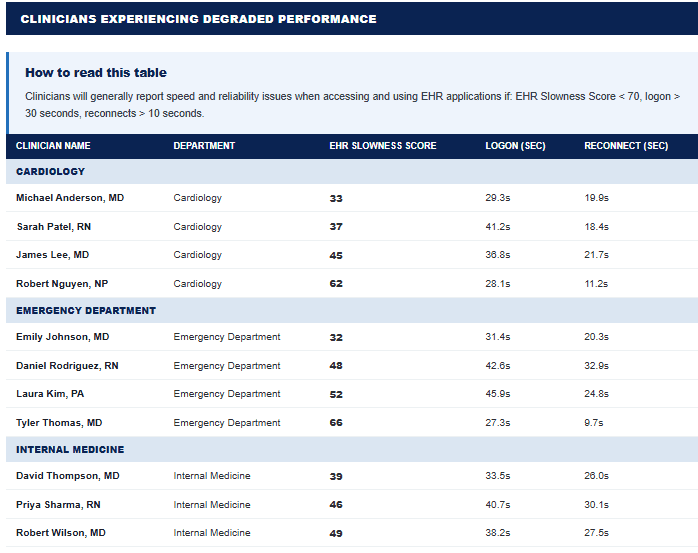
Clinicians Experiencing Degraded Performance

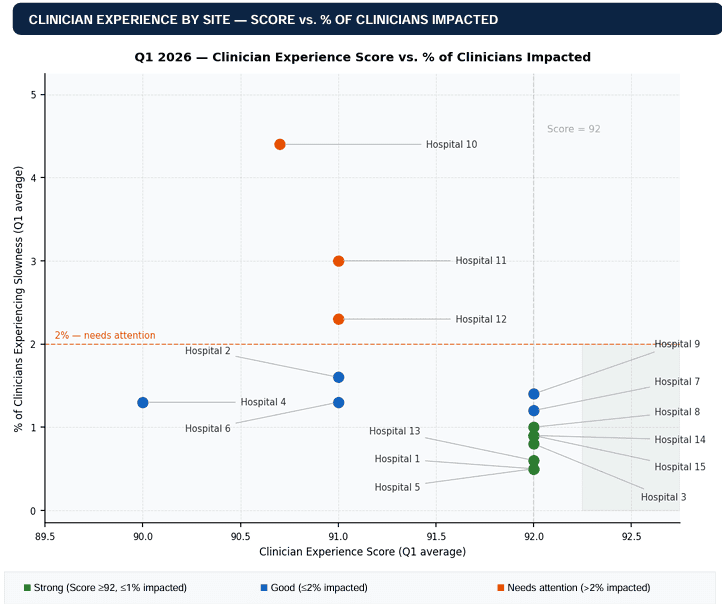
Step 2: Benchmark Performance Against Best-Practice Thresholds

Once the experience was measurable, the organization could evaluate logon performance against expected and best-practice thresholds. This converted clinician complaints into a measurable performance gap and gave the team a clear definition of success: reduce the observed delays until initial logons and reconnects were operating within acceptable standards.

Benchmarking also helped focus the investigation. Rather than treating every technology component as equally suspect, the team could concentrate on the part of the delivery path where the measured experience deviated from expectations.

Illustrative example data:
Limited And Siloed Visibility Clinician Connection

Step 3: Turn the Benchmark into Actionable Data

Goliath’s AI-enhanced contextual data allowed the IT team to move from identifying the scope of the problem to isolating its root cause. The data showed repeated Citrix and Epic Hyperdrive login failures followed by slow logons across multiple devices.

The investigation traced the delay to the Citrix “profile-load” stage. A legacy home-folder path remained on the Active Directory object even though the network location no longer existed. Each logon attempt waited for the unavailable path, creating forced timeouts and extending the clinician’s logon experience.

Because the problem was supported by empirical evidence, the team could make a targeted change rather than broadly modifying the Epic, Citrix, network, or endpoint environments. An emergency change removed the obsolete home-folder path from Active Directory and eliminated the forced timeout.

Step 4: Re-Measure and Validate the Outcome

After remediation, the health system used the same clinician experience data to determine whether the change had produced the intended result. The before-and-after measurement demonstrated a substantial improvement rather than relying on a reduction in complaints as a proxy for success.

Within the first two weeks, Epic Hyperdrive clinician logon times were reduced by 50%. During the following 45 days, initial logon times dropped to under 30 seconds and reconnects to under 10 seconds. According to the source case study, the organization had reached industry best-practice standards for logon performance.

Step 5: From Measurement to Proactive Experience Management

With the reported issue permanently resolved, the organization extended the same approach into ongoing operations. The IT team implemented proactive alerting so future availability and logon problems could be detected by technology rather than waiting for clinicians to report them.

Goliath’s application availability capability automatically logs on to Epic 24/7/365 and alerts on logon difficulties, providing evidence that can be used for rapid troubleshooting. This changes the operating model from reactive support to proactive clinician experience management.

For IT, the data provides early visibility into emerging performance issues and evidence for root-cause analysis. For clinical and informatics teams, the same measurements can provide objective context around clinician feedback and help prioritize where intervention will have the greatest impact.

A Repeatable Clinician Experience Improvement Model

The Epic health system case demonstrates that measurement and benchmarking are not separate from remediation; they are what make precise remediation possible. The baseline defines the actual clinician experience. Benchmarking establishes the performance gap. Contextual analytics identify the likely cause. Remediation addresses the specific condition. Re-measurement proves whether the intervention worked. Ongoing monitoring helps preserve the improvement.

MEASURE → BENCHMARK → IDENTIFY → REMEDIATE → RE-MEASURE → PROACTIVELY MANAGE

Key Outcomes

  • 50% reduction in Epic Hyperdrive clinician logon times within two weeks
  • Initial logon times reduced to under 30 seconds within the subsequent 45-day period
  • Reconnect times reduced to under 10 seconds
  • Performance brought to the case study’s stated industry best-practice standards for logon times
  • Objective measurement across more than 7,000 Epic Hyperdrive users and 24 clinics
  • Identification of an intermittent, chronic issue that self-reported data alone could not quantify
  • Root cause isolated to a legacy Active Directory home-folder path affecting Citrix profile load
  • Targeted remediation based on empirical evidence rather than broad speculative changes
  • Before-and-after measurement validating the impact of the corrective action
  • Proactive 24/7/365 availability and logon monitoring to identify future issues before clinicians report them

Key Insights for Health System Leaders

  1. Clinician complaints identify symptoms; measurement defines the problem.
    Self-reported feedback is important, but objective experience data can quantify how many clinicians are affected, where the issue occurs, its frequency and duration, and the likely technology domain involved.

  2. Benchmarking gives the measurement context.
    Performance data becomes more actionable when compared with expected thresholds and best practices. The benchmark establishes both the size of the gap and a measurable target for improvement.

  3. Evidence enables precision remediation.
    The measured data narrowed the investigation from a broad “Epic is slow” complaint to a specific profile-load delay caused by an obsolete network path. That distinction allowed focused corrective action.

  4. Re-measurement proves the result.
    A 50% reduction in logon times and subsequent achievement of stated best-practice logon thresholds provided objective evidence that the remediation improved the clinician experience.

  5. The same data supports proactive management.
    Once the baseline and measurement framework are established, the organization can use continuous availability and experience data to identify emerging issues before they become widespread clinician complaints.

Conclusion: From “Epic is Slow” to a Measurable Improvement Discipline

This health system’s experience demonstrates the value of beginning clinician EHR improvement with measurement rather than assumptions. Objective data revealed the scope of the issue across thousands of users, benchmarked the experience against expected performance, directed the team to the actual root cause, and provided a way to validate the result after remediation.

For health systems seeking to improve Epic clinician experience, the lesson is straightforward: measure first, benchmark the experience, act on evidence, and measure again. The same data can then become the foundation for proactive IT performance management and a shared, objective understanding of the clinician’s lived digital experience.

Learn More Here: EHR Speed & Reliability Improvement Program.

Source Notes

This case study was developed from the Goliath Technologies consulting engagement, work product, and interviews with this large non-profit health system. These are the documented results from that engagement. The health system is not named in the source document, so this version preserves that anonymity.

About Goliath Technologies

Goliath helps ensure EHR speed & reliability for 25 million care interactions annually by providing at-the-elbow digital experience insights for 100% of clinicians without the need for self-reporting. Purpose-built for Epic, Oracle Health, and Meditech, Goliath provides the data that clinical and IT leaders use to understand EHR speed & reliability issues and implement fact-based initiatives to improve clinician experience. Goliath Technologies has been rated “A” by KLAS Research.
How They Did IT  Epic Health System  Measured, Benchmarked & Reduced Epic Hyperdrive Clinician Logon Times by 50%

At-the-Elbow Executive Insights with Dr. Brian Patty, Former CMIO Rush Medical Center

At The Elbow – Executive Insights with Dr. Brian Patty, Former CMIO Rush Medical Center

How cross-functional alignment between clinical and IT teams improved clinician EHR experience, and how new data is creating opportunities for transformational change.

Thomas Charlton

Dr. Patty, thanks for joining us for At-the-Elbow. When clinicians first raised concerns about EHR speed and reliability during your time at Rush, what were they most frustrated by?


Dr. Brian Patty

What I consistently heard from clinicians was frustration with logon times and screen lag. Some were waiting over a minute just to log in, and once inside the system, they experienced pauses, connectivity issues, and sluggish response times. The problem was that the feedback was often vague. Clinicians couldn’t always remember what device they were using, where they were located, or what part of the workflow triggered the issue.

When I brought these concerns to IT, I often heard, “Everything looks fine on our end.” That created a huge disconnect. Physicians were clearly struggling, but we lacked objective data to explain what was actually happening from the clinician’s perspective. We could give incidental observation at best, but I always thought that somehow we should know what clinicians were experiencing because they were all connected to the network, so there must be some sort of digital footprint. I was just not able to get this data.


Thomas Charlton

Without access to real experience data at the time, how did you bridge that gap between clinician frustration and IT visibility?


Dr. Brian Patty

Honestly, the only way we could do it was by physically going into clinical areas and watching clinicians work “at-the-elbow.” I would walk the floors with IT leaders, stand behind physicians, and observe what they were experiencing in real time.

Those “at-the-elbow” moments were eye-opening. IT teams would say, “Wow, that’s actually happening?” Seeing the delays firsthand finally made the problem real. But it was manual, time-consuming, and inefficient. We were essentially doing time-and-motion studies just to understand basic performance issues.


Thomas Charlton

What were the biggest challenges in turning those observations into action?


Dr. Brian Patty

One of the biggest challenges was organizational silos. You had the network team, Citrix team, and desktop team all looking at their own dashboards and saying everything appeared normal from their perspective. No one was looking holistically across the full delivery chain.

It took bringing in a new CIO who was willing to step back and say, “We need to look at this end-to-end, from how the EHR is delivered to what the clinician actually experiences.” Once leadership aligned on that mindset and teams started collaborating across boundaries, we were finally able to dig into root causes.

The payoff was significant. We reduced login times from over a minute down to about five seconds. We eliminated lag and freezing issues. But getting there required enormous effort because we didn’t have the kind of experience-level visibility that exists today.


Thomas Charlton

You often talk about evidence-based practice in medicine. How does that apply to digital experience and IT operations?


Dr. Brian Patty

It applies exactly the same way. Whether I’m practicing medicine or serving as a CMIO, I want data. I want evidence. The KLAS Arch Collaborative survey gave us strong benchmark data on clinician satisfaction, which was incredibly valuable.

But surveys alone don’t tell you where problems are occurring, who is affected, how often it’s happening, or what’s causing it. That’s what was missing.

What excites me about tools like Goliath is that they finally provide that missing foundation. You can actually see what clinicians experience: where it’s happening, when it’s happening, and why. Instead of chasing symptoms, IT and clinical leaders can work from the same set of facts and make targeted improvements that actually move the needle.


Thomas Charlton

That alignment between clinical and IT leadership is really what “At-the-Elbow” is all about.


Dr. Brian Patty

Exactly. When both sides are working from the same objective data, the conversation changes. It stops being about opinions and frustration and starts being about action. That’s how you improve clinician experience, reduce burnout, and ultimately deliver better patient care.

If you would like to discuss further, reach out directly at techinfo@goliathtechnologies.com or request to speak with a healthcare IT consultant.

How They Did IT  Epic Health System  Measured, Benchmarked & Reduced Epic Hyperdrive Clinician Logon Times by 50%

When Oracle Health Is Slow: What the Data Reveals About the True Bottleneck

When Oracle Health Is Slow: What the Data Reveals About the True Bottleneck

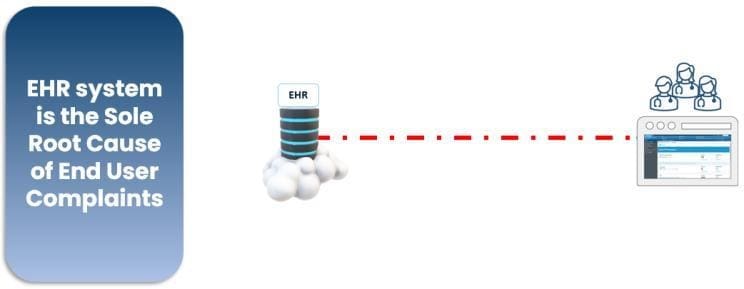
When clinicians experience performance issues with Oracle Health EHR, often the immediate assumption is that the problem lies with the application vendor. Many believe there is a direct, one-to-one connection between the end user and the data center where the application is hosted.

Goliath offers great observability by giving us objective measurement of clinician satisfaction with Millennium and the analytics to foster a productive, data-driven dialogue between our IT staff and Oracle to resolve issues.

Jamey Pennington, CIO, Southwell Health

The perception: Oracle Health EHR is the root cause of performance issues

Ehr Systems Sole Cause User Complaints

Not so fast!

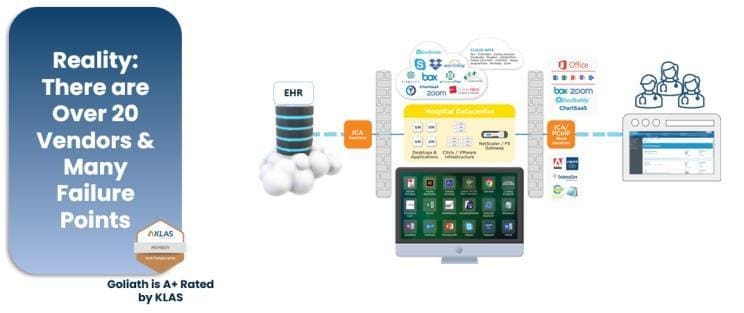
The reality: a complex IT ecosystem

In truth, performance issues are rarely that straightforward. As illustrated below, there are multiple IT infrastructure elements, applications, and other variables between the clinician and the EHR application.

20 Vendors Many Failure Points

Over the last decade, we’ve participated in numerous Incident Response Calls (IRCs) and troubleshooting sessions with Oracle Health EHR clients. From these experiences, three key takeaways stand out:

  1. Most speed and reliability issues attributed to Oracle Health EHR originate on the client side.
  2. Clients lack the necessary data to identify and isolate these client-side issues.
  3. With the right data, clients can resolve issues faster, without escalating to Oracle.

Why Oracle’s hosting isn’t usually the issue

Oracle Health EHR operates in a highly controlled, well-managed hosting environment with robust performance monitoring. It has been our experience, when attempting to resolve speed and reliability issues, that the client doesn’t have the same visibility into their IT infrastructure and end users as Oracle does, so there isn’t a common set of facts upon which to build a resolution plan. Oracle has very complete performance data, while the client has limited insight into the IT elements and many variables that can impact clinician experience. This incomplete picture on the client side results in many hours of wasted time attempting to isolate the root cause of issues.

Having the right data matters

In an Oracle Health hosted environment, accurately isolating the root cause of clinician experience issues requires access to the right operational and experiential data, not assumptions or self-reported feedback. Because Oracle hosts and manages the core infrastructure, most traditional IT monitoring tools lack visibility into what clinicians actually experience at the point of care. Through Goliath’s exclusive access to Oracle-approved clinician experience and performance telemetry, healthcare organizations gain objective, real-time insight into session performance, application responsiveness, and end-user experience. This unique data foundation enables IT and clinical leadership to quickly differentiate between EHR application issues, network latency, virtualization performance, and endpoint constraints, dramatically reducing troubleshooting time and allowing teams to focus remediation efforts where they will have the greatest clinical impact.

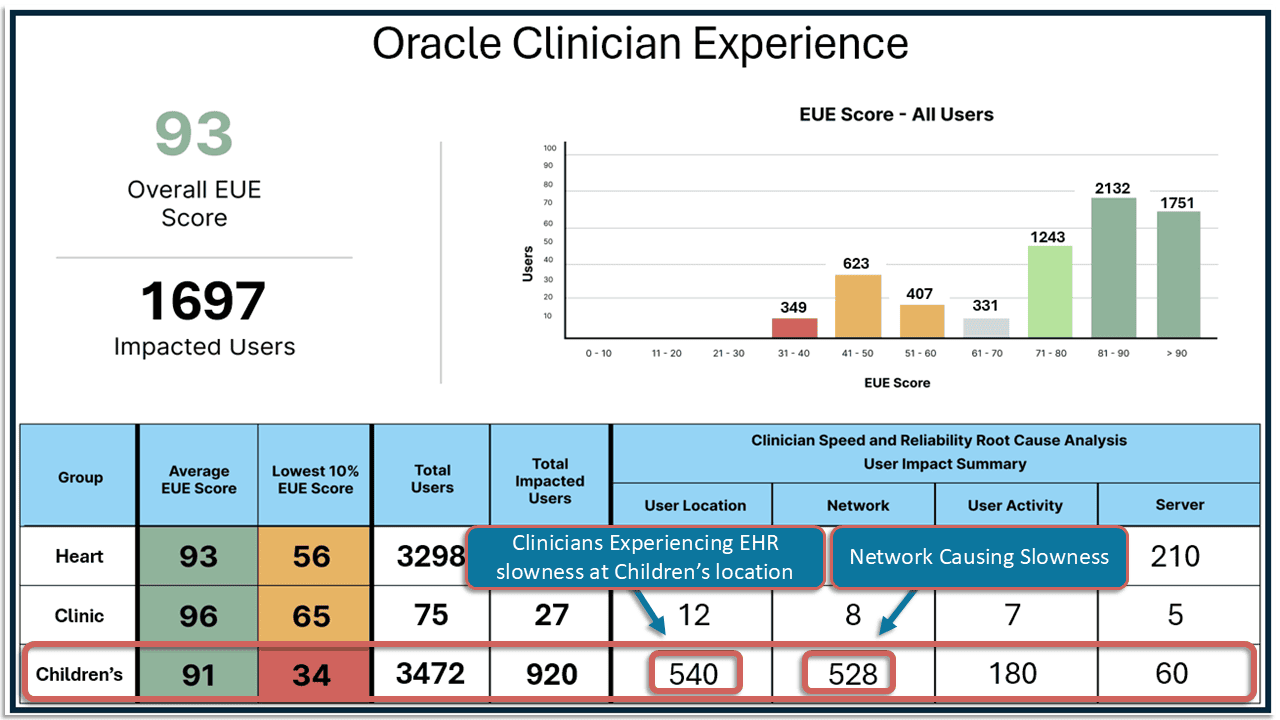
Here is an example from an actual health system we worked with recently on a project to improve speed and reliability.

Oracle Clinician Experience

Troubleshooting any hosted application is complex, but without the right performance data, it becomes nearly impossible. This is where end-user experience analytics make a difference.

While we don’t claim that Goliath Technologies is the answer to every issue, we do provide a unique level of visibility that Oracle Health EHR clients simply don’t have elsewhere. With our technology, you can:

  • See exactly which clinicians are experiencing performance issues.
  • Identify issue frequency, duration, and likely root cause.
  • Eliminate guesswork and reduce reliance on clinician self-reporting.

If you would like to discuss further, reach out to techinfo@goliathtechnologies.com or request to speak with a healthcare IT consultant.

How They Did IT  Epic Health System  Measured, Benchmarked & Reduced Epic Hyperdrive Clinician Logon Times by 50%

How They Did IT Days to Hours

How They Did IT

Days to Hours
Southwell & Oracle Health transformed issue resolution

In this How They Did IT conversation, I sat down with Jamey Pennington, CIO of Southwell Health, to discuss a recent frontline engagement where Goliath worked with the IT teams at Southwell Health and Oracle Health in a collaboration effort to resolve issues causing clinician frustration when using the Oracle EHR.

Thomas Charlton

Jamey, what are your responsibilities as CIO of Southwell Health?


Jamey Pennington

My division covers all things technology, except for biomedical equipment. That includes the EHR, ERP systems, clinical informatics, telecommunications, and infrastructure. While biomed is technically separate, those lines blur in healthcare, so we work closely together. Ultimately, my responsibility is to make sure the technology environment supports clinicians and the organization.


Thomas Charlton

What was your path into healthcare IT, and how technical do you believe today’s healthcare CIO needs to be?


Jamey Pennington

I started in healthcare IT pulling wires through medical office buildings and connecting terminals to Unix systems. That technical foundation has been extremely valuable, especially when challenging vendors and evaluating overlapping tools. Today’s CIO must balance innovation while minimizing duplication and control costs by leveraging enterprise platforms.


Thomas Charlton

Can you frame up the situation at Southwell when you first reached out to Goliath?


Jamey Pennington

We were dealing with infrastructure changes and limited resources. Clinicians were experiencing freezing systems, session lockups, and forced logouts when using the Oracle EHR. This directly impacts clinical workflows and patient care. With multiple technologies involved, troubleshooting was extremely complex and there was quite a bit of trial and error or educated guessing about what might be causing the issues. We were working with our service provider, and of course, Oracle Support in an attempt to find the root cause of the issues, but we were unsuccessful.

Keep in mind, when these types of issues occur and the clinician is having slowness or application crashes in a patient care setting, it is very disruptive and causes acute frustration. I am very aware of the fact that EHR performance issues contribute to physician and nurse burnout, so it is something that receives immediate escalation and attention.


Thomas Charlton

How long were these issues occurring before you contacted Goliath?


Jamey Pennington

It is important to remember that when clinicians and users report issues there is very little actionable data. They describe what they are experiencing, for example, an application freezing up, but beyond that there is little data to go on to begin a troubleshooting sequence.

The issues went on for about a month and when we called Goliath, we were just shooting arrows in the air trying to hope something hits.


Thomas Charlton

So how did you do IT or find a solution?


Jamey Pennington

As you know we called you all and first pulled together a meeting with Oracle Support, our internal team, and our service provider to bring you up to date. Then your team really began to examine the data both current and historic. This is critical because, as I said earlier, you don’t get actionable feedback from users and sometimes the incident being reported isn’t fully accurate in terms of date, time, and location. This is an enormous challenge and detailed data from Goliath was critical.

Specifically for this situation, I knew that Goliath is deployed in the Oracle Hosted Environment which provides extremely valuable clinician experience data. Your team ran reports immediately looking back 30 days and could see data on 100% of the clinicians in terms of who was having problems, frequency, duration, and root cause. Also, your product pulls in performance data from our on-premises infrastructure, so we have a complete end-to-end picture.

We are an Oracle First health system, and we were working together closely on this issue, and I think I speak for all of us that we didn’t as much care where the problem was, we just wanted it fixed, so a single view of both environments was critical.

I don’t want to get into the specifics around the exact root cause and where it existed, but I can tell you that without the added visibility and support that Goliath provided, we would likely still be chasing the problem today.

It was one of those issues where the description of the problem (application freezing and session lockups) was so broad that we literally had to check everywhere. After a month of fighting these issues with multiple partners and with many hours expended, Goliath was able to determine the exact root cause in a single call over two hours and we applied a fix that resolved the issues permanently.


Thomas Charlton

Oracle EHR being a hosted application wasn’t an issue when it came to troubleshooting?


Jamey Pennington

As with any hosted application, we must rely on the team that is managing the hosted environment to contribute to the troubleshooting process. Oracle Health Support was fully engaged but they don’t see beyond their hosted environment. At Southwell, we operate in a double-hop Citrix environment which means the two environments are totally separate, which adds a layer of complexity when it comes to management and troubleshooting.

Goliath has a special partnership with Oracle and can see both environments from a single console. Having this independent and intelligently correlated performance data allowed us to see the clinician connection path fully from the initial connection at a remote location through to accessing Millennium. This enabled us to isolate the root cause and work collaboratively with Oracle using a common data set from Goliath, which included both environments.


Thomas Charlton

Pivoting a bit from this issue but related, how do IT and clinical leadership collaborate at Southwell?


Jamey Pennington

We work closely with our CMIO. Transparency and shared understanding are critical. Seeing problems firsthand helps convert subjective feedback into actionable improvements. In fact, I commonly do rounding with clinicians in person to proactively understand their perspective and identify issues you can’t see unless you are with them personally. It also builds confidence.


Thomas Charlton

What are your keys to success as a healthcare CIO?


Jamey Pennington

My core focus areas are balancing innovation with regulatory compliance; transparency is essential of course, as well as clear communication to build trust and alignment across teams.


Thomas Charlton

How do you see healthcare IT evolving in the next 24–36 months?


Jamey Pennington

AI will play a major role, particularly in diagnostics, transcription, and automation. Strong governance will be critical to maximizing benefits while minimizing risk.


Thomas Charlton

Do you have a final takeaway for the readers?


Jamey Pennington

Improving clinician experience and patient care requires collaboration, frontline engagement, and data-driven decisions. Aligning Clinical and IT teams around shared facts enables faster resolution and better outcomes.


If you would like to discuss further, reach out to techinfo@goliathtechnologies.com or request to speak with a healthcare IT consultant.


How They Did IT  Epic Health System  Measured, Benchmarked & Reduced Epic Hyperdrive Clinician Logon Times by 50%

How Three Children’s Hospitals Made Oracle Health EHR Faster

How They Did IT

How 3 Children’s Hospitals Made Oracle Health EHR Faster

In one case, substantial financial resources were deployed to upgrade networks, add server resources, and implement other remediation actions. No positive improvement in speed and reliability had been realized by the clinicians.

The teams at these health systems, both clinical and IT, were positively engaged in arriving at a solution, as were the account teams from Oracle. The collaboration and teamwork were fantastic, but the solution remained elusive. We were then engaged to assist in finding the cause of the EHR speed and reliability issues.

The result, in our clients’ words

In 48 hours, we were able to isolate the root cause of problems that have plagued us for months. And, we now also understand the scope of the issues, which were not as widespread as we thought. We should have had this data years ago.
CTO

Now, without being physically present, I can understand what clinicians are experiencing as if I were at the elbow. And, on 100% of my clinicians, whenever I need the data.
CMIO

I blamed these speed issues on Oracle, but the data clearly shows they are a result of our on-premises infrastructure and not Oracle.
Director of IT

Challenge

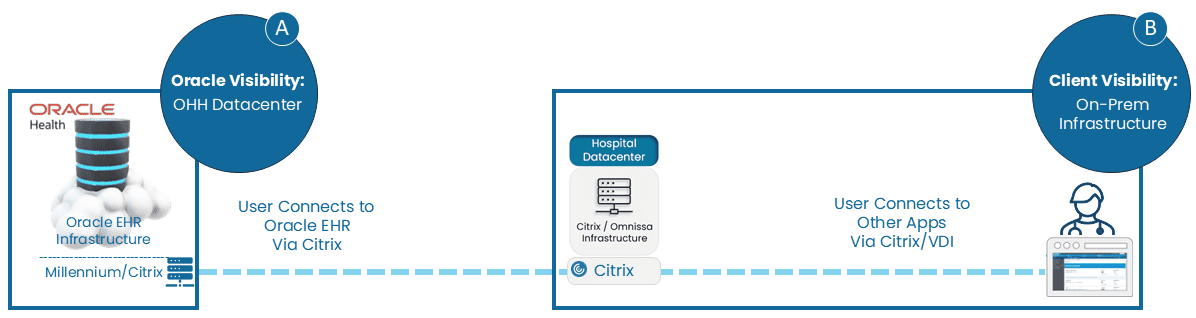
The challenge with Oracle clients is always the same: limited and siloed visibility compounded with missing data. The image below describes the limited visibility well. Oracle only has visibility to the edge of the data center (A). The client’s view is restricted to their infrastructure on premises (B). This challenge is a byproduct of cloud architecture and is common with most hosted applications. There are great benefits to this type of architecture, especially for health systems with the inherent resource constraints faced by health IT. However, additional technology is required to accentuate the benefits and close the visibility gap.

Limited And Siloed Visibility

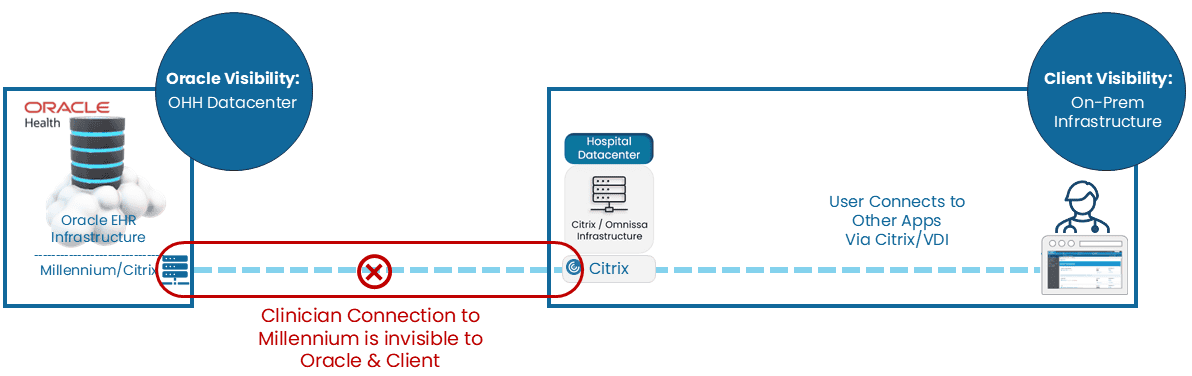
You have two teams trying to resolve clinician experience issues, but each is working from different performance data. Crucially, neither has access to the missing dataset: the clinician’s actual experience as they connect to Oracle EHR/Cerner Millennium, as shown in the image below.

Limited And Siloed Visibility Clinician Connection
This connection is essential: it carries all clinician–application traffic, and when properly analyzed, reveals rich telemetry on clinician experience, including frequency, duration, and likely root causes. Goliath provides a purpose-built solution that delivers this insight.

Beyond the technical challenges is the need to understand the true scope of the issues and act on meaningful data. Standard methods for gauging clinician satisfaction make this nearly impossible. Surveys, feedback, and ticket volumes produce only 10%–25% response rates, and human descriptions of EHR speed and reliability like “slow”, “unavailable”, etc., are too vague to drive action. Ticket volumes are equally misleading; clinicians rarely submit tickets, certainly not more than once, even as frustration grows.

Solution: digital problems require digital answers

The foundation of the challenges formed the basis of our solution. Clinician speed and reliability issues with Oracle are digital issues. There is a footprint, literal documentation of who, where, when, and why every time a clinician attempts to initiate a connection to Oracle Health EHR. We used proprietary and purpose-built technology to:

  • Resolve the siloed visibility gap, so both Oracle and the client had the same end-to-end visibility data (within 48 hours).
  • Quantify the number of clinicians experiencing speed and reliability issues, frequency, duration, and possible root cause.
  • Work with Oracle, IT, and clinical teams to isolate and remediate the root cause of clinician experience issues.

Reading the report

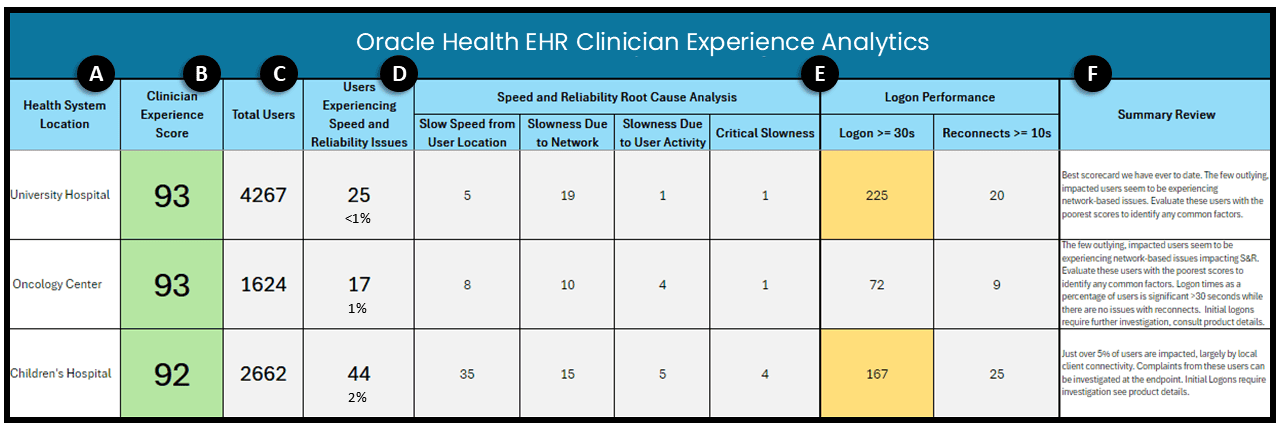
An example of one report we commonly use is below. The letters match the columns in the table.

  1. Hospital or clinic location
  2. Clinician experience score
  3. Total number of clinicians
  4. Number experiencing issues
  5. Root cause analysis, which shows why issues are occurring
    • User location
    • Network
    • User behavior
    • Critical slowness
    • Logon timing
  6. Summary analysis and remediation actions
Oracle Health Clinician Experience Analytics

Working closely with the local IT teams across the three children’s hospitals, we determined that most issues originated on the client side, not in the Oracle-hosted environment.

Many of these issues were simple to fix but completely invisible without the right technology. Remediation included:

  • Rebooting Wi-Fi devices at clinics
  • Replacing laptops
  • Replacing routers and local network equipment
  • Increasing bandwidth at remote clinics
  • Upgrading home broadband packages for clinicians
  • Increasing on-prem server resources

Ongoing clinician experience management

Reactions from Oracle and client teams were extremely positive. Most said that having this level of data years earlier would have enabled proactive identification and resolution of clinician experience issues.

Going forward, the report above is automatically generated and distributed to clinical and IT leadership, as well as select vendors. Two health systems have already formed cross-functional tiger teams that meet bi-monthly to address proactive measures and prevent future issues. In all three cases, clinical executives are using this data to communicate more effectively with clinicians.

If you’re experiencing end-user issues with your clinical or business applications, let’s talk. We identify and fix highly specific problems, and in a brief discovery call we’ll tell you whether we can help. If the issues fall outside our scope, we’ll let you know that too.

To talk with a healthcare IT consultant, email techinfo@goliathtechnologies.com.

About Goliath Technologies

Goliath helps ensure EHR speed and reliability for 25 million care interactions annually by providing at-the-elbow digital experience insights for 100% of clinicians without the need for self-reporting. Purpose-built for Epic, Oracle Health, and Meditech, Goliath provides the data that clinical and IT leaders use to understand EHR speed and reliability issues and implement fact-based initiatives to improve clinician experience.

How They Did IT  Epic Health System  Measured, Benchmarked & Reduced Epic Hyperdrive Clinician Logon Times by 50%

Oracle Health Was Slow – They Improved Performance 17% by Fixing the Real Problem

How They Did IT

Oracle Health Was Slow – They Improved Performance 17% by Fixing the Real Problem

A large non-profit health system in the Western United States, serving a broad geographic region through more than 28 hospitals and 300 outpatient clinics, was facing growing concerns around Oracle Health Millennium speed and reliability. Clinician feedback and third-party benchmarking confirmed what leadership already suspected: performance issues were impacting daily workflows and patient-facing care delivery.

To address this, the organization engaged Goliath’s accelerated 45-day EHR Speed & Reliability Improvement Program with a clear objective – move beyond perception-based feedback and establish an objective, data-driven foundation for performance improvement.

Want to learn more? Request to speak with a healthcare IT consultant.

For those who want the results up front, here’s how the project leader summarized the impact:

“In a matter of one week we were able to review data about the daily experience of our clinicians when using Millennium. It was truly amazing to have hard facts about which clinicians were experiencing issues, what time of day, at which locations, and how performance changed based on what they were doing within the application. In some cases, we found problems we didn’t know existed, and in others we confirmed long-standing suspicions. Once we had objective facts, clinical and IT teams could finally partner around a common set of data – and we did.”

Challenge

The health system had recently participated in a KLAS Research clinician survey, which revealed poor satisfaction scores related to EHR speed and reliability. While the survey validated that a problem existed, it did not provide the operational detail required to resolve it.

Two priorities immediately emerged.

The first was establishing visibility into the true scope of performance issues across the organization. Surveys rely on voluntary participation and subjective perception. In contrast, Goliath captures empirical experience data directly from clinician sessions, requiring no user interaction or self-reporting. This resulted in a complete dataset representing the experience of 100% of users, not just the small subset motivated to respond to a survey.

The second priority was turning that data into action. When it comes to EHR performance, human feedback can identify frustration, but it cannot pinpoint technical root causes. Clinicians can report that a system is “slow” or “unavailable,” but performance degradation caused by infrastructure, virtualization, network conditions, or endpoint constraints requires technical instrumentation to diagnose. By combining KLAS survey feedback with Goliath’s experience analytics, the organization gained both validation of the problem and the operational intelligence required to fix it.

Solution

Goliath worked closely with both the Oracle Health hosting team and the health system’s internal IT organization to deploy Goliath Monitoring and Troubleshooting Analytics. The technical deployment required approximately four hours and consisted primarily of coordination between teams.

Once deployed, Goliath’s embedded intelligence, automation, and AI-driven analytics immediately began collecting and correlating performance data across the EHR delivery stack. This included session performance, application responsiveness, authentication workflows, infrastructure dependencies, and end-user experience metrics. The platform automatically identified abnormal patterns and surfaced performance bottlenecks in a format that enabled immediate remediation.

The result was improved visibility and operational clarity.

Finding the Root Cause

One example from the engagement highlights why experience-level analytics matter.

Several clinicians at a remote outpatient clinic were consistently reporting slow Millennium performance. The network team confirmed that available bandwidth to the site was well within acceptable thresholds. Oracle Health support also verified that no performance issues were present within the hosted Millennium environment. On the surface, there appeared to be no clear explanation for the degradation.

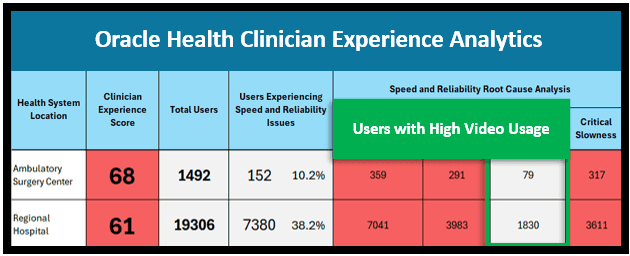
Using Goliath’s clinician experience analytics, the team performed deeper session-level analysis. The data revealed that clinicians experiencing performance issues were consistently using video-based applications alongside Millennium workflows. At the same time, Goliath identified increased end-user network latency impacting those specific sessions.

This was not the type of latency typically captured by traditional network monitoring tools. While total site bandwidth was sufficient, individual clinician sessions were experiencing contention that directly impacted application responsiveness. Without end-user experience telemetry, this condition would have remained invisible, continuing to create performance degradation while appearing “healthy” at the infrastructure level.

Here, you see that the clinicians who are experiencing the most slowness are also using video at the time of the performance degradation.

Oracle Health Clinician Experience Analytics High Video Usage

Discussions with the application team revealed that the application had recently been upgraded and the clinicians were making heavy use of video, so the network settings that prioritize user traffic were no longer adequate after the upgrade. This is a common issue we see often that is impossible to see without specialized software but relatively quick and easy to fix.

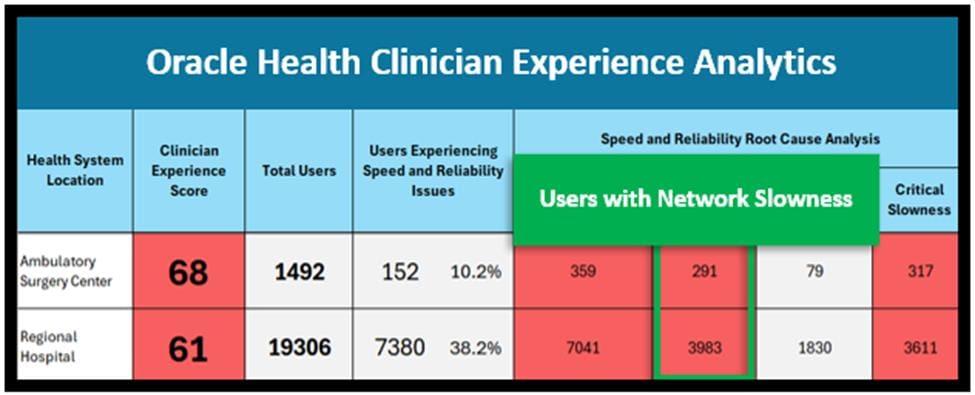
The root cause investigation conclusion, again, not available through other means, is clear. There isn’t enough bandwidth allocated to Citrix users at this site to accommodate the application.

The image below shows a direct correlation between application usage (video) and network bandwidth to those user sessions for clinicians who are experiencing the most slowness.
Oracle Health Clinician Experience Analytics Network Slowness

Armed with this insight, the IT team was able to implement targeted remediation strategies that addressed the real bottleneck instead of continuing to troubleshoot the EHR application itself.

The IT team was able to adjust the network settings and upgrade some of the network gear on site to improve performance. This is one example of the improvements we made as part of our EHR performance improvement program.

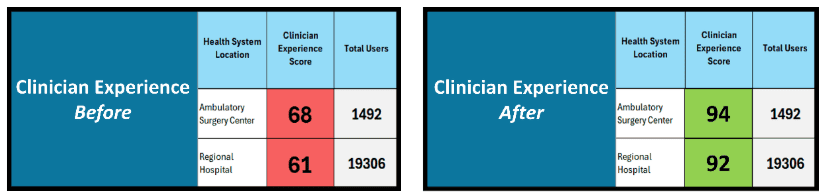
Here, we see that overall, we improved the clinician experience score from a low 61% to a high 94%, with contributing variables improving by even more.
Clinician Experience Before and After

Proof in the Data: Clinician Experience Scores Before and After

By combining clinician experience analytics with coordinated remediation efforts across IT, network operations, and Oracle hosting teams, the health system achieved measurable improvements in Millennium performance.

Within the program window, the organization realized a 17% increase in its Oracle Health EHR Speed & Reliability Score across all locations. More importantly, clinicians experienced faster access to the EHR, fewer workflow interruptions, and reduced performance-related frustration at the point of care.

The impact of the remediation effort is clearly reflected in the clinician experience data shown above. The “before” image highlights widespread performance degradation, with elevated latency and reliability issues impacting a significant portion of Millennium users. After targeted remediation actions were implemented, the “after” image shows a measurable improvement in overall experience scores, with fewer degraded sessions, faster response times, and improved consistency across clinical locations. This side-by-side comparison provides objective proof that focusing on the true root cause rather than surface-level symptoms delivered meaningful performance gains for clinicians at the point of care.

If you are having end user experience issues with your clinical or business applications, reach out and let’s discuss. We find and fix very specific issues and in a discovery conversation we will let you know if we can assist. If the issues you are experiencing are outside our purview, we will share that as well.

If you would like to discuss, reach out to techinfo@goliathtechnologies.com or request to speak with a healthcare IT consultant.