Oracle Health EHR Is Slow? Data Reveals the True Bottleneck

Oracle Health EHR Is Slow? Data Reveals the True Bottleneck

Oracle Health EHR Is Slow? Data Reveals the True Bottleneck

When Oracle Health EHR Is Slow: What the Data Reveals About the True Bottleneck​

By Thomas Charlton, Goliath Technologies


When Oracle Health EHR is slow, clinicians often assume the bottleneck is the application vendor. In reality, the data often shows the root cause sits in the client-side ecosystem – network, virtualization, endpoints, or session performance – well before Oracle’s hosted environment.

“Goliath offers great observability by giving us objective measurement of clinician satisfaction with Millennium and the analytics to foster a productive, data-driven dialogue between our IT staff and Oracle to resolve issues.”

– Jamey Pennington, CIO, Southwell Health


The Perception: Oracle Health EHR is the Root Cause of Performance Issues

Oracle Heath EHR Children Hospital Network Slowness V2

NOT SO FAST!


The Reality: A Complex IT Ecosystem


In truth, performance issues are rarely that straightforward. As illustrated below, there are multiple IT infrastructure elements, applications, and other variables between the clinician and the EHR application.


Oracle Heath EHR Reality
Over the last decade, we’ve participated in numerous Incident Response Calls (IRCs) and troubleshooting sessions with Oracle Health EHR clients. From these experiences, three key takeaways stand out:

1. Most speed & reliability issues attributed to Oracle Health EHR originate on the client side.

2. Clients lack the necessary data to identify and isolate these client-side issues.

3. With the right data, clients can resolve issues faster—without escalating to Oracle.

Why Oracle’s Hosting Isn’t Usually the Issue

Oracle Health EHR operates in a highly controlled, well-managed hosting environment with robust performance monitoring. It has been our experience, when attempting to resolve speed and reliability issues, that the client doesn’t have the same visibility into their IT infrastructure and end users as Oracle does, so there isn’t a common set of facts upon which to build a resolution plan. Oracle has very complete performance data, while the client has limited insight into the IT elements and many variables that can impact clinician experience. This incomplete picture on the client side results in many hours of wasted time attempting to isolate the root cause of issues.

Having the Right Data Matters

In an Oracle Health hosted environment, accurately isolating the root cause of clinician experience issues requires access to the right operational and experiential data — not assumptions or self-reported feedback. Because Oracle hosts and manages the core infrastructure, most traditional IT monitoring tools lack visibility into what clinicians actually experience at the point of care. Through Goliath’s exclusive access to Oracle-approved clinician experience and performance telemetry, healthcare organizations gain objective, real-time insight into session performance, application responsiveness, and end-user experience. This unique data foundation enables IT and clinical leadership to quickly differentiate between EHR application issues, network latency, virtualization performance, and endpoint constraints – dramatically reducing troubleshooting time and allowing teams to focus remediation efforts where they will have the greatest clinical impact.

Here is an example from an actual health system we worked with recently on a project to improve speed and reliability.


Oracle Heath EHR Perception
Troubleshooting any hosted application is complex, but without the right performance data, it becomes nearly impossible. This is where end-user experience analytics make a difference.

While we don’t claim that Goliath Technologies is the answer to every issue, we do provide a unique level of visibility that Oracle Health EHR clients simply don’t have elsewhere. With our technology, you can:

· See exactly which clinicians are experiencing performance issues.

· Identify issue frequency, duration, and likely root cause.

· Eliminate guesswork and reduce reliance on clinician self-reporting.

If you would like to discuss further, reach out to techinfo@goliathtechnologies.com or learn about the Goliath EHR Speed & Reliability Improvement Program.

Ryan Oliver

Thomas Charlton

Thomas is Founder and CEO of Goliath Technologies.

At-the-Elbow: Executive Insights with Dr. Brian Patty, Former CMIO Rush Medical Center

At-the-Elbow: Executive Insights with Dr. Brian Patty, Former CMIO Rush Medical Center

At-the-Elbow: Executive Insights with Dr. Brian Patty, Former CMIO Rush Medical Center

At-the-Elbow: Executive Insights with Dr. Brian Patty, Former CMIO Rush Medical Center

By Thomas Charlton, CEO Goliath Technologies


How Cross-Functional Alignment between Clinical and IT Teams Improved Clinician EHR Experience and How New Data is Creating Opportunities for Transformational Change.


Thomas Charlton:

Dr. Patty, thanks for joining us for At-the-Elbow. When clinicians first raised concerns about EHR speed and reliability during your time at Rush, what were they most frustrated by?


Dr. Brian Patty:

What I consistently heard from clinicians was frustration with logon times and screen lag. Some were waiting over a minute just to log in, and once inside the system, they experienced pauses, connectivity issues, and sluggish response times. The problem was that the feedback was often vague. Clinicians couldn’t always remember what device they were using, where they were located, or what part of the workflow triggered the issue.

When I brought these concerns to IT, I often heard, “Everything looks fine on our end.” That created a huge disconnect. Physicians were clearly struggling, but we lacked objective data to explain what was actually happening from the clinician’s perspective. We could give incidental observation at best but I always thought that somehow we should know what clinicians were experiencing because they were all connected to the network so there must be some sort of digital footprint. I was just not able to get this data.


Thomas Charlton:

Without access to real experience data at the time, how did you bridge that gap between clinician frustration and IT visibility?


Dr. Brian Patty:

Honestly, the only way we could do it was by physically going into clinical areas and watching clinicians work “at-the-elbow”. I would walk the floors with IT leaders, stand behind physicians, and observe what they were experiencing in real time.

Those “at-the-elbow” moments were eye-opening. IT teams would say, “Wow, that’s actually happening?” Seeing the delays firsthand finally made the problem real. But it was manual, time-consuming, and inefficient. We were essentially doing time-and-motion studies just to understand basic performance issues.


Thomas Charlton:

What were the biggest challenges in turning those observations into action?


Dr. Brian Patty:

One of the biggest challenges was organizational silos. You had the network team, Citrix team, and desktop team all looking at their own dashboards and saying everything appeared normal from their perspective. No one was looking holistically across the full delivery chain.

It took bringing in a new CIO who was willing to step back and say, “We need to look at this end-to-end from how the EHR is delivered to what the clinician actually experiences.” Once leadership aligned on that mindset and teams started collaborating across boundaries, we were finally able to dig into root causes.

The payoff was significant. We reduced login times from over a minute down to about five seconds. We eliminated lag and freezing issues. But getting there required enormous effort because we didn’t have the kind of experience-level visibility that exists today.


Thomas Charlton:

You often talk about evidence-based practice in medicine. How does that apply to digital experience and IT operations?


Dr. Brian Patty:

It applies exactly the same way. Whether I’m practicing medicine or serving as a CMIO, I want data. I want evidence. The KLAS Arch Collaborative survey gave us strong benchmark data on clinician satisfaction, which was incredibly valuable.

But surveys alone don’t tell you where problems are occurring, who is affected, how often it’s happening, or what’s causing it. That’s what was missing.

What excites me about tools like Goliath is that they finally provide that missing foundation. You can actually see what clinicians experience – where it’s happening, when it’s happening, and why. Instead of chasing symptoms, IT and clinical leaders can work from the same set of facts and make targeted improvements that actually move the needle.


Thomas Charlton:

That alignment between clinical and IT leadership is really what “At-the-Elbow” is all about.


Dr. Brian Patty:

Exactly. When both sides are working from the same objective data, the conversation changes. It stops being about opinions and frustration and starts being about action. That’s how you improve clinician experience, reduce burnout, and ultimately deliver better patient care.


If you would like to discuss further, reach out to techinfo@goliathtechnologies.com or learn about the Goliath EHR Speed & Reliability Improvement Program.

Ryan Oliver

Thomas Charlton

Thomas is Founder and CEO of Goliath Technologies.

How They Did IT: 3 Children’s Hospitals Find & Fix Chronic Oracle Health EHR Speed Issues

How They Did IT: 3 Children’s Hospitals Find & Fix Chronic Oracle Health EHR Speed Issues

3 Children’s Hospitals Find & Fix Chronic Oracle Health EHR Speed Issues

3 Children’s Hospitals Find & Fix Chronic Oracle Health EHR Speed Issues

By Thomas Charlton, Goliath Technologies


Three Children’s Hospitals from different geographic regions in the US were reporting chronic slowness issues with Oracle Health EHR, formerly Cerner Millennium. They exhausted all standard methods of resolving these issues through Oracle, consultants, and internal IT teams using data from multiple tools. In two cases, the Children’s Hospitals had measured with KLAS Research, whose surveys confirmed the frustration expressed by clinicians displeased with the EHRs response time.

In one case, substantial financial resources were deployed to upgrade networks, add server resources, and implement other remediation actions. No positive improvement in speed and reliability had been realized by the clinicians.

The teams at these health systems, both clinical and IT, were positively engaged in arriving at a solution, as were the account teams from Oracle. The collaboration and teamwork were fantastic, but the solution remained elusive. We were then engaged to assist in finding the cause of the EHR speed and reliability issues.

For the result without further reading, our clients’ comments describe it well:

“In 48 hours, we were able to isolate the root cause of problems that have plagued us for months. And, we now also understand the scope of the issues, which were not as widespread as we thought. We should have had this data years ago” – CTO

“Now, without being physically present, I can understand what clinicians are experiencing as if I were at the elbow. And, on 100% of my clinicians, whenever I need the data.” – CMIO

“I blamed these speed issues on Oracle, but the data clearly shows they are a result of our on-premises infrastructure and not Oracle.” – Director of IT   

Challenge

The challenge with Oracle clients is always the same – limited and siloed visibility compounded with missing data. The image below describes the limited visibility well. Oracle only has visibility to the edge of the data center (A).  The client’s view is restricted to their infrastructure on premises (B). This challenge is a byproduct of cloud architecture and is common with most hosted applications. There are great benefits to this type of architecture, especially for health systems with the inherent resource constraints faced by health IT. However, additional technology is required to accentuate the benefits and close the visibility gap.

Oracle Siloed Visibility

You have two teams trying to resolve clinician experience issues, but each are working from different performance data. Crucially, neither has access to the missing dataset: the clinician’s actual experience as they connect to Oracle EHR/Cerner Millennium, as shown in the image below.

Oracle Visibility Gap

This connection is essential: it carries all clinician–application traffic, and when properly analyzed, reveals rich telemetry on clinician experience, including frequency, duration, and likely root causes. Goliath provides a purpose-built solution that delivers this insight.

Beyond the technical challenges is the need to understand the true scope of the issues and act on meaningful data. Standard methods for gauging clinician satisfaction make this nearly impossible. Surveys, feedback, and ticket volumes produce only 10%-25% response rates, and human descriptions of EHR speed and reliability like, “slow”, “unavailable”, etc., are too vague to drive action. Ticket volumes are equally misleading; clinicians rarely submit tickets, certainly not more than once, even as frustration grows.

Solution- Digital Problems Require Digital Answers  

The foundation of the challenges formed the basis of our solution. Clinician speed and reliability issues with Oracle are digital issues. There is a footprint, literal documentation of who, where, when, and why every time a clinician attempts to initiate a connection to Oracle Health EHR. We used proprietary and purpose-built technology to:

  • Resolve the siloed visibility gap, so both Oracle and the client had the same end-to-end visibility data (within 48 hours).
  • Quantify the number of clinicians experiencing speed and reliability issues, frequency, duration, and possible root cause.
  • Work with Oracle, IT, and Clinical teams to isolate and remediate the root cause of clinician experience issues.

An example of one report we commonly use is below. Here you can see

A) Hospital or clinic location

B) Clinician experience score

C) Total number of clinicians

D) Numer experiencing issues

E) Root Cause Analysis which shows why issues are occurring

    • User location
    • Network
    • User behavior
    • Critical slowness
    • Logon timing

F) Summary analysis and remediation actions

Oracle Clinician Experience Analytics

Working closely with the local IT teams across the three Children’s Hospitals, we determined that most issues originated on the client side – not in the Oracle-hosted environment.

Many of these issues were simple to fix but completely invisible without the right technology. Remediation included:

  • Rebooting Wi-Fi devices at clinics
  • Replacing laptops
  • Replacing routers and local network equipment
  • Increasing bandwidth at remote clinics
  • Upgrading home broadband packages for clinicians
  • Increasing on-prem server resources


Ongoing Clinician Experience Management

Reactions from Oracle and client teams were extremely positive. Most expressed having this level of data years earlier would have enabled proactive identification and resolution of clinician-experience issues.

Going forward, the report above is automatically generated and distributed to Clinical and IT leadership, as well as select vendors. Two health systems have already formed cross-functional tiger teams that meet bi-monthly to address proactive measures and prevent future issues. In all three cases, clinical executives are using this data to communicate more effectively with clinicians.


If you’re experiencing end-user issues with your clinical or business applications, let’s talk. We identify and fix highly specific problems, and in a brief discovery call we’ll tell you whether we can help. If the issues fall outside our scope, we’ll let you know that too.

Learn more about our EHR Speed & Reliability Improvement Program.

Feel free to email the author at charlton@goliathtechnologies.com with any questions or comments. 


About Goliath Technologies

Goliath helps ensure EHR speed & reliability for 25 million care interactions annually by providing at-the-elbow digital experience insights for 100% of clinicians without the need for self-reporting. Purpose-built for Epic, Oracle Health, and Meditech, Goliath provides the data that clinical and IT leaders use to understand EHR speed & reliability issues and implement fact-based initiatives to improve clinician experience.


"Ryan

Thomas Charlton

Thomas is Founder and CEO of Goliath Technologies.


Going Beyond Your KLAS Measurement: Turn EHR Experience Data into Actionable IT Conversations

Going Beyond Your KLAS Measurement: Turn EHR Experience Data into Actionable IT Conversations

Going Beyond Your KLAS Measurement: Turn EHR Experience Data into Actionable IT Conversations

Going Beyond Your KLAS Measurement: Turn EHR Experience Data into Actionable IT Conversations

By Ryan Oliver, SVP of Healthcare Solutions at Goliath Technologies

Looking at the Clinician EHR Experience 2025: State of the Industry, I wanted to reflect on their key takeaways and compare them to what we’re seeing at Goliath, where we focus deeply on EHR performance.

I may be a little biased having worked at KLAS for nearly a decade, but they do an excellent job of collecting, analyzing, and understanding human experience data to help health systems improve. Over 45% of health systems have measured clinician EHR experience through the KLAS Arch Collaborative, and many have made improvements. Notable recent gains highlighted in this report include improved user interfaces, reduced documentation time, and more collaborative, secure messaging. It’s refreshing to see this progress.

It’s no surprise, however, to see KLAS state that EHR response time remains a major challenge. They also point out that most healthcare leaders do not even realize many of their clinicians struggle with slow EHR response times.

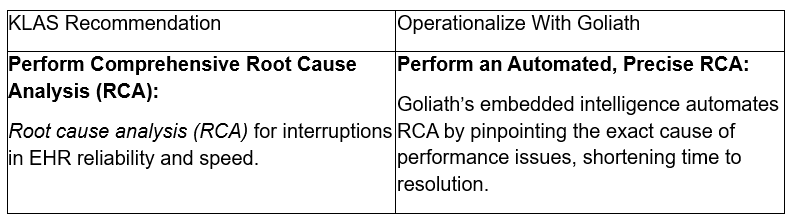
Now, in Phase 2, we focus on the next critical step recommended by KLAS: performing a comprehensive root cause analysis (RCA). While proactive monitoring tells you that something is wrong, RCA helps you understand why, so you can fix the issue at its source and prevent it from recurring.

Traditional RCA efforts can be manual, slow, and incomplete. Goliath changes that by automating the process with embedded intelligence, delivering precise insights into performance disruptions across the entire IT stack. In this article, we’ll walk through three best practices to fully operationalize RCA using Goliath.


EHR response time

The reason some areas improve while others remain problematic likely lies in the nature of human experience data. A clinician can describe why they need more training and even tell you the specific training needed. They can also tell you exactly why they have alert fatigue or what an ideal workflow should look like. As a result, this data is actionable, and we continue to see progress in those areas.

While this human experience data has been incredibly valuable, it does have its limitations. When it comes to EHR response time, it can indicate that a problem exists, but it can’t tell you how widespread it is, or why it’s happening.

You’ll never hear a clinician say they’re experiencing slowness because there are too many clients on a server, or that there needs to be more network bandwidth allocation to their location given the application they are using. You won’t see a physician launching a session and saying, “Oops, looks like we’re having another issue with the Citrix server”, or “Let’s get that SQL database issue fixed so I can log in and help this patient”. These are technical problems that require technical solutions.

 
quote

When a health system deploys Goliath’s technology, they gain immediate visibility into user experience data for 100% of their clinicians. This is data they’ve never had access to before. While the specific findings may vary, one thing is always consistent: new, actionable insights are always uncovered. Sometimes the problem is far more widespread than originally thought; other times, it’s more isolated than expected. But in every case, the data is actionable.

I remember one case where a health system spent months trying to address relentless complaints from physicians, only to discover the issue was limited to a small group of loud, but very influential, orthopedic surgeons (who would’ve thought orthopedic surgeons had complaints?). Goliath revealed that the problem stemmed from network issues at a single location. A simple fix to a problem that had previously been difficult to isolate.

In another case, a health system believed the problem was confined to a small group of physicians that had been logging complaint tickets. But after deploying Goliath, they realized they had thousands of clinicians suffering in silence. Although many had stopped complaining, there is no doubt those issues were impacting efficiency, patient care, and contributing to burnout.

You can get actionable data through human interaction and self-reporting, but not when it comes to solving technical issues. These require data that goes beyond what clinicians can tell you.

We’re looking forward to another great year supporting Arch Collaborative members and other health systems.

As a KLAS Arch Collaborative member, we provide clinician experience data that complements your Arch Collaborative insights by showing what all of your clinicians are experiencing in terms of EHR speed and reliability.

Learn more about out EHR Speed & Reliability Improvement Program.

Performing Comprehensive Root Cause Analysis for EHR Speed & Reliability

Performing Comprehensive Root Cause Analysis for EHR Speed & Reliability

Performing Comprehensive Root Cause Analysis for EHR Speed & Reliability

Performing Comprehensive Root Cause Analysis for EHR Speed & Reliability

Operationalizing KLAS EHR Speed and Reliability Recommendations


By Ryan Oliver, former Research Director at KLAS

This is the second installment in our three-part series on Operationalizing KLAS EHR Speed & Reliability Recommendations. In the article, we explored Phase 1: Proactive Monitoring – detailing how health systems are using Goliath Technologies to move beyond anecdotal reports and gain objective, real-time data about clinician EHR experience. We highlighted how Goliath helps IT teams detect hidden issues such as logon delays and system slowness, even before clinicians submit support tickets.

Now, in Phase 2, we focus on the next critical step recommended by KLAS: performing a comprehensive root cause analysis (RCA). While proactive monitoring tells you that something is wrong, RCA helps you understand why, so you can fix the issue at its source and prevent it from recurring.

Traditional RCA efforts can be manual, slow, and incomplete. Goliath changes that by automating the process with embedded intelligence, delivering precise insights into performance disruptions across the entire IT stack. In this article, we’ll walk through three best practices to fully operationalize RCA using Goliath.


KLAS Recommendation

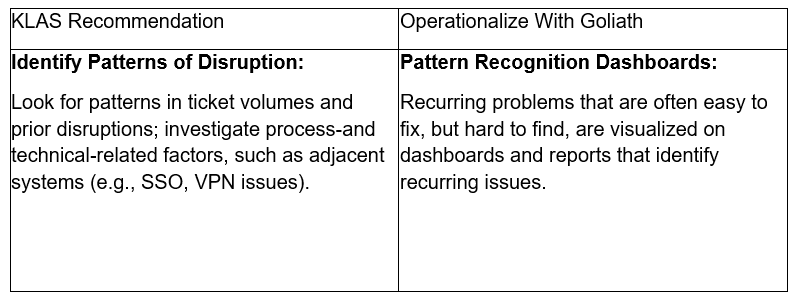
Some of the most frustrating EHR problems are intermittent, easy to fix – but hard to detect. Goliath’s pattern recognition dashboards surface trends in ticket volumes, time of day, user groups, and system interactions. These insights enable IT to stop chasing symptoms and instead eliminate systemic disruptions at their source. 


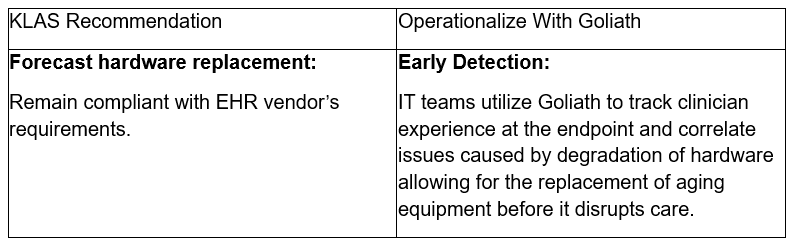
Aging or underperforming hardware can silently degrade clinician experience over time. Goliath correlates device-level performance with user experience to identify hardware issues before they disrupt care. This empowers IT teams to remain compliant with EHR vendor requirements and proactively replace equipment – preventing costly downtime and clinician frustration. 


Automating RCA to Drive Faster, Lasting Improvements

Comprehensive root cause analysis is a necessity for healthcare organizations striving to deliver fast, reliable EHR performance.  Goliath automates this process by providing a common set of facts that shows the number of clinicians being impacted, the duration of issues, and the root cause.

An example of this was published in a recent article, by Thomas Charlton, where a top 5 largest non-profit health system was facing widespread Epic Hyperdrive speed and reliability issues, with clinicians experiencing slow Citrix logon times that impacted over 37,000 users across 60 locations. The IT team struggled to pinpoint the root cause due to the use of generic unassigned accounts and intermittent issues spanning multiple health systems. Traditional support tickets did not reveal the full extent or source of the problem, delaying effective remediation.

By leveraging Goliath’s AI-enhanced contextual data and automated root cause analysis, the team identified that long Citrix “profile load” times caused the slow logons. The root cause was traced to a legacy, incorrect home folder path in Active Directory, forcing timeouts during login. After removing this obsolete path, logon times dropped by more than 50%. Furthermore, Goliath’s continuous monitoring enabled proactive alerts for future performance issues, helping the health system maintain fast, reliable Epic Hyperdrive access for all users.

By operationalizing RCA with Goliath, health systems can move from reactive firefighting to proactive performance assurance – ultimately improving clinician satisfaction, reducing support burden, and protecting patient care.

If you are having end user experience issues with your clinical or business applications reach out and let’s discuss. We find and fix very specific issues and in a discovery conversation we will let you know if we can assist. If the issues you are experiencing are outside our purview, we will share that as well.

If you want to learn more, check out our EHR Speed & Reliability Improvement Program.


How They Did IT: Identifying & Fixing The “True Root Cause” of Epic Hyperdrive Slowness

How They Did IT: Identifying & Fixing The “True Root Cause” of Epic Hyperdrive Slowness

Identifying & Fixing The “True Root Cause” of Epic Hyperdrive Slowness

Identifying & Fixing The “True Root Cause” of Epic Hyperdrive Slowness

By Thomas Charlton, Goliath Technologies


Part 2 of 2

This two-part blog post tells the story of how we engaged with the second largest nonprofit health system in the US to improve clinician experience with Epic Hyperdrive.

In the first post of this two-part series, we started the Epic Speed & Reliability Improvement Program by establishing a baseline of the clinicians’ actual experience when using Epic Hyperdrive. We use technology to collect and correlate this data across 100% of the users, so it is not a survey or in any way subjective. We are looking at the digital footprint of every clinician to frame up the size of the problems, whether loud and/or broad, isolate root cause, and determine remediation plan based on the findings.

The Analysis

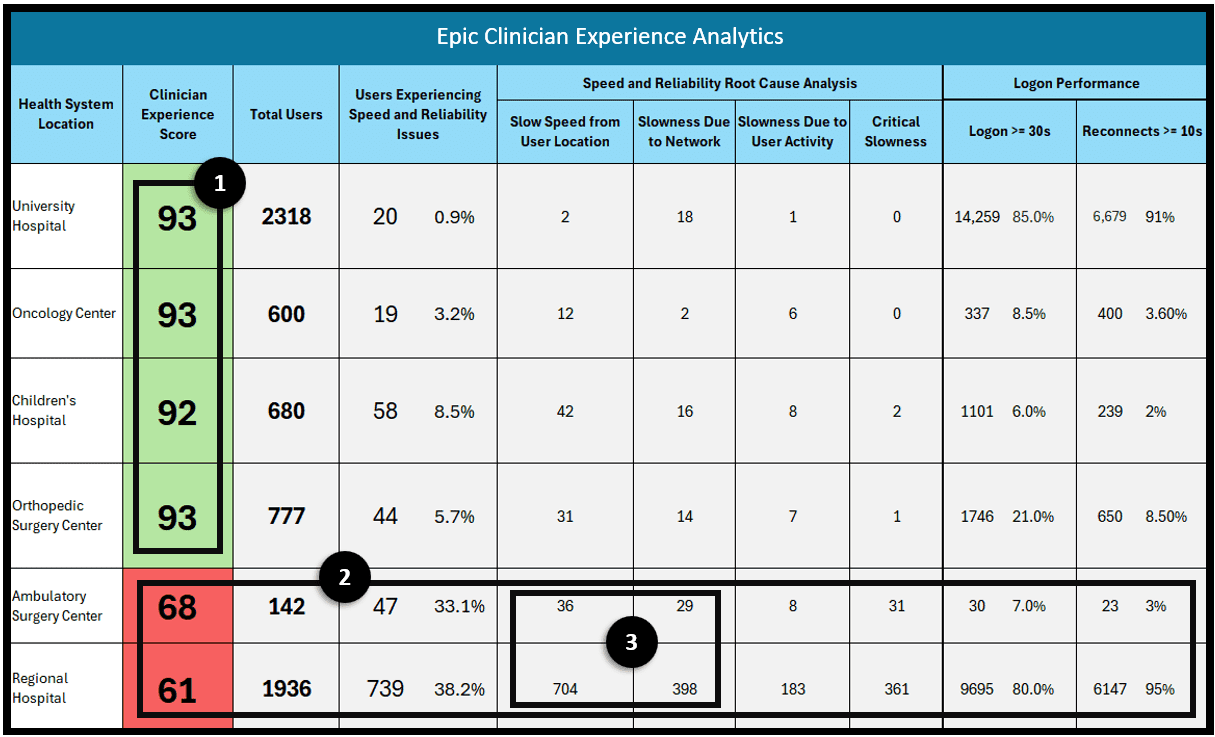
Within the first 48 hours we had our first reports across various locations that we could use for analysis. From the report in the previous post, we focused on the ambulatory surgery center and the regional hospital. We could isolate a few things very quickly:

1. In most locations the clinician experience was acceptable. The issues were isolated to an  ambulatory surgery center and regional hospital. Though this was a small number of clinicians, on a percentage basis the impact was amplified.
2. At the two locations they were experiencing a number of issues including slow logon times and latency when using the application.
3. The issues appeared to be either at the location or the connection path to the Epic Hyperdrive application. We did not think it was Epic or the immediate supporting infrastructure.


Image A: Epic Hyperdrive & Citrix Overall End User Experience Scores 

Epic EUE Summary

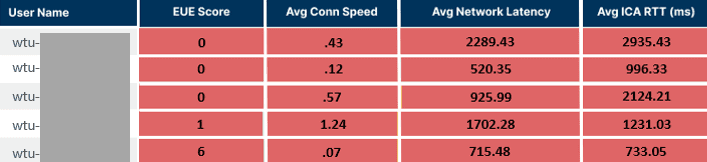
Still within the first 48 hours we consulted another, more detailed report on the users’ experience from that location. When we analyzed the data, we noticed a high correlation of user accounts that started with “wtu” which had some of the worst EUE scores (Image B below). Those accounts are auto logon accounts from Wyse Thin Clients.

Image B: Lowest End User Experience Scores for Wyse Thin Client Users

Epic EUE Summary

This is a sample of the 40k+ users included in the report. This report image shows that almost all the users experiencing slow logons and session latency were Wyse Thin Client users.

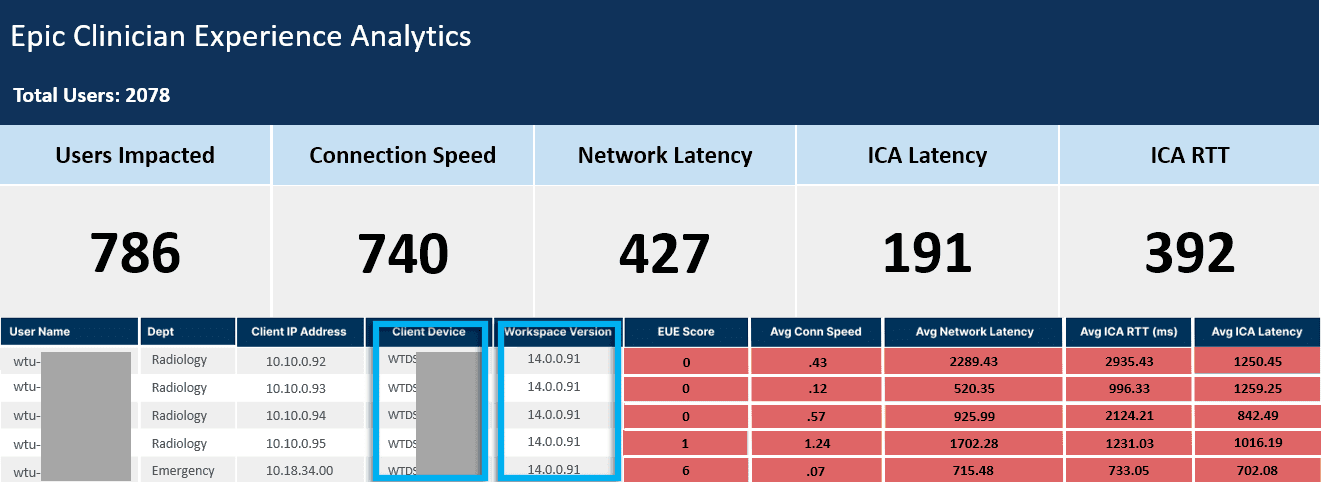
Next, we searched for some of those user accounts that had the worst scores over an extended period to put together trends and we noticed that they were running a Citrix Receiver version that was 10 versions behind and that the Wyse thin clients themselves were also old. Image C

Image C: Poor Performance Correlated Out of Date Client Versions

Epic EUE Summary

When analyzing user sessions, we confirmed consistently high latency, which was a downstream effect of having outdated versioning on Citrix and the thin client technology. These older versions cannot take advantage of the optimization technology enhancements that Citrix has delivered over the last 10 updates.

Remediation Actions

The IT department submitted change requests to update both Citrix and the old Wyse Thin Clients. There was a concerted outreach effort to upgrade the sites and users so within 60 days after the updates were made the issues were resolved. It was significant that test upgrades were made by IT to validate versioning as the root cause and the performance improvement was significant.

There are a few takeaways from this engagement that are significant to note:

  1. Overall, this Epic speed & reliability improvement engagement was initiated because of what were thought to be widespread issues. In fact, the complaints were amplified and only came from two facilities.
  2. Tremendous cost was saved as they were initially suggesting network upgrades to all sites as a potential solution. Once the size of the problems was understood, there was no need for a widespread upgrade.
  3. Within 48 hours suggested remediation actions were proposed and in 60 days chronic performance issues that had been challenging for IT and problematic for clinicians were solved at low cost.
  4. Ongoing, the IT and Clinical teams have access to data weekly that they can use to understand, isolate, and resolve clinician issues.

The Health IT Team and Goliath Performance Consultants did a great job working together to positively impact clinician experience with Epic and corresponding patient care.


If you would like to discuss further, reach out directly at techinfo@goliathtechnologies.com or the author charlton@goliathtechnologies.com


Ryan Oliver

Thomas Charlton

Thomas is Founder and CEO of Goliath Technologies.