Operationalizing KLAS EHR Speed and Reliability Recommendations

Operationalizing KLAS EHR Speed and Reliability Recommendations

Convert Insight to Action: Operationalizing KLAS EHR Speed and Reliability Recommendations

Convert Insight to Action: Operationalizing KLAS EHR Speed and Reliability Recommendations

By Ryan Oliver, former Research Director at KLAS


KLAS Research has surveyed over 500,000 clinicians from 300+ Healthcare Organizations to determine what drives a positive clinician experience with the EHR.

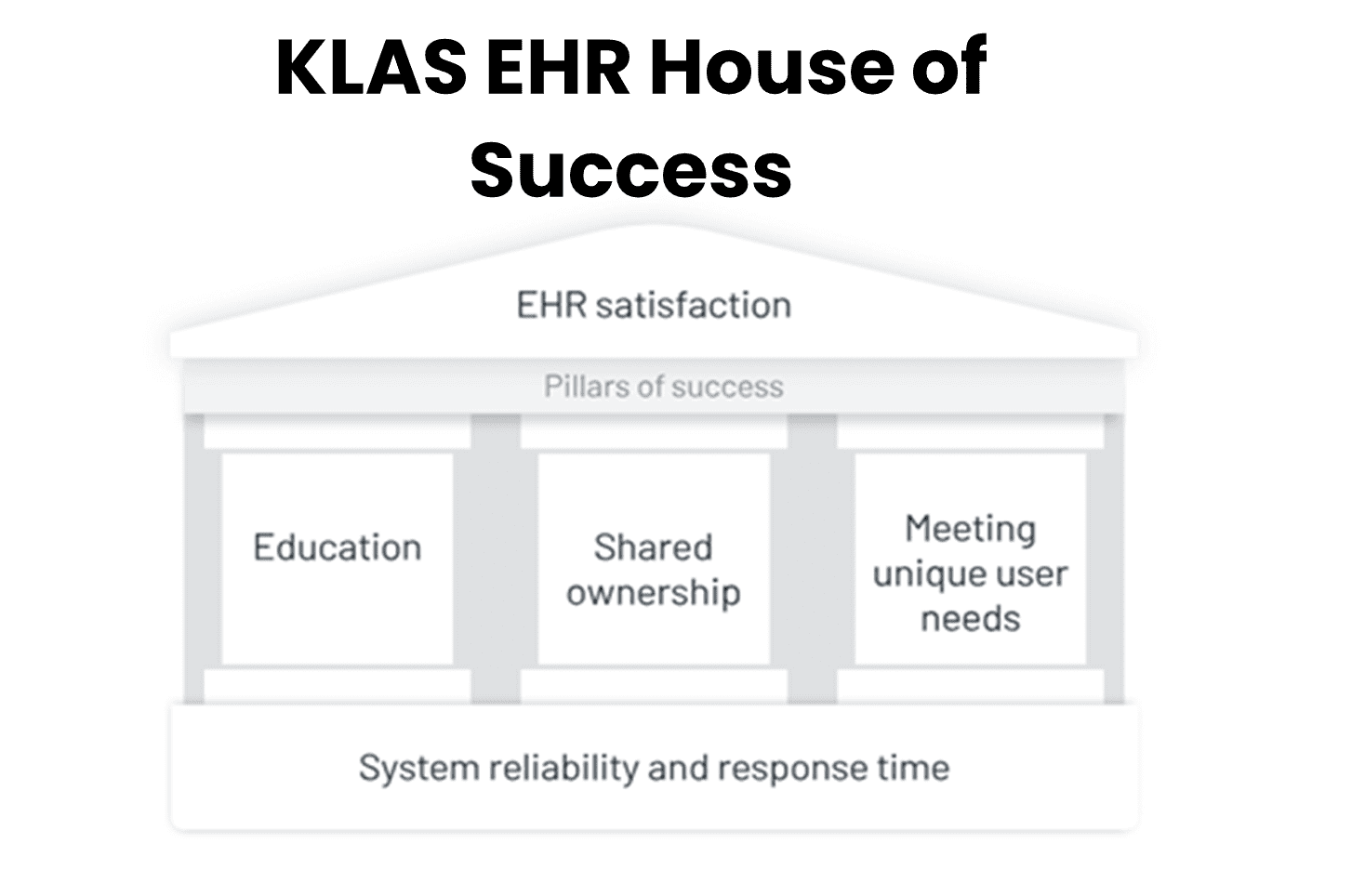
From this data set came the KLAS EHR house of success, a framework that emphasizes a strong foundation of EHR speed and reliability. The pillars of success focus on training, shared ownership, and personalization. Efforts to optimize the EHR in these areas will not yield the desired results until the foundation of speed and reliability is in place.
 

Turnover-Cost-Graphic

System Speed and Reliability issues are those that impede a clinician when they are attempting to use the EHR application. These problems often manifest as logon slowness, latency, and overall lack of responsiveness. These issues are especially frustrating and critical when they occur in a patient setting.  

KLAS Research survey measurements provide health systems with industry benchmarks as well as deep insights through personal contact and feedback. The measurement of human interaction and self-reporting provide essential data used to plan strategic optimization opportunities that improve the three pillars of success. This critical human feedback provides personal descriptions of challenges that enable KLAS Research to pinpoint the issues and corresponding remediation actions to improve clinician experience. Years of data are available that prove the impact of KLAS measurements.

When it comes to the foundational elements of speed and reliability, the challenge is the user can only describe their lived experiences and identify at a high level that something is wrong. Unfortunately, however, speed and reliability issues are inherently technical. As a result, individuals can only describe how the problem presents itself, but they don’t have the technical knowledge to even attempt a diagnosis of the underlying cause. Addressing problems with system speed and reliability requires purpose-built technology capable of delivering actionable insights into the underlying causes, enabling effective remediation.

Goliath is the only KLAS-rated solution specifically focused on improving the foundational elements of EHR speed and reliability. While the KLAS Arch Collaborative survey provides valuable clinician-reported insights, Goliath enhances this by delivering objective, technology-driven data. Our platform automatically identifies the exact number of clinicians affected by performance issues, along with the duration, frequency, and root causes, without relying on self-reporting.

This distinction is critical: because this data is captured directly from the clinician’s digital interaction with the EHR, it reflects the actual experience of all users, resulting in a complete and unbiased dataset. On-demand reporting from Goliath provides a shared set of concrete facts that both clinical and IT teams can trust. With clear evidence of problems, their scope, and underlying causes, teams can align priorities, create targeted action plans, and execute them effectively.

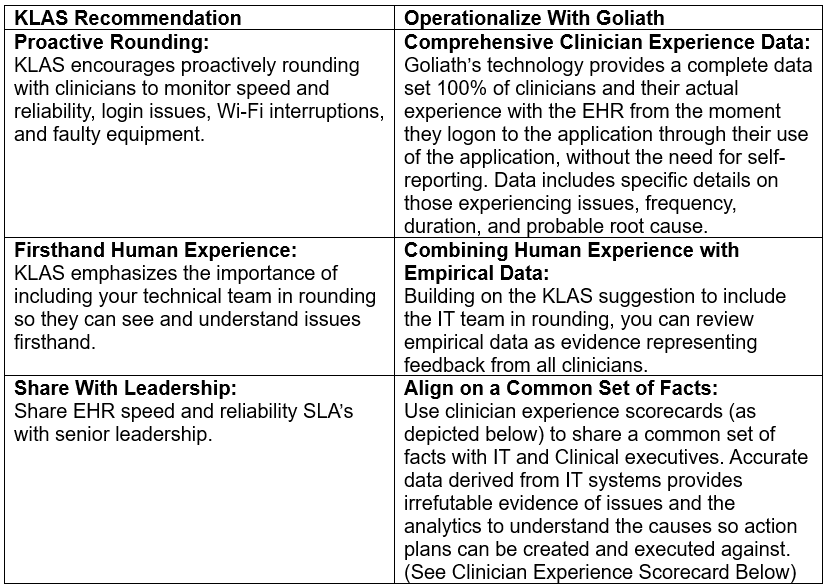
In a recent KLAS report on EHR Reliability & System Speed, Jenifer Gordon outlines four key phases for optimizing EHR performance. Goliath complements this framework by providing empirical data and automating performance insights so organizations can take deliberate and precise actions to improve issues that impact clinicians and ultimately patient care.

This blog is the first of three where we will examine the three best practices phases outlined in the KLAS report.

Phase 1 – KLAS Recommends Proactive Monitoring:
 

We have been discussing using empirical data to complement and complete the KLAS Measurement/findings. Here are two examples from different health systems. One that uses Epic Hyperdrive and the other Oracle Health EHR (Millennium).

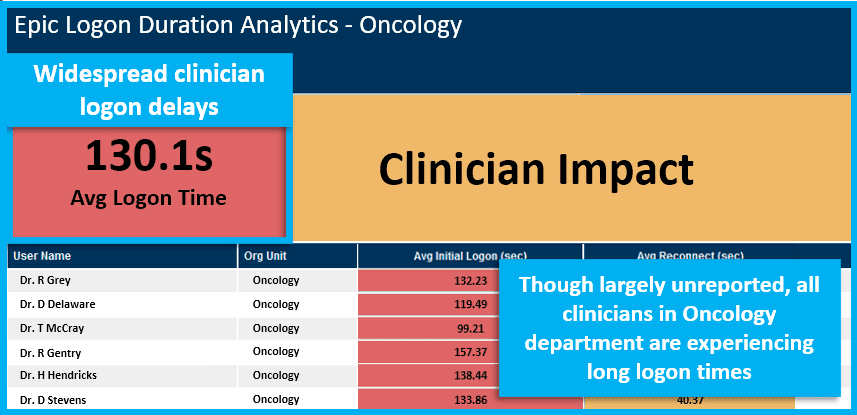
First, you see in example 1 below, a health system using Epic Hyperdrive. They received some complaints related to logon issues. Unsurprisingly, their KLAS measurement results suggested they work on improving speed and reliability. Goliath’s technology was deployed, uncovering widespread issues with logon delays, many of which had gone unreported. The scorecard also showed that clinicians in the Oncology department were experiencing the most severe problems. A quick analysis was done within the Goliath data isolating the root cause, allowing IT to quickly resolve the problem. 

Example 1: Clinician EHR Logon Analytics 
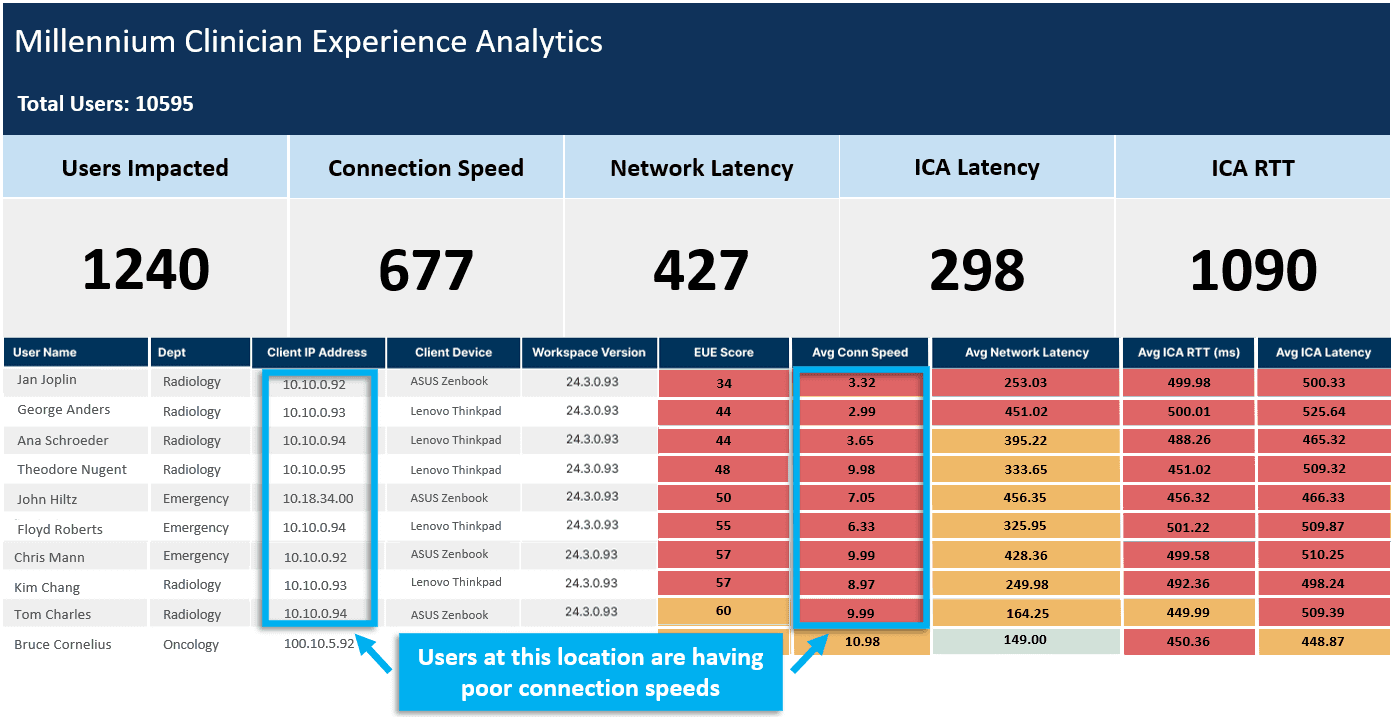
In example 2 below, this health system is using Oracle Health EHR. Their KLAS measurement results showed poor system speed and reliability issues. They utilized Goliath’s Clinician EHR Experience Analytics to run the following report. What they found was ~12% of their clinicians were experiencing speed and reliability issues, however, 9 of the 1240 impacted clinicians were experiencing issues so severe it impacted their ability to deliver patient care. They now had access to data not previously available that identified specifically which clinicians were impacted, the frequency and duration of the issue, and the root cause. This data allowed them to immediately target their remediation efforts on the location and clinicians with the most severe impact, drastically reducing mean time to remediation and potential patient impact. 

Example 2: Clinician EHR Experience Analytics
If you are having end user experience issues with your clinical or business applications reach out and let’s discuss. We find and fix very specific issues and in a discovery conversation we will let you know if we can assist. If the issues you are experiencing are outside our purview, we will share that as well. 

If you want to learn more, check out our EHR Speed & Reliability Improvement Program. 

Next Up: Automating Root Cause Analysis for EHR Performance Issues
In Phase 2, KLAS recommends performing a comprehensive root cause analysis. Our next blog will show how to automate RCA using embedded intelligence that pinpoints the exact source of performance disruptions. This accelerates resolution times and drives sustained improvements in clinician experience.

How They Did IT: Epic Hyperdrive Logon Times for Clinicians Reduced by 50%

How They Did IT: Epic Hyperdrive Logon Times for Clinicians Reduced by 50%

How They Did IT: Epic Hyperdrive Logon Times for Clinicians Reduced by 50%

Epic Hyperdrive Logon Times for Clinicians Reduced by 50%

By Thomas Charlton, Goliath Technologies

“Within the first two weeks we were able to take corrective action to dramatically improve our clinician’s logon experience. I don’t want to say actual numbers because it was so bad, but we reduced the logon times by 50% quickly, and in the next 45 days we dropped to just under 30-second initial logon times and sub-10-second reconnects.” 

– Director, System Engineering Team & Clinician Experience Lead

Want to learn more? Request to speak with a healthcare IT consultant.

The Backdrop


An acute care health system with more than 9,500 employees recently engaged in Goliath’s EHR Speed & Reliability Improvement Program to address a growing clinician frustration problem. Physicians and nurses were experiencing consistently slow logon times when accessing Epic and other critical clinical applications. The delay in launching Epic Hyperdrive was especially disruptive because it frequently occurred at the point of care, forcing clinicians to wait while patients sat in front of them. What initially appeared to be “another Epic performance issue” quickly became a broader operational concern impacting workflow efficiency, clinician satisfaction, and patient experience. Our objective was clear: isolate the true root cause as quickly as possible so remediation efforts could be targeted, measurable, and effective, allowing clinicians to stay focused on delivering care instead of fighting technology.

Challenge

The IT Incident Response Team was actively investigating multiple reports of slow logon performance when clinicians attempted to access Epic Hyperdrive. The first challenge, however, wasn’t fixing the problem, it was understanding the true scope of the issue. As anyone who has worked in healthcare IT knows, relying on self-reported feedback through support tickets or surveys only tells part of the story. Most clinicians simply work around performance issues rather than reporting them, and even when response volume is high, the data often lacks the precision needed to drive targeted remediation.

This is where quantifying digital experience fundamentally changes the troubleshooting process. Because clinician experience is digital, it can be measured objectively and continuously. By leveraging technology-enabled, empirical experience data, the team was able to move beyond anecdotal complaints and gain granular visibility within hours, not weeks. Specifically, they could immediately identify:

• Which clinicians were experiencing speed and reliability issues
• How often those issues occurred and how long they lasted
• Where the most probable root cause was occurring within the delivery stack

With this level of clarity, the investigation shifted from reactive troubleshooting to proactive diagnosis. Instead of guessing whether the problem originated in the EHR, virtualization layer, network, or endpoint environment, the team now had objective evidence to guide next steps. This allowed remediation efforts to be prioritized based on impact to patient facing workflows, ensuring that technical resources were focused where they would deliver the greatest clinical and operational return.

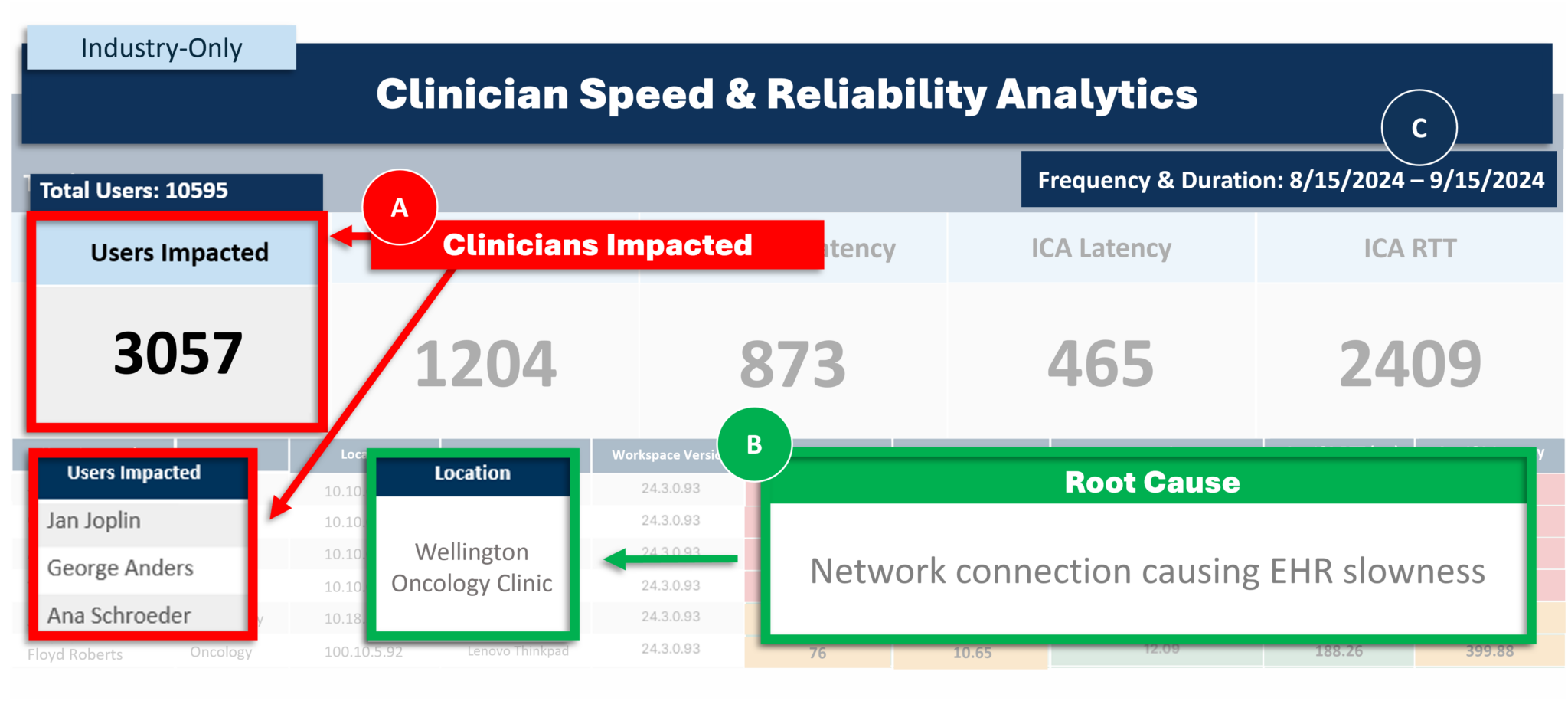
Example readout:

Clinician Speed & Reliability Analytics

A. Which clinicians are impacted
B. When and for how long
C. Likely root cause

Goliath identified a recurring pattern of failed Citrix and Epic Hyperdrive login attempts followed by successful, but consistently slow, authentication. Importantly, this behavior was not isolated to a single workstation or user group. The pattern was observed across multiple devices and locations, indicating a systemic issue rather than an endpoint specific configuration problem.

By drilling into the failed and degraded sessions, the underlying bottleneck became immediately apparent: the Citrix profile load stage was introducing excessive delay during the authentication process. This insight provided the breakthrough moment for the IT team, allowing them to pivot remediation efforts toward the true source of clinician frustration instead of continuing to troubleshoot the EHR application itself.

Even with successful Citrix logons, the profile load time was extremely high. This health system uses local profiles on Epic Citrix servers, and this step in the logon process should be completed within 1-2 seconds. Looking at the Active Directory object for that account, they found a defined home folder path that should not be there. The identified path does not exist on the network and as a result, users were forced to wait for Windows to time-out the home drive connect action before eventually being logged into their workstation, or having their Citrix delivered applications connect.

As this path was a legacy carryover from a Google Drive migration, they opened a Priority 2 ticket and then implemented an emergency change to remove the path from the Active Directory object resolving the forced timeouts and long logon times.

Additionally, this problem had been previously reported by users; however, lacking the necessary data, the team was unable to identify the root cause and put permanent fixes in place.


Clinician Experience Analytics

The results of the initial performance baseline immediately reframed the problem and sharpened the troubleshooting focus. Contrary to initial assumptions, the data made it clear that the bottleneck was not occurring inside the Epic Hyperdrive application itself. Instead, latency was introduced before clinicians ever reached their active Epic session, specifically during the connection path from the endpoint to the application delivery layer.

What made this especially challenging to detect through traditional methods was the nature of the issue. While support tickets and clinician feedback suggested isolated incidents, the empirical data revealed a much broader and more persistent pattern. The performance degradation was both intermittent and chronic, spanning two major health systems, 24 clinical locations, and impacting more than 3,000 Epic Hyperdrive users. Without objective experience analytics, this systemic issue would have continued to appear as disconnected, one-off complaints rather than a widespread operational problem.


Solution

With clear visibility into where performance degradation was occurring, the IT team leveraged Goliath’s AI-enhanced contextual analytics to isolate the true root cause of the slow logon experience. This capability correlated session behavior, infrastructure events, and user experience metrics in real time, allowing the team to move beyond symptom-level troubleshooting and focus on permanent remediation.

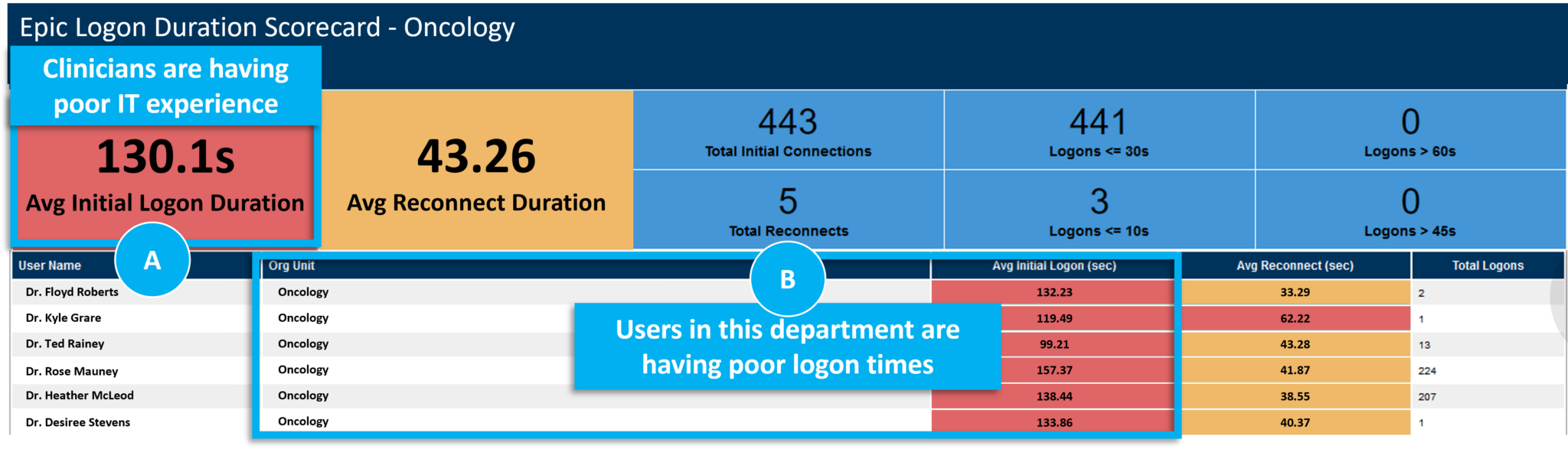
Example readout:


Epic Logon Duration Scorecard - Oncology

A. Clinicians impacted by excessive logon times
B. Location of impacted clinicians

Goliath identified a recurring pattern of failed Citrix and Epic Hyperdrive login attempts followed by successful, but consistently slow, authentication. Importantly, this behavior was not isolated to a single workstation or user group. The pattern was observed across multiple devices and locations, indicating a systemic issue rather than an endpoint specific configuration problem.

By drilling into the failed and degraded sessions, the underlying bottleneck became immediately apparent: the Citrix profile load stage was introducing excessive delay during the authentication process. This insight provided the breakthrough moment for the IT team, allowing them to pivot remediation efforts toward the true source of clinician frustration instead of continuing to troubleshoot the EHR application itself.

Even with successful Citrix logons, the profile load time was extremely high. This health system uses local profiles on Epic Citrix servers, and this step in the logon process should be completed within 1-2 seconds. Looking at the Active Directory object for that account, they found a defined home folder path that should not be there. The identified path does not exist on the network and as a result, users were forced to wait for Windows to time-out the home drive connect action before eventually being logged into their workstation, or having their Citrix delivered applications connect.

As this path was a legacy carryover from a Google Drive migration, they opened a Priority 2 ticket and then implemented an emergency change to remove the path from the Active Directory object resolving the forced timeouts and long logon times.

Additionally, this problem had been previously reported by users; however, lacking the
necessary data, the team was unable to identify the root cause and put permanent fixes in
place.


Resolution and Ongoing Proactive Management 

As the project manager mentioned in the quote at the beginning of the post, the client was able to get their logon times down to industry’s best practices standards.  

Now with the reported issues permanently resolved, the IT team wanted to ensure that they would not have these issues again and if they did occur, they wanted to be alerted by technology and not end users.  

They rely on several features for proactive alerting but one such feature is the application availability feature which will proactively log on to Epic 24/7/365 automatically and alert to any logon difficulty with corresponding data necessary to troubleshoot as is seen in the image below. Here a logon failure occurred, and the alert contained an image sent to the IT administrator with key data to enable remediation actions.  

Automated Troubleshooting Without Engaging the Users 

Profile Bloat

If you are having end user experience issues with your clinical or business applications, reach out and let’s discuss. We find and fix very specific issues and in a discovery conversation we will let you know if we can assist. If the issues you are experiencing are outside our purview, we will share that as well. If you would like to discuss, reach out to techinfo@goliathtechnologies.com or request to speak with a healthcare IT consultant.


Ryan Oliver

Thomas Charlton

Thomas is Founder and CEO of Goliath Technologies.

Physician Burnout:  Fix the Foundation First

Physician Burnout: Fix the Foundation First

Physician Burnout: Fix the Foundational Elements First

Physician Burnout: Fix the Foundational Elements First

By Ryan Oliver, former Research Director at KLAS


Efforts to reduce physician burnout and increase productivity remain a top priority for health systems. In this blog, we will explore the high cost of physician burnout, the fundamental contributing factors that are often overlooked, and how technology can be used to identify and address these issues.

Significant investments are being made in ambient speech technology and education to reduce documentation time, decrease cognitive burden, and improve overall productivity. While these efforts are valuable, it’s time to take a step back and consider all the fundamental factors contributing to burnout, beginning with the low-hanging fruit – long logon times and application slowness. According to KLAS Research, more than half of physicians still report EHR slowness and long logon times as major contributors to dissatisfaction and, ultimately, burnout. In fact, KLAS identified speed & reliability as the foundational element to clinician satisfaction with their EHR.

I recently met with a CMIO who spoke enthusiastically about reducing physician documentation time by 45 minutes per shift. At the same time, however, several physicians are complaining about spending 45 minutes per shift waiting for applications to load and logon issues.


Turnover, The High Cost of Doing Nothing

According to KLAS Research’s Clinician Turnover 2024 report, physicians report EHR inefficiency as a top contributor to burnout. Not surprisingly, burnout is highly correlated to risk of turnover. In another KLAS report, nearly 40% of physicians were found to be at risk of turnover and the cost is steep – upwards of $1M per/physician.


Turnover-Cost-Graphic

EHR Slowness and Logon Problems are Still a Major Problem 

According to KLAS Research’s EHR Response Time & Reliability 2022 report, around half of clinicians are still experiencing EHR slowness. System response time is highly correlated to overall user satisfaction, as well as other metrics including burnout and turnover. So why does the problem persist?In most cases, the root causes are difficult to identify, but relatively easy to fix.


The Difference a Few Weeks Can Make 

Just a few weeks ago, Goliath received a call from the CTO and CMIO of a leading children’s hospital. They were urgently seeking answers to a persistent EHR slowness issue that was directly impacting physician workflows, and ultimately, patient care. 


Their story was familiar: 

  • “We’re getting constant complaints from clinicians. I’ve even walked the floors and seen the delays firsthand.” 
  • “Our on-prem infrastructure checks out—no red flags.” 
  • “The EMR vendor reports no issues within the application or hosted environment.” 
  • “We’ve exhausted every angle—and we heard Goliath might be able to help.” 


After unsuccessful efforts to find the root cause, they engaged Goliath for our 60-day EHR Speed and Reliability Improvement Program with the hope they could uncover the issues in a few days and get some results for clinicians the first week. 

We deployed our technology within days – and in just 24 hours, the hospital had access to user experience reporting and performance insights they’d never seen before. The data revealed that over 140 clinicians were affected by slowness and logon delays, far exceeding acceptable thresholds. Most importantly, we identified the true root cause: issues within the hospital’s own infrastructure – not the EHR vendor. One outdated Citrix server alone was impacting nearly a dozen clinicians daily. 

By the end of the project, we expect this hospital to join the growing list of Goliath Success Stories where we helped health systems reduce downtime, improve clinician satisfaction, and enhance patient care. 

If you are having end user experience issues with your clinical or business applications reach out and let’s discuss. We find and fix very specific issues and in a discovery conversation we will let you know if we can assist. If the issues you are experiencing are outside our purview, we will share that as well. 


Improve Oracle EHR Physician Experience and Reduce MTTR

Improve Oracle EHR Physician Experience and Reduce MTTR

Improve Oracle EHR Physician Experience and Reduce MTTR

By Cory Crawford, 14 years as a Lead Integration Architect with Oracle Health 

Throughout my 14-year career at both Cerner and Oracle Health, I’ve spent countless hours on the phone with the Oracle Health IRC (Immediate Response Center). Typically, an end user reports an issue with minimal details, expecting a swift resolution. While numerous tools exist to assist in troubleshooting, logging into multiple systems to gather scattered data points is both tedious and time-consuming. 

During a demo with Goliath, I immediately recognized the value of having an all-in-one solution. From accelerating initial triage to reducing overall resolution time, Goliath streamlines the troubleshooting process in a way that traditional methods simply can’t match. 


Faster Triage, Quicker Mean Time to Resolution

When you call the IRC, a Situation Manager is your first point of contact. Their role is to assess the issue and connect you with the right resource to resolve it. 

With Goliath’s comprehensive data insights, you can provide precise, real-time information, allowing the Situation Manager to immediately page the appropriate team. This eliminates the common frustration of waiting for a resource to join the call – only for them to say, “This isn’t me; you need to page another team.” 

The Goliath Solution is unique due to the partnership they maintain with Oracle Health Hosted which allows them to deploy their technology into the hosted environment. This gives them access to data regarding end user clinician experience that is not available through other means. The technical reasoning for this deployment architecture and why it is wholly complimentary to Lights On Network will be explained in a future post or on the next webinar.    

Given the complexity of healthcare IT and the vast number of teams and subject matter experts (SMEs) at Oracle Health, having instant access to key metrics significantly improves both initial triage and overall troubleshooting. 

My Personal Experience Managing a Client Crisis

When put to use, Goliath’s Technology immediately gives end-to-end visibility from multiple Oracle Health domains to on-premises issues, all the way to the clinician’s experience at their devices. For the first time, we could quickly determine whether the issue was client side or vendor side and approach the IRC with a common set of facts. We could stop pointing fingers and build a resolution plan.  

I can recall one situation where we were informed of massive slowness issues and we were engaged along with other members of the Oracle team, health system IT department, and multiple vendors. Fortunately, we were able to run reports from Goliath on demand to help us frame up the problems.  Again, the tension was high because of all the complaints that had been registered.  

What we found was a more manageable situation. The clinician experience issues had been greatly amplified. That “over amplification” was not unusual but in this case, we were able to prove, as seen in the image below that the complaints were not from hundreds of clinicians but a few dozen and further, they were all from one location.  


With that knowledge, we were able to drill down into historical and real time data to confirm that the issues were connection speed related caused by problems with Citrix receiver versions, improperly patched routers, and downed Wi-Fi devices. Easy to fix, but impossible to find without Goliath. 

We want to fix issues no matter the root cause so clinicians can provide seamless patient care without having to overcome technical challenges. Goliath is able to deploy their technology on both the Oracle and Healthcare infrastructures so complete visibility is now achievable and consequently troubleshooting is made not only easier, but possible, which sometimes is not the case without full end-to-end visibility.

Real-Time Insights for Proactive Issue Resolution

Using Goliath while working with an Oracle Health SME provides real-time alerting, detailed troubleshooting feedback, and visibility into CPU/memory utilization to ensure domain stability. Most importantly, it enables instant confirmation of issue resolution – helping you close the loop faster and with confidence. 

By leveraging Goliath, you’re not just resolving issues more efficiently, you’re transforming how healthcare IT teams approach troubleshooting and system stability. 

If you are having end user experience issues with your clinical or business applications, reach out and let’s discuss. We find and fix very specific issues and in a discovery conversation we will let you know if we can assist. If the issues you are experiencing are outside our purview, we will share that as well. Learn more about our EHR Speed & Reliability Improvement Program. 


thomas charlton

Cory Crawford

With a background as a System Engineer, transitioning to a Lead Integration Architect, I’ve honed my skills in project management, solution support and domain strategy planning, most notably with Oracle and now at Vandalia Health. Over ten years of experience in this specialized field have equipped me to tackle complex integration challenges within the healthcare sector. At Vandalia Health, my mission is to streamline systems to improve patient outcomes, reflecting my commitment to technological excellence and patient-centric care. My approach is collaborative, ensuring that my work not only supports but also advances the organization’s goals through innovative solutions. 

Oracle Health EHR Slow? Not So Fast

Oracle Health EHR Slow? Not So Fast

Oracle Health EHR Slow? Not So Fast

Oracle Health EHR Slow? Not So Fast

By Thomas Charlton, Goliath Technologies

When clinicians experience performance issues with Oracle Health EHR, often the immediate assumption is that the problem lies with the application vendor. Many believe there is a direct, one-to-one connection between the end user and the data center where the application is hosted.  


The Perception: Oracle Health EHR is the Root Cause of Performance Issues


NOT SO FAST!

The Reality: A Complex IT Ecosystem

In truth, performance issues are rarely that straightforward. As illustrated below, there are multiple IT infrastructure elements, applications, and other variables between the clinician and the EHR application. 


Over the last decade, we’ve participated in numerous Incident Response Calls (IRCs) and troubleshooting sessions with Oracle Health EHR clients. From these experiences, three key takeaways stand out:

1. Most speed & reliability issues attributed to Oracle Health EHR originate on the client side.

2. Clients lack the necessary data to identify and isolate these client-side issues.

3. With the right data, clients can resolve issues faster—without escalating to Oracle.


Why Oracle’s Hosting Isn’t Usually the Issue

Oracle Health EHR operates in a highly controlled, well-managed hosting environment with tight controls and robust performance monitoring. It has been our experience, when attempting to resolve speed and reliability issues, the client doesn’t have the same visibility into their IT infrastructure or end users as Oracle does, so there isn’t a common set of facts upon which to build a resolution plan. Oracle has very complete performance data while the client has limited insight into the IT elements and many variables that can impact clinician experience. This incomplete picture on the client side results in many hours of wasted time attempting to isolate the root cause of issues. 
 

Having the Right Data Matters

“Goliath offers great observability by giving us objective measurement of clinician satisfaction with Millennium and the analytics to foster a productive, data-driven dialogue between our IT staff and Oracle to resolve issues.”

– Jamey Pennington, CIO, Southwell Health


Troubleshooting any hosted application is complex, but without the right performance data, it becomes nearly impossible. This is where end-user experience analytics make a difference. 

While we don’t claim that Goliath Technologies is the answer to every issue, we do provide a unique level of visibility that Oracle Health EHR clients simply don’t have elsewhere. With our technology, you can: 

  • See exactly which clinicians are experiencing performance issues. 
  • Identify issue frequency, duration, and likely root cause. 
  • Eliminate guesswork and reduce reliance on clinician self-reporting. 


If you’re contending with speed and reliability issues, feel free to reach out to me directly at charlton@goliathtechnologies.com. 


thomas charlton

Thomas Charlton

Thomas is Founder and CEO of Goliath Technologies.

50% of Health Systems: Clinicians Report EHR Speed & Reliability Issues

50% of Health Systems: Clinicians Report EHR Speed & Reliability Issues

50% of Health Systems: Clinicians Report EHR Speed & Reliability Issues

50% of Health Systems: Clinicians Report EHR Speed & Reliability Issues


By Ryan Oliver, former Research Director at KLAS

I spent almost 10 years at KLAS, and during that time, I extensively researched IT infrastructure and how speed and reliability impact clinicians’ overall experience with the EHR. When these systems lag or fail, clinician’s experience severely reduced productivity, frustration, and negative perception of IT. Of course, this dissatisfaction extends to the EHR application they see on their screen, whether it is Epic, Oracle Health EHR, or another vendor.

Despite massive investments in optimizing, enhancing, or even replacing EHRs, over 50% of health systems still struggle with speed and reliability issues. That’s a staggering statistic, considering the direct impact on provider efficiency and patient care.

Using Data to Tell the Story

Jenna Anderson, VP of Collaborative Insights at KLAS, shared eye-opening data:

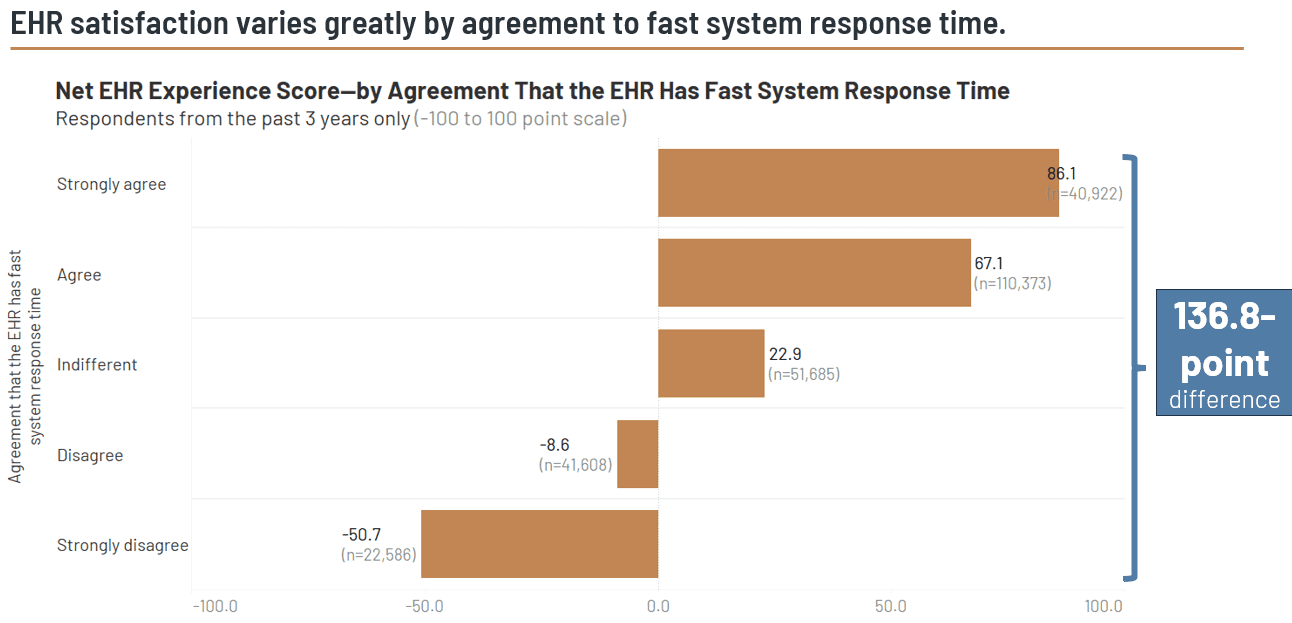
  • When physicians strongly agree that response times are adequate, their net experience score is a highly positive 86.1.
  • Out of 267,000 physicians surveyed, fewer than 41,000 strongly agree with this statement.
  • When physicians strongly disagree, the average score plummets 136.8 points to negative 50.7.

In simple terms: doctors are much happier when response times are good, but very unhappy when they aren’t. The problem is, only a small percentage (~15%) think response times are good. This leaves massive room for improvement with the right technology.


Troubleshoot Citrix remote workers


The message is clear: speed and reliability are the foundation of a positive EHR experience. These issues can always be fixed—the real challenge is finding the root cause before they disrupt workflows. 

How Goliath Helps Health Systems Fix EHR Performance Issues

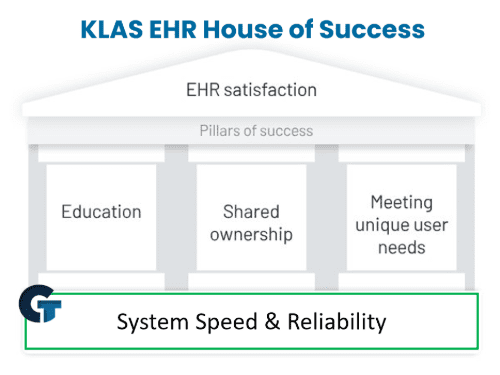
The KLAS House of Success for EHR Satisfaction shows system speed & reliability as the foundational element to improving EHR satisfaction, and Goliath Technologies is the only fully KLAS-rated solution that addresses system speed and reliability (KLAS report here).


EHR Speed and Reliability

Real-World Impact: A Top 5 Non-Profit Health System’s Success Story

One of the largest non-profit health systems leveraged Goliath to diagnose and resolve their biggest speed and reliability challenge – logon issues.

Here’s how they did it:

  • Using Goliath’s AI-enhanced contextual data, the IT team pinpointed the root cause of slow logins. The solution was deployed in less than two hours.
  • They quickly discovered that local profiles on Epic Citrix servers were causing delays, forcing users to wait for Windows to time out before logging in.
  • An emergency Active Directory change was implemented to resolve the issue.

Further: They thought the issue was isolated to only a handful of users based on the number of support tickets submitted. Goliath quickly pointed out that the issue was widespread, impacting 37K users despite being largely unreported.

Profile Load


The Result:

Logon times dropped by over 50%, allowing physicians to see more patients—or even get home for dinner on time. Read the full story here.


Fix the Foundation Before Investing in New Solutions

Over the past year, nearly every health system I’ve spoken with has either purchased or is considering ambient speech products to improve clinician efficiency. But here’s the reality: if your EHR infrastructure is slow and unreliable, physicians will still be dissatisfied—no matter what new technology you add.

You can contact the author directly at ryan.oliver@goliathtechnologies.com