Central Maine Healthcare Improves Clinician Experience with Cerner by Drastically Reducing Time to Remediation

How We Did IT

Central Maine Healthcare Improves Clinician Experience with Cerner by Drastically Reducing Time to Remediation


User Story Banner

“Every morning, I use Goliath to set the stage for my day. The software proactively monitors events, conditions, and failure points 24/7/365 to help solve end user experience issues. It even alerts me before users are impacted.”
–  Aaron Hilton, System Administrator at Central Maine Healthcare

Infrastructure

Cerner Millennium, Citrix Virtual Apps (XenApp)


Challenge

Troubleshooting Citrix Performance Issues Exhausts IT Support

“I’ve received so many tickets where I would spend hours troubleshooting four or more applications to try and find what was causing the latency when it was connection speed all along,” shares Aaron Hilton, a system administrator at Central Maine Healthcare system.  Aaron is one of the main points of contact for resolving Citrix tickets, and the lack of visibility into the Citrix delivery infrastructure caused him to be reactive instead of proactive. “It took so much time to react to complaints that I didn’t have time or data to isolate the root cause and resolve the underlying issues that were actually causing the Citrix and Cerner performance issues.” Central Maine’s IT team needed a solution that would allow them to become proactive and reduce performance issues that were causing clinician frustration.

Solution

End-to-End Visibility into Cerner & Citrix End-User Experience Improves Clinician Satisfaction

Goliath Technologies was selected by Central Maine Healthcare to give their IT team an end-to-end view from the initiation of a Cerner session, through the logon process and experience while using the application. All the data is presented based on what the user is experiencing. The traditional IT approach is to monitor the health of individual IT elements like networks, servers, storage, and the applications. This, however, offers no insights into how the IT delivery infrastructure is performing and one is left to infer that the end user is having a good experience. Unfortunately, that is often not the case and administrators are regularly surprised by complaints without the details necessary to solve the problem. Goliath approaches it from the end-user’s perspective and proactively identifies if there is slowness, for example, and then identifies which IT element is causing the issue to help pinpoint root cause. Aaron remarked, “Goliath has improved the credibility and reputation of the IT department due to the success with resolving clinician issues. In addition, other Cerner application support analysts are coming to me to get user experience data that Goliath collects.”   

Resolving “Citrix is Slow”

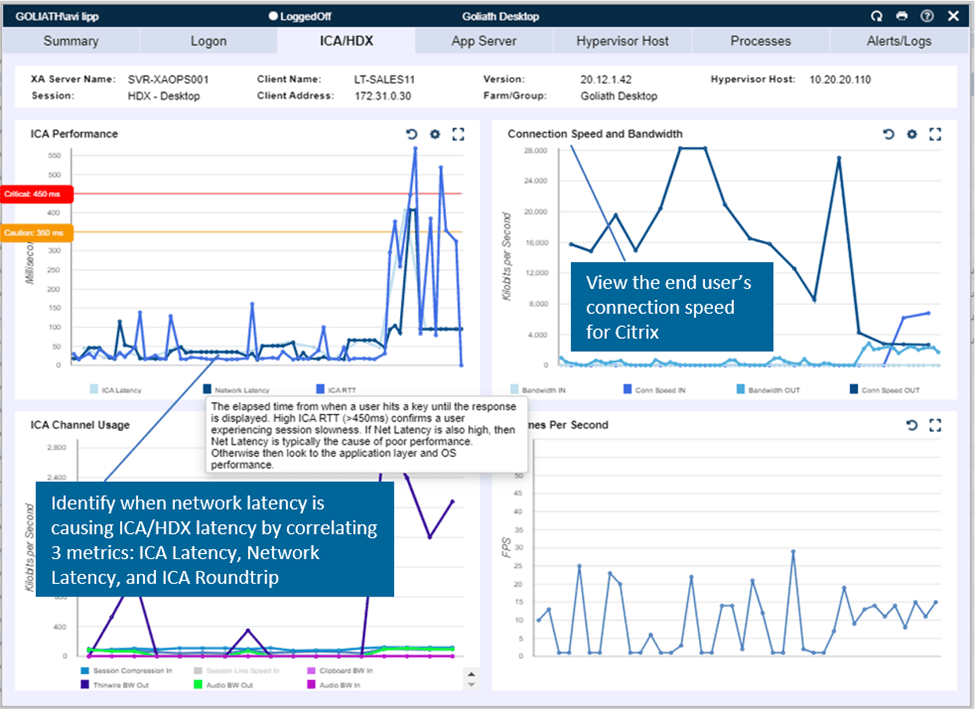
The very ambiguous “Citrix is slow” complaints have increased since the pandemic when their users went remote. With Goliath operational, Aaron and his team have been able to quickly determine if issues actually came from the Citrix or data center side, or if they were the result of the end-user’s behavior. The ability to drill all the way down into an end user’s session and analyze an array of visual proof, in real time, makes it much less challenging to convince end users that something on their end is the cause of their performance issues. 
ICAHDX

In the past, the team handled persistent issues by holding a weekly committee meeting to work together and try to remediate them. Now, with the use of Goliath’s technology, Aaron has become invaluable to his team as he has insights that not everyone else is able to see, and is even able to cut down the amount of time required for the meeting. Anyone could be in such a meeting and have a million assumptions of what the root cause is, Aaron tells us, and then everyone points their fingers to each other – “not my problem!” – puts their hands up, and passes the buck off to another team. But when you have proof of something, or good information including visual representations in the form of graphs, it gives you really fast resolution. 

Automated system notifications resolve issues before users are impacted:

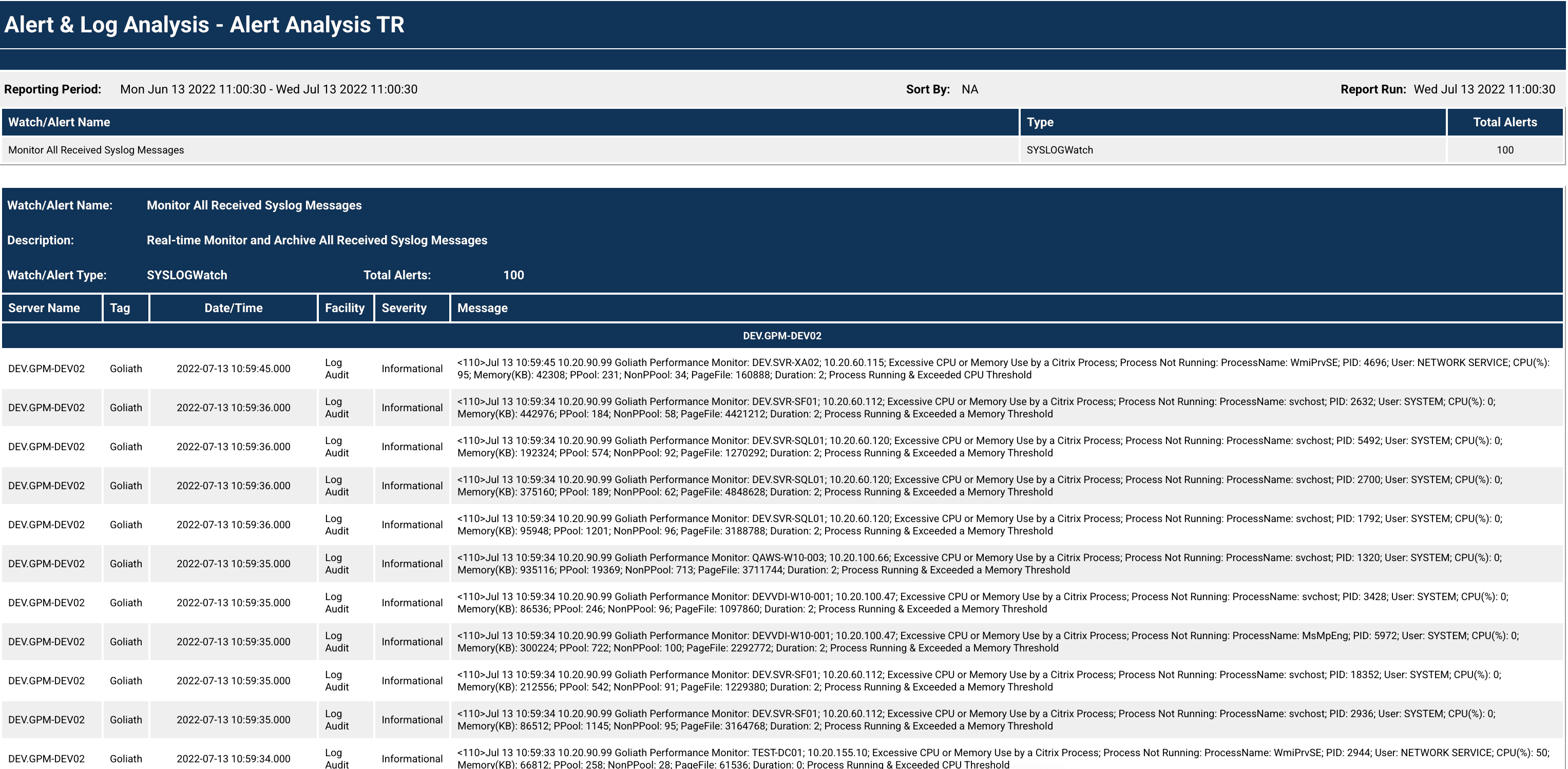
In addition to responding to regular “Citrix is Slow” tickets, Goliath can also be used to set up reporting to track the status of different components of the Citrix environment. For Central Maine, this involves monitoring their use of drive space within their cache. “When the drives all fill up, the server becomes unstable and begins kicking users off. I’ve made some custom reports to alert me when they reach a certain threshold. I can then put the server into maintenance mode to get all the users off and do a quick reboot before anyone gets kicked off.” This kind of proactive management using Goliath’s documentation helps to keep server instability from unexpectedly interrupting the workday for end users. As the team grows more comfortable with the platform, they hope to start making use of Goliath’s remediation functionalities to allow the system to automatically update when the alert conditions are met.
Alert Analysis

Conclusions

Before adding the Goliath solution, they only had time to do the bare minimum in support and react to issues as they came up. Now that they have deeper insights into the root cause, they can solve issues quickly and have the documentation to put permanent fix actions into place. Goliath has enabled them to be proactive instead of reactive.

Aaron summed up his experience with Goliath this way, “I recommend Goliath to any other Citrix admin that has never used this before. Once you use Goliath, it is going to be your go-to tool for sure.  The software is so user friendly and has such detailed metrics that I can resolve sporadic end-user experience issues incredibly quickly and move on to fixing longer term issues.”
ABOUT ORGANIZATION

Central Maine Healthcare (CMH) is an integrated healthcare delivery system serving 400,000 people living in central, western, and mid-coast Maine. CMH’s hospital facilities include Central Maine Medical Center in Lewiston, Bridgton Hospital, and Rumford Hospital. CMH also supports Central Maine Medical Group, a primary and specialty care practice organization.

Headquarters location: Lewiston, Maine
Founded: 1888
Employees: 3000
Industry: Healthcare
Terralogic, IT Service Provider,  Avoids Ticket Escalations with Proactive Citrix Troubleshooting

Terralogic, IT Service Provider, Avoids Ticket Escalations with Proactive Citrix Troubleshooting

How We Did IT

Terralogic, IT Service Provider, Avoids Ticket Escalations with Proactive Citrix Troubleshooting


citrix troubleshooting

Level 1 Service Desk Uses Goliath to Resolve Tickets Quickly

“Our Level 1 Service Desk supports all of our Citrix managed services clients. With Goliath, the team resolves 9 out of 10 performance issues, avoiding escalations to our Level 3 Citrix architects.”

Infrastructure

Citrix XenApp & XenDesktop, Citrix XenServer, Nutanix, RDS, vCenter


Challenge

Citrix Architects Spend Too Much Time Troubleshooting Citrix

Terralogic is a USA based software and IT services company with expertise in IoT, Cloud, DevOps, Citrix, App development, Cybersecurity and more. They turned to Goliath because their Citrix Architects were spending too much time troubleshooting basic Citrix end user experience issues around slow logons, applications failing to launch, and overall slow performance. They needed a solution that would enable their Level 1 Service Desk to resolve more issues on their own, avoiding escalations.

Mark Gigliotti, CIO of Terralogic, shares, “The free tools provided by Citrix do not provide enough insights to troubleshoot Citrix end user issues quickly. They are also too complex for a non-Citrix expert to use.” He added, “Most of our Level 1 Support Desk is managed in India or sourced with recent college graduates. We needed a technology that provided data to isolate root cause, guide the team on how to remediate, and was intuitive enough to be used by non-Citrix experts.”

Solution

Level 1 Service Desk to Solve Citrix Performance Issues With Software

Terralogic selected Goliath Technologies due to its embedded intelligence and automation for monitoring and troubleshooting Citrix and the end user experience for their managed services customers. Goliath automatically discovers the entire Citrix delivery infrastructure, identifies what to monitor, the thresholds to set, and then alerts when thresholds are exceeded for all potential events, conditions, and failure points.

Results

As a result of using Goliath, Terralogic has been able to reduce time to remediation as well as escalations to their Level 3 Citrix Architects. Not only does this positively impact client satisfaction, but it also lowers cost.

“Prior to Goliath, almost every Citrix ticket went to our Level 3 Architects. We have turned this around to where our Level 1 Service Desk is troubleshooting Citrix and resolving issues for 90% of all performance-related tickets,” states Gigliotti. “Our Level 1 Service Desk is alerted on issues, views data in Goliath to isolate root cause, and resolves them before end users are impacted – increasing our client satisfaction while reducing support costs.”

Level 1 Service Desk Resolves 9 out of 10 Performance Issues

Terralogic uses Goliath’s threshold-based alerts to be notified anytime a VM or host is running low on memory, a primary server fails, memory leaks with 3rd party software, or other infrastructure issues occur that can result in slow logons or performance.

The alert is sent to their Level 1 Service Desk based either in India or locally manned by recent college graduates and interns. The team then resolves the issue quickly by restarting a server or adding memory to ensure end users are never impacted.

Image 1 shows Goliath’s alert dashboard, highlighting all alerts that have been triggered due to performance issues. Alerts can be viewed here or received via email or text message. Terralogic’s Service Desk can monitor this screen to proactively address any potential issues that could negatively impact end user performance.


Image 1: Goliath’s embedded intelligence and automation will automatically identify what to monitor, thresholds to set, and alert when thresholds are exceeded. All executed alerts can be viewed in the alert dashboard.


Gigliotti summarizes the overall value of Goliath by stating, “Goliath has transformed the way we support our Citrix managed service customers. Our Level 1 Service Desk team in India is being alerted of any potential issues that could negatively impact the end user experience and fixing them before end users start their day. We have reduced support costs and number of escalations to our architects – all while increasing our client satisfaction.”

Chris Hughes

ABOUT TERRALOGIC

Terralogic is a global IT service provider delivering end-to-end technology solutions, including software development, DevOps, cloud infrastructure, and cybersecurity. With expertise in emerging technologies like AI/ML, IoT, and automation, the company helps businesses accelerate their digital transformation. Terralogic’s engineering-driven approach and scalable delivery model support clients across industries such as healthcare, automotive, fintech, and smart cities.

Headquarters location: San Jose, California
Founded: 2008
Employees: >1200
Industry: Information technology

CGH Medical Center Resolves Citrix Performance Issues

CGH Medical Center Resolves Citrix Performance Issues

How We Did IT

CGH Medical Center Finds Root Cause and Resolves Cerner Millennium & Citrix Performance Issues


citrix performance issues

“I use Goliath daily to quickly troubleshoot and resolve end user complaints around slow logons and poor performance with Cerner applications delivered via Citrix. What had previously taken me hours to hunt down root cause, now takes me minutes with Goliath.” – Greg Beck, System Administrator at CGH Medical Center

Infrastructure

Cerner Millennium, Citrix Virtual Apps (XenApp), VMware vSphere


Challenge

Troubleshooting Citrix and Cerner Performance Issues Consumes Hours of IT Time

CGH Medical Center is a progressive acute care facility located in Northern Illinois leveraging Citrix to deliver their clinical applications including Cerner Millennium. Greg Beck, System Administrator, routinely fields end user complaints around “Citrix is slow,” “my system keeps disconnecting,” or worse yet “I can’t login.” He shared, “End users have sporadic slow logons or performance issues that can consume hours of hunting down answers as the system works 90% of the time as expected. Our clinicians are often moving floor to floor and using different machines, so hunting down root cause of a sporadic issue can be challenging when you don’t have visibility into their exact behavior when they experienced an issue.”

As Beck and team prepared to upgrade Citrix Virtual Apps and Desktops 7.15, they knew they needed a purpose-built tool that would help them monitor and troubleshoot end user experience issues. Part of the expectation with the Citrix upgrade was that performance and logon times would be faster. They needed a solution that would enable them to hit these targets and provide visibility into root cause when problems did occur and then document proof that permanent fixes had been put in place.

Solution

End-to-End Visibility Isolates Root Cause of End User Performance Issues

Goliath Technologies was selected by CGH Medical Center to provide end-to-end visibility from endpoint logon, through the Citrix infrastructure, to the Cerner Millennium environment. Its deep and broad metrics offer visibility into both the infrastructure and end user behavior, empowering the team to quickly troubleshoot performance issues and reduce remediation times.

“We selected Goliath Technologies as it was one of the only solutions that had both a technical and business partnership with Cerner,” shared Beck. “We needed a solution that would last five or more years and have the flexibility to support our infrastructure regardless if we implemented elements and applications on-premises or hosted in the cloud.”

“I use Goliath daily to quickly troubleshoot and resolve end user complaints around slow logons and poor performance with clinical applications delivered via Citrix. What had previously taken me hours to hunt down root cause, now takes me minutes with Goliath,” shares Beck.

Greg Beck said he consistently has Goliath’s Citrix Published Apps and Desktop tab (Image 1) open to not only quickly troubleshoot issues if a user calls in, but also to periodically check that logon times and overall performance looks normal throughout the day. “Goliath gives me and the team real numbers so that I know what the end user experience is. I no longer have to go off gut feelings if things are working or not.”

Results

As a result of using Goliath, CGH Medical Center has been able to more quickly troubleshoot and resolve performance issues when medical staff is accessing Cerner Millennium and other applications delivered via Citrix.

Improving End User Complaint Resolution Times

“I use Goliath daily to quickly troubleshoot and resolve end user complaints around slow logons and poor performance with clinical applications delivered via Citrix. What had previously taken me hours to hunt down root cause, now takes me minutes with Goliath,” shares Beck.

Greg Beck said he consistently has Goliath’s Citrix Published Apps and Desktop tab (Image 1) open to not only quickly troubleshoot issues if a user calls in, but also to periodically check that logon times and overall performance looks normal throughout the day. “Goliath gives me and the team real numbers so that I know what the end user experience is. I no longer have to go off gut feelings if things are working or not.”


Citrix Published Apps and Desktops View

Image 1: The Citrix Published Apps and Desktop view gives a high-level overview of all end-user sessions’ key performance metrics such as logon times and what apps are in use.


Reducing Logon Times

With the migration of Citrix over to version 7.15 and increased visibility on performance with Goliath, the team has been able to reduce logon times by almost 50%, taking what was typically over a minute to log on down to under 30 seconds consistently.

If issues do arise, the team can quickly troubleshoot those individual issues by drilling into Goliath’s logon tab (Image 2), showing individual user sessions, and drilling into the various logon stages.


Goliath Logon Tab View

Image 2: The logon tab in Goliath breaks down the end-user’s login from start to finish, providing the administrator actionable metrics to reduce troubleshooting times. The example highlights a user experiencing slow logons due to high-profile load times.

Baselining Performance During Citrix Migration

When the team at CGH Medical Center upgraded Citrix, they used Goliath to baseline performance to measure key performance indicators, such as logon times, application launch times, VM resource consumption, and more, before and after the upgrade. This enabled them to confirm that changes in the environment only had positive impact on performance as they moved forward – not negative.

With the migration almost complete, Greg Beck says he can now leverage Goliath’s historical reports to anticipate and prevent future issues and continue to drive collaboration across internal IT teams, vendors, and the end users themselves.


Goliath's Session Logon Report

Image 3: The above image is Goliath’s Session Logon report integrated with Power BI showing average logon times broken down over the past week highlighting average time at each stage of the process. It also showcases average logon times per app, session counts by day, and session counts per hour to track overall activity.

Beck summarizes the overall value of Goliath by stating, “Goliath has significantly cut down the amount of time I spend answering questions around performance issues related to Citrix, Cerner, and any applications delivered via Citrix. I also have been able to find and fix issues before end users complain, reducing our overall support tickets.”

Chris Hughes

ABOUT CGH

CGH Medical Center is a progressive acute care facility located in the heart of the Sauk Valley, in Northern Illinois. Since opening in 1909, CGH has consistently received high ratings for delivering quality care to our community, positive public awareness, safety, and high patient satisfaction. CGH is committed to the health and wellness of our community, and to providing leadership in the healthcare field. This includes public education and free to low-cost early detection activities.

Headquarters location: Sterling, IL
Founded: 1909
Employees: 700
Industry: Healthcare

Try Goliath For Free

Experience true end user experience monitoring and troubleshooting free for 30 days.

Quickly Troubleshoots “Citrix is Slow” Complaints

Quickly Troubleshoots “Citrix is Slow” Complaints

How We Did IT

Quickly Troubleshoots “Citrix is Slow” Complaints


citrix is slow

“Citrix gets a bad reputation as being blamed for everything, but the underlying issue rarely has anything to do with Citrix. Goliath provides end-to-end visibility across the entire Citrix delivery infrastructure and enables us to quickly isolate root cause of performance issues, identifying who in IT can help resolve the issue quickly.” – Vitaly Petrovsky, Manager of Enterprise Applications, Maimonides Medical Center

Infrastructure

Citrix XenApp, Citrix XenDesktop, VMWare Hyper-V, Nutanix, Allscripts


Challenge

Increase in Remote Workers Due to COVID-19

Maimonides Medical Center is a non-profit hospital located in Brooklyn, N.Y. When COVID-19 hit, many on their team were instructed to work from home. Vitaly Petrovsky, Manager of Enterprise Applications, realized that with an increase in remote workers, he needed a solution that would more effectively monitor and troubleshoot their Citrix infrastructure, which was delivering medical staff access to clinical and other applications.

Even prior to COVID-19 Petrovsky shared that, “Citrix gets a bad reputation as the root cause of all slow logons or session performance issues. The reality is many of the underlying issues just surface themselves when users logon to Citrix, and Citrix is not at fault.” When many on Maimonides’ medical staff started working from home, Petrovsky recognized the number of “Citrix is Slow” complaints were only going to increase.  He needed a tool that the support team could use to prevent calls being falsely escalated to his 3rd line engineers.

“I had looked at Citrix native tools, like Director, but it lacked the granularity in its metrics to isolate root cause of poor performance issues. It also didn’t provide historical data to look back at past trends,” said Petrovsky. End users don’t typically report issues in real-time, so he needed the ability to look historically to understand how performance has changed or find exactly when an issue did occur.

Finally, Petrovsky said when he started looking at monitoring tools he “needed a solution that would proactively look for issues. My team can’t just be reactive waiting to hear end users complain. We need to prevent issues from occurring before our medical team even logs into Citrix to access their clinical applications.”

Solution

Purpose-built Monitoring and Troubleshooting Tool with Embedded Intelligence & Automation

When COVID-19 hit, Petrovsky knew he needed a solution that not only delivered broad and deep metrics for troubleshooting, but also had intelligence and automation embedded so that the support team and his infrastructure team could utilize it for troubleshooting.

“We selected Goliath Technologies as it offered us a single pane of glass along with deep and broad metrics to isolate the root cause of end user performance issues beyond Citrix. It easily identified if slow performance could be attributed to a bad network drive mapping inside of a group policy or to slow connection speed with a user working from their home WiFi network,” shared Petrovsky. He asked his support team to learn how to use the tool by attending a webinar and virtual training, and they have found it beneficial when verifying end users are experiencing slowness and isolating the root cause to pass along to the appropriate team to fix. This helps reduce the number of escalations to 3rd line support.

Results

As a result of using Goliath, Maimonides has been able to more quickly troubleshoot performance issues both for their remote medical staff and those on-site at the hospital. This has not only saved his team significant time but has also increased overall clinician satisfaction when accessing clinical apps.

Example #1: Troubleshooting Slow Performance for the Home Worker

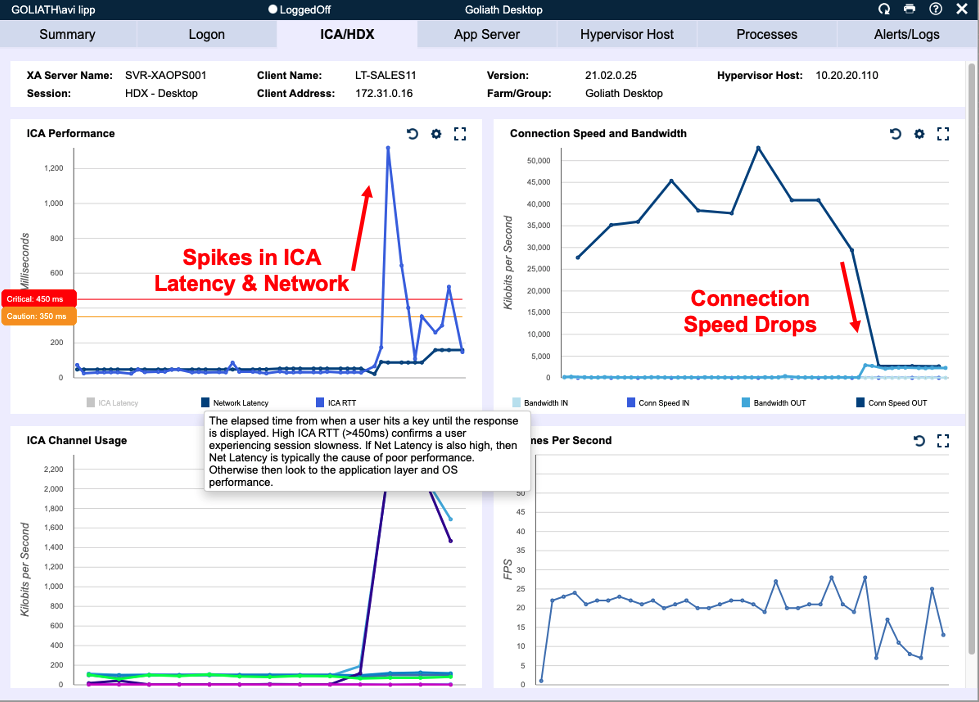
With everyone working from home, Maimonides’ support team was seeing an increase in calls about slow performance. Using Goliath, the team could easily view an end user’s session and see that their local network connection was slow (Image 1). They could then share the data with the user, highlighting the slow connection speed and either ask if someone else was consuming bandwidth (maybe streaming Netflix) or recommend they upgrade their internet speed in order to improve performance. This saved a lot of time trying to hunt down answers to complaints that had nothing to do with the Citrix environment, but instead, the user’s home office.

Screenshot

Image 1: Goliath enables admins to drill quickly into a Citrix user session and identify if slow performance can be attributed to a spike in network latency correlated to a drop in connection speed, identifying the root cause of poor performance is due to a poor Internet connection.

Example #2 Troubleshooting Slow Logons

Petrovsky shared, “We were getting sporadic complaints from some users that applications launching in Citrix were crashing. It wasn’t consistent and while some applications worked, others did not. Before, trying to troubleshoot these sporadic issues was difficult as a pattern could not be identified to understand what was going on.”

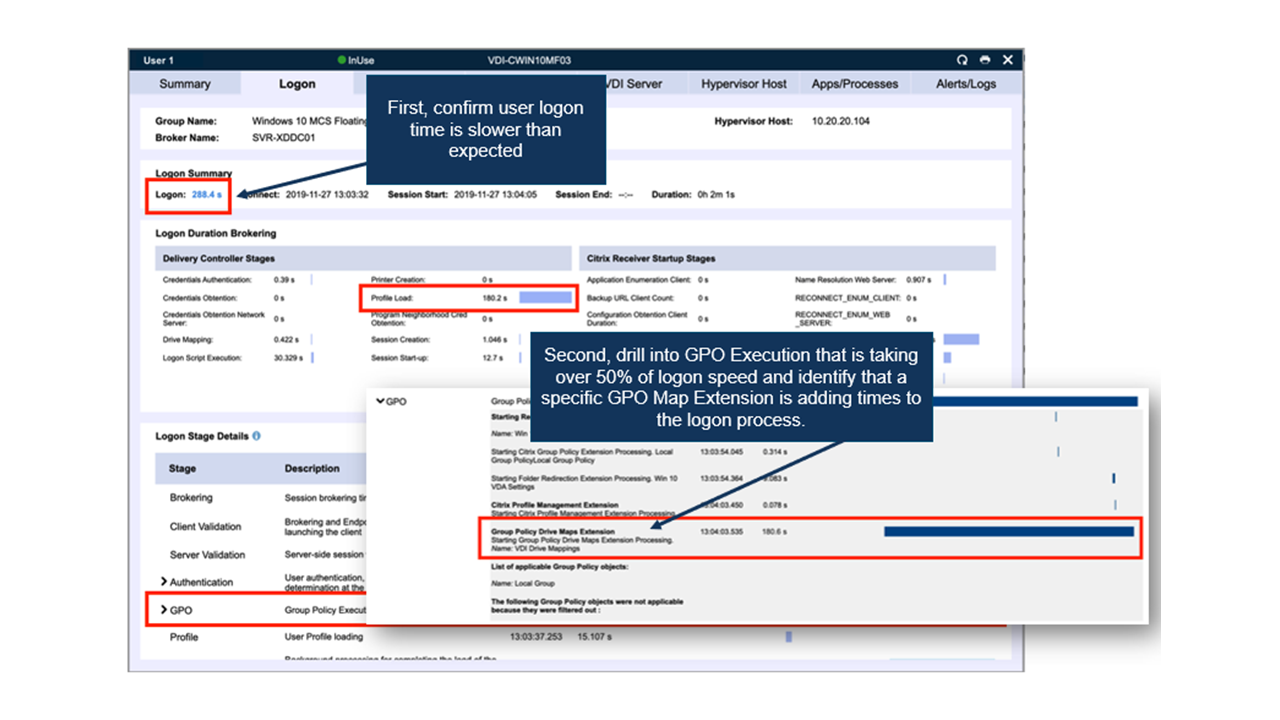
With Goliath, Maimonides was able to drill down into the end user session display and verify that the user was experiencing long logon processing time.  From there, they could see that the majority of logon time was being consumed at the group policy level. As they dug further, they identified that there was an old network drive that no longer existed mapped to their Active Directory group. As a result, when they logged on Citrix would time out looking for that drive. As soon as they removed the drive from the AD group, logon times went back up (Image 2).

“Goliath gives us the granular visibility we need to troubleshoot issues quickly,” said Petrovsky.

in session performance quickly evaluated

Image 2: Goliath enables admins to drill quickly into a user session and view detailed breakouts of the logon process to isolate quickly root cause of slow logons.

The other value that Goliath delivered is the visibility into logon times historically.

One thing they discovered using Goliath is that when they were running on Linux OS vs. Microsoft, there were significantly faster reconnects. It enables them to go back to Citrix who confirmed running on Linux is natively faster than Microsoft. This now has Maimonides exploring how they can potentially use more with Linux to improve logons.


Screenshot

Image 3: Goliath offers reports tracking initial logons and reconnect speeds to help IT management prove commitments around performance are being met.

When Petrovsky sums up the value that Goliath has delivered, he states “Goliath offers us a single pane of glass to view everything, helping us quickly troubleshoot performance problems for our staff. It is easy to use and offers historical insights we never had visibility into before.”

Maimonides Logo

ABOUT ORGANIZATION

Renowned healthcare institution known for its comprehensive range of medical services. It serves a diverse patient population in the Brooklyn area and is a vital healthcare hub for the community. The center is named after Moses Maimonides, a prominent Jewish philosopher and physician from the Middle Ages.

Maimonides Medical Center is at the forefront of utilizing information technology to enhance patient care, offering electronic health records and telemedicine solutions to improve healthcare delivery. It is also actively involved in medical education and research, contributing to advancements in the field of medicine and healthcare.

Headquarters location: Brooklyn, New York
Founded: 1911
Employees: >6000
Industry: Healthcare

Empire Office Gain Insight into Who is Using Citrix, When, And Which Applications with Citrix Activity Reporting

Empire Office Gain Insight into Who is Using Citrix, When, And Which Applications with Citrix Activity Reporting

How We Did IT

Empire Office Gains Insight into Who is Using Citrix, When, And Which Applications with Citrix Activity Reporting


User Story banner

“The Goliath report was purpose built to track the amount of time end users were active in their session and how much time they were inactive. This type of report fulfilled the mission management had set to better understand worker behavior. No other end user experience monitoring tools we looked at had just the right metrics to fulfill our needs.” – Michael Pfaeffle, Senior Vice President and CIO, Empire Office

Infrastructure

Citrix XenApp; VMware


The Shift to Hybrid & Remote Work

Empire Office is the United State’s largest commercial furniture dealer, providing creative and cost-effective workspace solutions. Based in Manhattan, NY, they wanted to enable a work from home or office hybrid model. Fortunately, their Senior Vice President and CIO, Michael Pfaeffle, had already enabled the teams to work remotely by investing in Citrix XenApp a few years prior. The team had the tools to work remotely, but the lingering question was if they could work effectively from their home offices.

The Challenge

Prior to the pandemic, the majority of Empire Office’s staff worked from their headquarters in Manhattan. To enable the work from home model using Citrix XenApp, management needed a better way to monitor and measure the productivity of the team. They wanted insights into the effectiveness and accessibility of the current tools the team had to ensure they could maintain their high level of productivity and avoid any roadblocks. Empire Office is a family-owned business and many employees have been at the company for decades. So it wasn’t about trusting employees, but really understanding if anyone was struggling to work in their new office space under these challenging conditions.

Initially, Michael looked into the free Citrix utilities with Citrix ADM, Citrix Analytics, Citrix Director, and other commercial tools like ControlUp, but none were purpose built to give insights into when or how individual workers were working or showed trends to see how work habits might be changing over time.


The Solution

A Citrix Employee Productivity Report

Michael started looking for a Citrix based solution that would give accurate metrics to understand if their team was in fact working during their open Citrix sessions and for how long each day. He also wanted to see trends in user behavior while working from home. It was important for HR to understand who might be struggling and ensure they had the right support and tools in place to be successful.

While researching solutions, Michael found Goliath Technologies Citrix monitoring software. “I had seen references to Goliath on several Citrix forums highlighting its ability to deliver deep and broad metrics around the end user experience within Citrix, and even had feedback from peers that it was the ultimate Citrix reporting tool,” said Michael. “At first I didn’t know if it had the right report I was looking for, but after some collaboration, we scoped the exact report I needed. It tracked the amount of time end users were active in their session and how much time they were inactive. This type of report fulfilled the mission management had set to better understand worker behavior. Goliath came to the rescue and answered all the questions we were asking.” No other end user experience monitoring tools Michael looked at had just the right metrics to fulfill his need.

Productivity Reporting with Goliath

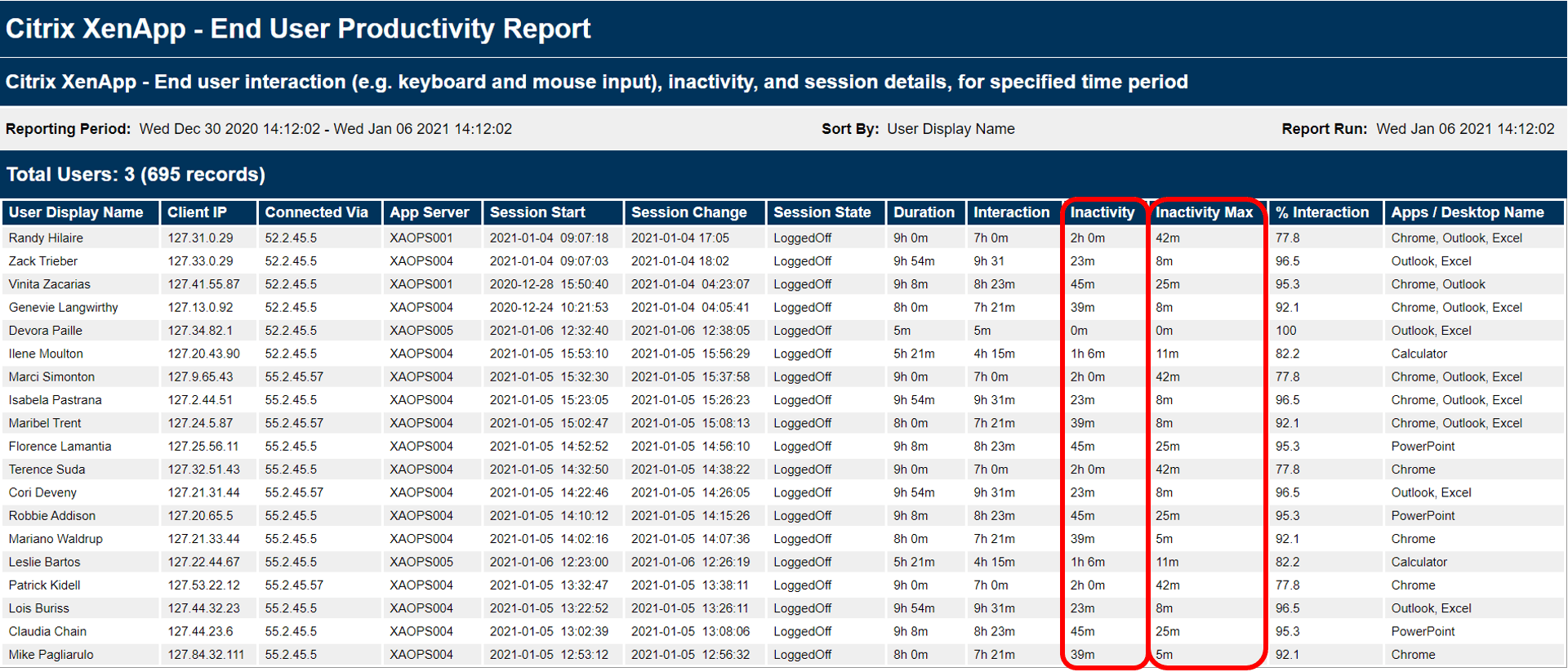
Goliath’s End User Productivity Report provides Empire Office a percentage of time someone was inactive, but most importantly shows the maximum amount of inactivity time in any given session. Most of the time we see this being 45-60 minutes, most likely someone’s lunch break. But then we do see some trends where the same person is inactive for 3-4 hours on a regular basis. Now we know there is a problem going on.

Empire Office gained more insights through:

  • Analyzing common active hours spent working, while employees work from home.
  • Understanding what employees, or departments, were most active during the workday.
  • Identifying what applications are most used (for XenApp customers).
  • Determining on average, how many hours employees, or departments, were working when at home.
Citrix Xenapp end user productivity report

    Figure 1: Goliath’s End User Productivity Reports track exactly how many hours an end user was interacting within their Citrix session and how much time they were inactive (i.e. not working). The report can be scheduled to run or executed on-demand and can be emailed, exported (PDF, CSV), or viewed directly within the Goliath interface.

    Results

    Michael can now accurately report to the CEO and EVP of Administration the overall productivity of the team while working remotely. “The data has driven great conversations around our culture and work styles. We know we have great people, and now we have the data to understand who might need our help. We have the insights and visibility we never had before,” shared Michael. In many cases, Empire Office found productivity to be even higher than before, with many employees logging in earlier than before or working into the late hours of the night. “With metrics from Goliath, we learned there is no normal set of work hours when everyone is working from home. Some employees start their day later and work late in the evening. Others start even earlier, wrapping up their day sooner. Some just frankly work more hours.”

    The other side benefit is while Goliath provides Empire Office the employee productivity report they need to track end user productivity, it is also helping them troubleshoot performance issues for their remote workers. With a limited team, the deep and broad metrics Goliath offers enable Empire Office’s team to quickly isolate root cause and determine if an issue is global, related to the Citrix infrastructure, or if it is isolated to a single user who happens to be using an old MacBook from 2001.

    Future

    Now with data-driven insights, Empire can determine which teams may need to spend more time in the office and which jobs can be effectively done remotely. There are no commitments of what the future may hold, but Empire Office feels empowered with data to understand how their hybrid and remote employees are working and how they might be able to work in the future.

    Empire Office logo

    ABOUT EMPIRE OFFICE

    Empire Office is a leading provider of top-notch office furniture solutions. With a rich history spanning decades, they offer a wide range of stylish and functional furniture, from desks and chairs to storage solutions and accessories. Known for their commitment to sustainability, they provide eco-friendly options and promote responsible industry practices. Empire Office is renowned for its innovative designs and unwavering dedication to customer satisfaction, making them the preferred choice for organizations aiming to create efficient and inspiring workspaces.

    Headquarters location: New York, NY
    Founded: 1946
    Employees: >450
    Industry: Commercial furniture

    Penn National Ramps Up Remote Work with Citrix

    Penn National Ramps Up Remote Work with Citrix

    Penn National Ramps Up Remote Work with Citrix


    Originally published by Citrix.

    Company leverages digital workspace solutions to quickly expand work-from-home capabilities, keeping employees safe and customers satisfied in the face of global pandemic

    FORT LAUDERDALE, Fla. – April 7, 2020 – When COVID-19 made its way to the United States and remote work became a mandate, many companies were caught off guard. But Penn National Insurance was prepared. Last year, with the help of Citrix® Ready™ partner Goliath Technologies, the company launched an aggressive plan to virtualize its operations, leveraging digital workspace solutions from Citrix Systems, Inc. (NASDAQ: CTXS) to empower its employees to work from anywhere at any time using any device. When the pandemic hit, the company was quickly able to extend its remote work capabilities and ensure that its employees remain safe, connected and able to serve customers in these most challenging times.

    “At Penn National Insurance we help people feel secure and make life better when bad things happen,” said Mike Watts, VP of IT, Penn National Insurance. “With Citrix and Goliath, we have been able to do this, providing a simple, secure and reliable way for our employees to access the tools and information they need deliver the products, services and support our customers require from the safety of their homes.”

    Staying Connected

    Using Citrix® Virtual Apps and Desktops, Penn National is able to deliver unified access to the tools and applications that its employees need and prefer to use to get work done while working remotely, and dynamically apply security policies based on a user’s behavior and environment to ensure that customer and customer information and applications remain secure.

    And, using Goliath Performance Monitor, they can do so in a reliable manner. “We are able to see all of our delivery infrastructure subsystems and elements of worker behavior to monitor them proactively from a single pane of glass so we can anticipate end user experience issues and troubleshoot them quickly when they arise,” said Dan Morrison, Director IT I&O, Penn National Insurance.

    Driving Business Continuity

    This, says Morrison enables Penn National Insurance to deliver a superior experience that keeps employees engaged and productive under any circumstances. “Business disruptions can happen any time,” he says. “With Citrix and Goliath, we are prepared to manage them and ensure that our team has everything they need to serve our customers with the excellence we are known for wherever they happen to be.”

    Citrix provides a complete range of digital workspace solutions designed to ensure that business operations can continue, no matter the disruption. Click here to learn more about the solutions and how your organization can leverage them to  enable remote work and seamless productivity while giving employees the flexibility to work from anywhere in a safe, secure and reliable manner.